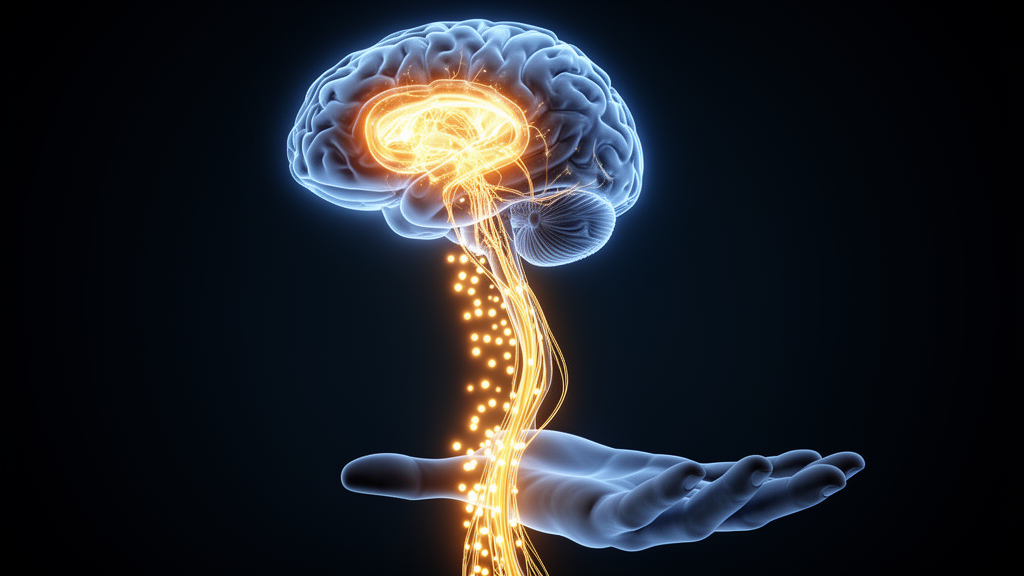
For decades, the slowness that defines Parkinson’s disease has been explained in two competing ways. One view holds that the brain’s command to move is generated normally but is scaled down too far, a concept researchers call reduced motor vigour. The alternative view is more pessimistic: that the disease damages the machinery that generates and transmits neural drive to muscles, so that even a correctly intended movement cannot be executed with full force. A new study, published in npj Parkinson’s Disease, puts these hypotheses to a direct experimental test and comes down firmly on the side of the vigour account, showing that the capacity to produce neural drive in people with Parkinson’s remains fundamentally intact.
The research team, led by Vishal Rawji and Cosima Graef of Imperial College London and King’s College London, with senior supervision from Mark Edwards and Dario Farina, recruited twelve people with Parkinson’s disease who were treated with subthalamic deep brain stimulation, alongside ten age-matched healthy controls. Deep brain stimulation was a critical design feature. Because the therapy temporarily suppresses the cardinal motor symptoms of the disease, switching it on and off allowed the investigators to observe the same patients’ neuromuscular systems in both a medicated-device state and a more symptomatic state, effectively doubling the contrast available from a modest sample.
The technical heart of the study was high-density surface electromyography, a non-invasive technique that records electrical activity from dozens of closely spaced electrodes placed over the skin. Modern decomposition algorithms can separate this composite signal into the firing patterns of individual motor units, the spinal motor neurons and their associated muscle fibres that represent the final common pathway of all voluntary movement. By tracking these units during precisely controlled force tasks, the researchers could interrogate, at the level of single neurons, whether the nervous system of a person with Parkinson’s can still assemble and deliver a properly sized burst of drive to muscle.
Participants performed ballistic isometric contractions, rapid force efforts against a fixed resistance, at three target levels: ten, thirty and fifty percent of their maximum voluntary force. In healthy controls, these movements were typically accomplished with a single compact burst of motor unit activity, averaging 1.41 bursts per contraction. Patients with stimulation on behaved differently, recruiting 2.57 bursts on average, and when their stimulation was switched off the number rose further to 2.90 bursts, coinciding with a measurable worsening of bradykinesia. Instead of one decisive command, the patients’ motor systems issued a series of smaller, successive pulses.
The most striking finding emerged when the researchers examined the size of the patients’ first bursts during the harder contractions. At the thirty and fifty percent force targets, the initial burst of motor unit activity was large enough to have achieved the ten and thirty percent targets respectively. In other words, the patients demonstrably could generate neural drives of the appropriate magnitude for easier movements; they simply did not deploy them at the correct scale for the task at hand. This dissociation between capacity and deployment is precisely what the motor vigour hypothesis predicts, and it is difficult to reconcile with an account in which the drive-generating machinery itself is broken.
Further evidence came from the detailed properties of motor unit firing. During both the ballistic contractions and separate repetitive contraction tasks, the discharge rate of motor units and its variability did not differ between patients and controls, nor between stimulation-on and stimulation-off conditions. If the mechanisms for generating neural drive, or for transmitting it from spinal motor neurons to muscle fibres, were impaired in Parkinson’s, one would expect these parameters to shift with disease state and with the suppression of symptoms by stimulation. Their stability across all conditions indicates a preserved low-level neuromuscular apparatus.
What, then, explains the slowness? The answer lies in timing. Because the patients’ movements were assembled from multiple successive bursts separated by delays, they reached the target force roughly 230 milliseconds later than controls. In everyday terms, the movement is not weak so much as hesitant: the nervous system issues an underscaled command, registers the shortfall, and issues another, repeating the process until the target is met. Each extra step in that iterative chain adds latency, and the accumulated cost is the characteristic bradykinesia and hypokinesia, the reduced amplitude and speed of movement, that clinicians observe at the bedside.
The findings carry conceptual weight for how the field understands basal ganglia function. The subthalamic nucleus and its neighbours are increasingly viewed not as simple relays but as modulators of movement vigour, the internal gain setting that determines how boldly a planned action is executed. The present results align with this framework: with stimulation restoring more appropriate scaling, patients converge toward the single-burst strategy of controls, while the raw capacity for drive generation remains untouched by the disease process. Slowness, on this reading, is a calibration problem rather than a transmission failure.
There are also practical implications. Rehabilitation and behavioural therapies for Parkinson’s have long exploited external cues and reinforcement to encourage larger, faster movements, approaches that make intuitive sense if the underlying system is intact but miscalibrated. The study’s methodology, combining high-density surface EMG with single-motor-unit decomposition in patients with implanted devices, offers a template for quantifying how such interventions reshape the scaling of motor commands. It may also inform the programming of deep brain stimulation itself, since the on-off contrast showed that symptom severity tracked the fragmentation of motor unit activity in a graded way.
Caveats remain. The patient cohort was small and specifically composed of individuals with subthalamic implants, so the findings may not generalise uniformly to all people with Parkinson’s or to those managed with medication alone. The tasks examined were isometric and constrained, whereas natural movement unfolds across many joints with sensory feedback continuously in play. Nevertheless, by demonstrating that patients can generate appropriately sized neural drives but fail to scale them, the study provides some of the most direct single-neuron evidence to date that the slowness of Parkinson’s disease reflects a vigour deficit in motor command generation, not a degraded capacity to drive muscle. The distinction matters, because it redirects attention from the muscle and the final motor pathway toward the higher-order decision of how much force a movement deserves.
Subject of Research: Neural drive generation and motor vigour in Parkinson's disease bradykinesia
Article Title: Hypokinesia and bradykinesia in Parkinson’s disease are consistent with reduced motor vigour, not an impaired capacity to generate and transmit neural drive to muscle
Article References: Rawji, V., Graef, C., Foltynie, T., Haar, S., Tai, Y. F., Edwards, M., & Farina, D. (2026). Hypokinesia and bradykinesia in Parkinson’s disease are consistent with reduced motor vigour, not an impaired capacity to generate and transmit neural drive to muscle. npj Parkinson's Disease. https://doi.org/10.1038/s41531-026-01590-7
Image Credits: AI Generated
DOI: 10.1038/s41531-026-01590-7
Keywords: Parkinson's disease, bradykinesia, hypokinesia, motor vigour, neural drive, high-density surface EMG, motor units, deep brain stimulation, subthalamic nucleus, ballistic contractions, basal ganglia, motor control
News Source: Cassandra Pierce. (October 8, 2026). Slowed Movements in Parkinson’s Stem From Underscaled Motor Commands, Not Broken Neural Wiring. Scienmag.