Researchers have gained new knowledge of how drugs bind to connexin molecules. These molecules form channels that allow neighbouring cells to send direct messages to one another. Dysfunctions of these channels are involved in neurological and cardiac diseases. The new understanding of how drugs bind and act on them should help develop therapies to treat such conditions.
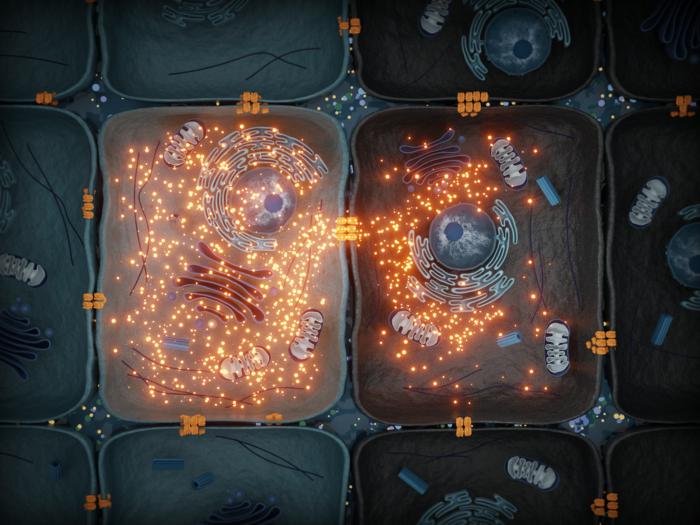
Credit: Laura Canil
Researchers have gained new knowledge of how drugs bind to connexin molecules. These molecules form channels that allow neighbouring cells to send direct messages to one another. Dysfunctions of these channels are involved in neurological and cardiac diseases. The new understanding of how drugs bind and act on them should help develop therapies to treat such conditions.
Today we use many electronic means to communicate, but sometimes dropping a note in a neighbour’s letter box or leaving a cake on a doorstep is most effective. Cells too have ways to send direct messages to their neighbours.
Adjacent cells can communicate directly through relatively large channels called gap junctions, which allow cells to freely exchange small molecules and ions with each other or with the outside environment. In this way, they can coordinate activities in the tissues or organs that they compose and maintain homeostasis.
Such channels are created from proteins known as connexins. Six connexins situated in the cell membrane create a hemichannel; this hemichannel joins with a hemichannel in a neighbouring cell to create a two-way channel.
When connexin channels do not work properly, they cause changes in intercellular communication that have been linked to many different diseases. These include cardiac arrhythmias, diseases of the central nervous system such as epilepsy, neurodegenerative diseases and cancer.
As a result, the search is on for drugs that target connexins. Yet, understanding of the structure of connexins and how drugs bind to connexin channels to block or activate them is limited. Indeed, of the twenty-one types of connexins known to exist in humans, few of them are currently evaluated as drug targets.
An explanation for antimalarial side-effects?
Now, researchers from PSI, ETH Zurich and the University of Geneva have deepened our understanding of connexin channels and how they bind to drug molecules. The study is published in the journal Cell Discovery.
The connexin they studied is known as connexin-36, or Cx36 for short. Cx36 plays important roles in the pancreas and the brain, respectively controlling insulin secretion and neuronal activity. Heightened levels of Cx36 channels have been found in patients suffering epilepsy following traumatic brain injury. Here, it is thought that the increased activity of the gap junction channels cause neurons to die. Therefore, the team were interested in drugs that inhibit the channels.
The team studied Cx36 bound to the antimalarial drug mefloquine (brand name Lariam). The drug is known to act on the parasites that cause malaria when they enter the blood stream from infected mosquitos. However, research has indicated that the mefloquine also binds to Cx36 in our cells, potentially explaining some of the well-known severe neuropsychiatric side effects of the drug.
Using cryo-electron microscopy, the research team captured high-resolution structures of Cx36 gap junction channels with and without the presence of mefloquine. They saw how the drug molecule binds to each of the six connexins composing the channel. The binding site is buried within the pore of the channel, and so, when six molecules bind, they effectively close the channel.
Computer simulations by collaborators at the University of Geneva helped the team understand the effect that mefloquine binding would have on the ability of the channel to permit ions to through. In this way, they showed that binding of the drug restricts the flow of solutes through the channel.
A starting point for structure-based drug discovery in connexins
The researchers hope that this new structural knowledge will be a starting point for developing new drugs with greater specificity for particular connexin channels.
“Our study shows how a drug molecule lands in the pore of the channel and, through our simulations, gives a plausible explanation for how the drug inhibits the channel,” says Volodymyr Korkhov, group leader at PSI and associate professor at the ETH Zurich, who led the study. “This is relevant not only to Cx36, but to the wider question of connexin – drug interactions.”
The latest findings complement other research activities into connexins from the PSI/ETHZ group: notably, the structure of connexin 43 in the closed conformation and how structure and function are linked in connexin 32, which plays a role in the peripheral nervous system.
Text: Paul Scherrer Institute PSI/Miriam Arrell
Journal
Cell Discovery
DOI
10.1038/s41421-024-00691-y
Method of Research
Experimental study
Subject of Research
Cells
Article Title
Structural basis of connexin-36 gap junction channel inhibition.
Article Publication Date
18-Jun-2024