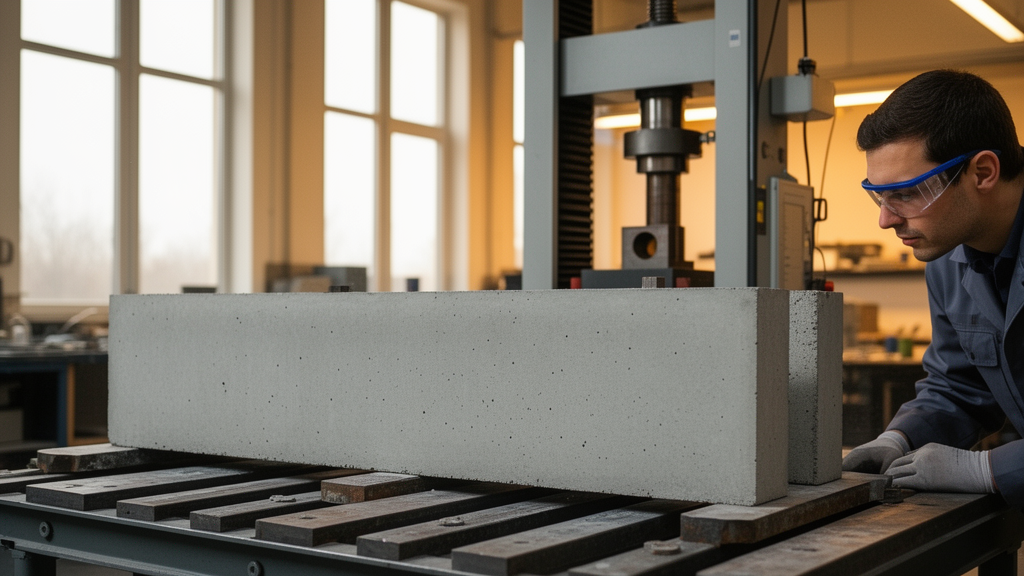
Concrete is the most consumed manufactured material on Earth, second only to water, and its dependence on ordinary Portland cement carries a heavy environmental price. Cement production contributes roughly 5 to 7 percent of global carbon dioxide emissions and accounts for nearly 3 percent of the world’s total energy consumption, according to figures cited in a new study published in Discover Civil Engineering. With global cement output now around 4.2 billion tons annually, releasing close to 4 billion tons of CO2 into the atmosphere every year, and each ton of Portland cement associated with roughly 0.8 to 1.0 ton of CO2, the search for alternative binders has become one of the most urgent challenges in construction materials research.
The study, led by Md Ruhul Amin with co-authors Mohd Shariq, Abdul Baqi, and Mohd Asif Ansari, presents a performance-driven optimization framework for geopolymer concrete based on fly ash and ground granulated blast furnace slag, two waste materials widely investigated as replacements for cement. Rather than testing mixes by trial and error, the researchers used response surface methodology, a statistical technique that builds predictive mathematical models between input variables and performance outcomes, combined with a desirability function that balances multiple goals simultaneously. The work was carried out in Design-Expert software and structured as a full-factorial experimental programme of 18 unique concrete mixtures, arranged as a 3 by 3 by 2 design crossing three slag replacement levels, three alkaline solution-to-binder ratios, and two predefined mix-design levels.
The two mix-design levels, labelled M1 and M2, corresponded to binder dosages of 360 and 420 kilograms per cubic meter respectively. Within each, the fly ash was replaced by slag at 25, 50, or 75 percent, while the alkaline liquid-to-binder ratio was set at 0.45, 0.50, or 0.55. The alkaline activator combined sodium silicate and sodium hydroxide in a 2.5 to 1 proportion, with the hydroxide solution prepared at 12 molar concentration and rested for one day before casting to allow the heat of dissolution to dissipate. A sulphonated naphthalene formaldehyde-based superplasticizer at 1.5 percent of binder mass, together with additional water equal to 1 percent of binder mass, was used to improve workability. River sand conforming to Zone II specifications served as fine aggregate, and well-graded 20 millimeter crushed granite served as coarse aggregate.
Every mixture was evaluated for five responses: slump as a measure of fresh workability, compressive strength at 7 and 28 days, and splitting tensile strength at the same two ages. Specimens were cast as 150 millimeter cubes and 100 by 200 millimeter cylinders, three of each per mixture and age, giving 108 cubes and 108 cylinders in total. After 24 hours in their molds under laboratory conditions, all specimens were demolded and cured unsealed at ambient room temperatures between 25 and 32 degrees Celsius until testing.
The fresh and hardened results revealed clear and consistent patterns. Slump increased as the alkaline liquid-to-binder ratio rose, because a larger liquid fraction helps the mixture flow, but it fell as slag content increased. The highest slump, 108 millimeters, was recorded for the M2 mix with 25 percent slag and the highest alkaline ratio, while the lowest, nearly 72 millimeters, occurred in the M1 mix with 75 percent slag and the lowest alkaline ratio. For example, in the M1 series, raising the alkaline ratio from 0.45 to 0.55 at 25 percent slag improved slump by about 16.7 percent, whereas increasing slag from 25 to 75 percent at a fixed alkaline ratio of 0.45 cut slump by 20 percent. The M2 series followed the same trend, with a 23 percent slump reduction as slag rose from 25 to 75 percent at a ratio of 0.50.
Mechanical performance moved in the opposite direction with respect to slag. Compressive and splitting tensile strengths generally increased as slag replacement climbed within the investigated range, with slag emerging as the dominant factor for the mechanical responses. The strongest mixture overall was M2G3A2, combining 75 percent slag with an alkaline ratio of 0.50, which reached 65.4 megapascals in 28-day compressive strength and 5.3 megapascals in 28-day splitting tensile strength. At the other extreme, the weakest M1 mixture, with only 25 percent slag and an alkaline ratio of 0.45, managed just 13.34 megapascals at 28 days and 1.60 megapascals in tension. In the M2 series, moving from 25 to 75 percent slag at an alkaline ratio of 0.45 lifted 28-day compressive strength by 243.8 percent and 28-day tensile strength by 191.67 percent, rising from 1.68 to 4.90 megapascals.
The alkaline liquid-to-binder ratio showed a distinctly non-monotonic effect on strength. Performance generally improved as the ratio rose from 0.45 to about 0.50, then declined when it was pushed to 0.55. In the M1 series at 75 percent slag, compressive strength at 7 and 28 days rose by 65.41 and 68.13 percent respectively when the ratio moved from 0.45 to 0.50, but then fell by about 5.68 and 1.61 percent at 0.55. The M2 series showed the same shape more dramatically: 28-day tensile strength dropped by 29.43 percent when the ratio increased from 0.50 to 0.55 at 75 percent slag. The authors caution that this decline cannot be attributed solely to excess liquid, because raising the ratio simultaneously changes the dosage of alkali and soluble silicate species; they interpret it as a combined effect of activator dosage and chemistry. All mixtures were stronger at 28 days than at 7 days, confirming continued strength development over time.
The statistical models fitted to these data performed strongly. Analysis of variance confirmed that all five reduced models were statistically significant, with F-values ranging from 24.42 to 70.57 and p-values below 0.0001. The coefficient of determination values ranged from 0.9302 to 0.9829, predicted values from 0.8000 to 0.9028, and Adequate Precision values from 16.1109 to 26.3199, all well above the desirable threshold of 4. A linear model sufficed for slump, reduced quadratic models described the compressive strength and 7-day tensile responses, and a reduced cubic model was retained for 28-day tensile strength. The authors are transparent about one limitation: because the 18 factorial combinations were unique design points without independent replication, and the three specimens per condition were specimen-level repetitions rather than replicated design runs, a pure-error-based lack-of-fit assessment was not available. The models were therefore treated as adequate for interpolation and optimization within the investigated domain only, with no extrapolation beyond the tested factor ranges.
Multi-response optimization, which maximized the mechanical responses while keeping slump within a prescribed range, identified constrained optima at the upper boundary of 75 percent slag for both mix designs, with alkaline ratios of 0.508 for M1 and 0.494 for M2 and overall desirability values of 0.945 and 0.976 respectively. Because 75 percent slag marks the edge of the investigated range, the authors describe these as constrained rather than stationary optima. Experimental confirmation runs at nearby conditions, an alkaline ratio of 0.510 for M1 and 0.486 for M2, showed reasonable agreement with model predictions, with absolute prediction errors between roughly 0.57 and 11.02 percent across the five responses. The study also estimated modulus of rupture values using a previously published predictive relationship, reporting model-based estimates ranging from 2.812 to 6.111 megapascals at 7 days and 3.828 to 7.732 megapascals at 28 days, with the highest estimates again at 75 percent slag and an alkaline ratio of 0.50; these figures are explicitly framed as estimates rather than measured flexural strengths.
The findings demonstrate that ambient-cured geopolymer concrete made from fly ash and slag can achieve favorable mechanical performance at high slag replacement levels within the investigated design space, with the best results near an alkaline ratio of 0.50. The scope of the work remains bounded: the results apply to the specific fly ash and slag sources studied, the tested replacement and ratio ranges, the two mix-design levels, and ambient curing conditions, and durability, shrinkage, creep, elastic modulus, bond behavior, long-term performance, and environmental impacts were beyond the study’s scope. The authors note that further validation using additional material sources, larger-scale specimens, field-relevant conditions, and service-life assessment is required before practical structural application. Within those limits, the framework offers a systematic, experimentally supported route to proportioning waste-based geopolymer concrete that sidesteps the carbon burden of Portland cement while gaining strength in ordinary ambient conditions.
Subject of Research: Multi-response optimization of ambient-cured fly ash and GGBFS geopolymer concrete using response surface methodology
Article Title: Performance-driven mix design and multi-response optimization of ambient-cured fly ash-GGBFS based geopolymer concrete
Article References: Amin, M. R., Shariq, M., Baqi, A., & Ansari, M. A. (2026). Performance-driven mix design and multi-response optimization of ambient-cured fly ash-GGBFS based geopolymer concrete. Discover Civil Engineering, 3(1), Article 266. https://doi.org/10.1007/s44290-026-00663-z
Image Credits: AI Generated
DOI: 10.1007/s44290-026-00663-z
Keywords: geopolymer concrete, fly ash, GGBFS, ambient curing, response surface methodology, compressive strength, splitting tensile strength, alkaline activator, mix design optimization, desirability function, sustainable construction, workability
News Source: Denise Maddox. (October 28, 2026). Slag-Rich Geopolymer Concrete Optimized for Strength Without Heat Curing. Scienmag.