


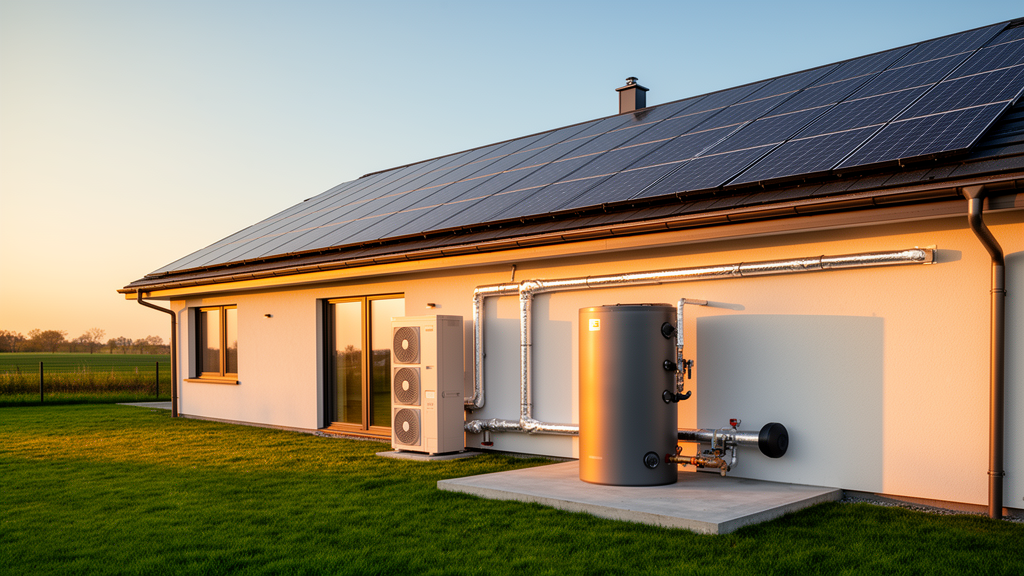
Buildings account for 37% of global carbon emissions and 32% of global energy consumption, and heating alone consumes nearly half of that energy, making building heating one of the most stubborn obstacles on the road to carbon neutrality. A new Perspective published in the journal Carbon Neutrality argues that the way out is not a single technology but a coordinated system: solar photovoltaic-thermal collectors, heat pumps, and a synergistic combination of thermal and electrical energy storage, tuned to the climate and economics of each region. Drawing on techno-economic models built for 31 provincial capital cities across China’s five major climate zones, the authors identify a specific configuration—photovoltaic-thermal collectors paired with heat pumps and jointly sized thermal and electrical storage—as the most promising long-term pathway for decarbonized heating.
The core insight is that thermal energy storage and electrical energy storage serve different roles, and neither alone is optimal. Thermal storage, typically water tanks or phase-change materials, is cheaper per unit of capacity but can only serve heating demand. Electrical storage, dominated by lithium-ion batteries, costs more but can simultaneously supply heat pumps, lighting, and appliances, so it cycles far more frequently. The authors’ optimization model, which minimizes annual total heating cost under local weather and time-of-use electricity prices, consistently finds that combining both storage types beats relying on either one exclusively. In every city modeled, the hybrid PVT-HP-TES/EES system achieved the lowest levelized cost of energy among the PVT-heat-pump variants, confirming the economic benefit of coordinating the two storage technologies.
The regional patterns are striking. There, thermal storage dominates, often exceeding 80% of the total and reaching 100% in some provinces, because low grid electricity prices and small peak-valley price differentials weaken the economic case for batteries. In southern regions with milder winters, lower heating demand, and large peak-valley price spreads, electrical storage takes a considerable share, exceeding 40% of the optimized configuration, because batteries can shift cheap valley electricity to cover both heating and non-thermal loads.
The choice of electrical heater matters as much as the storage mix. Heat pumps convert electricity to heat with an efficiency of 1.5 to 5 by extracting thermal energy from ambient sources, whereas resistive heaters top out at an efficiency of 1. The model shows that heat-pump-based pathways require substantially smaller total storage capacity and much lower installed electrical heater capacity than resistive-heater pathways, since high efficiency reduces peak power demand. The PVT-heat-pump-hybrid system also needs the smallest solar collector area of all four pathways examined, because PVT modules generate electricity and heat simultaneously—removing heat from the cells actually raises their electrical efficiency—while the heat pump amplifies that thermal output.
Thermal energy provision, the amount of useful heat delivered per square meter of collector area per year, separates the pathways dramatically. The PVT-heat-pump-hybrid system delivers 1,521.8 to 2,554.1 kilowatt-hours of thermal energy per square meter per year across the modeled cities, the highest of any configuration. The PV-heat-pump variant follows at 918.6 to 1,385.9, the PVT-resistive system at 799.0 to 1,695.7, and the PV-resistive system trails at just 216.2 to 475.5. The PVT-heat-pump-hybrid system performs especially well in temperate continental climates such as Inner Mongolia, Gansu, Ningxia, and Xinjiang, and in the high-altitude plateau climates of Tibet and Qinghai, where strong solar irradiance and cold winters reward both cogeneration and heat-pump efficiency.
Cost remains the principal barrier. The levelized cost of energy for the PVT-heat-pump-hybrid pathway ranges from 0.289 to 0.570 CNY per kilowatt-hour, higher than coal-fired heating at 0.151 to 0.458 and biomass at 0.269 to 0.447 in most cities. However, the heat-pump pathways undercut natural gas-fired heating in southern regions, particularly where gas prices are high, and the comparison does not account for carbon taxes or environmental externalities that would penalize fossil systems. Ground-source heat pump variants reach 0.248 to 0.567 CNY per kilowatt-hour but are constrained by geological conditions. The authors stress that without policy support, market innovation, and further cost reductions, the economic gap to coal remains a serious obstacle to large-scale deployment.
Life-cycle carbon analysis strengthens the case for electrification. Across 31 provincial regions, the PVT-heat-pump-hybrid system emits 1.15 to 120.79 kilograms of CO2 per square meter of heating area per year under the 2023 grid mix, falling to 1.15 to 80.66 under a projected 2030 grid with 35% coal and 31% wind and solar. It outperforms resistive-heater systems in 26 of 31 regions, with reductions of 21.9% to 87.1%, and produces lower emissions than coal-fired heating in all 31 regions under both grid scenarios. Grid decarbonization cuts emissions by 7.2% to 47.5% for the heat-pump pathway between 2023 and 2030. As the grid cleans up, embodied emissions from equipment manufacturing and refrigerant leakage grow as a share of the remaining footprint, making low-carbon manufacturing, longer component lifetimes, and refrigerant management increasingly important.
The Perspective also maps the technical challenges ahead. Thermal storage needs materials with higher energy density than water tanks, better thermal conductivity than the roughly 0.2 watts per meter-kelvin typical of storage media, and resistance to the supercooling, phase separation, and corrosion that plague hydrated salts over repeated cycles. Heat pumps need higher coefficients of performance in extreme cold, through vapor-injection and cascade designs. PVT modules, currently limited to 15% to 18% electrical efficiency in reported systems, could benefit from tunnel-oxide passivated contact, heterojunction, and perovskite cell technologies, with perovskite records reaching 29.1%. Building envelopes, responsible for half of total thermal losses, need insulation retrofits and low-emissivity glazing to cut demand at the source.
Deployment strategy matters as much as technology. The authors propose a staged rollout: southern provinces such as Hainan, Guangdong, Guangxi, and Fujian first, where mild climates boost heat-pump efficiency and synergistic cooling and heating improves economics; western solar-rich provinces next, with targeted subsidies and unified installation programs; and cold northeastern regions last, where low heat-pump efficiency and existing gas and coal infrastructure make transition slower. Dense urban buildings would need district-level PVT arrays and shared storage, while rural homes with ample rooftop space suit distributed systems. The authors are explicit that this is a model-based, comparative analysis of representative residential buildings, not site-specific operational forecasts, and that installation space constraints in dense cities are not fully captured. Still, they conclude that PVT-heat-pump-hybrid storage is a preferable long-term clean-heating pathway toward carbon neutrality—provided policy, market mechanisms, and digital regulation evolve alongside the hardware.
Subject of Research: Techno-economic modeling of solar photovoltaic-thermal heat pump systems with combined thermal and electrical energy storage for decarbonizing building heating in China
Article Title: Renewable energy-driven heat pumps integrated with synergistic thermal-electrical energy storage for decarbonizing building heating
Article References: Du, R., Han, H., Yin, G., Wang, S., Zhang, C., & Li, T. (2026). Renewable energy-driven heat pumps integrated with synergistic thermal-electrical energy storage for decarbonizing building heating. Carbon Neutrality, 5(1), Article 28. https://doi.org/10.1007/s43979-026-00181-y
Image Credits: AI Generated
DOI: 10.1007/s43979-026-00181-y
Keywords: building heating, heat pumps, photovoltaic-thermal, thermal energy storage, electrical energy storage, carbon neutrality, levelized cost of energy, life-cycle emissions, grid decarbonization, China, renewable energy, techno-economic modeling
News Source: Sloane Callahan. (October 28, 2026). Solar Heat Pumps With Hybrid Storage Emerge as a Long-Term Path to Carbon-Free Building Heating. Scienmag.



