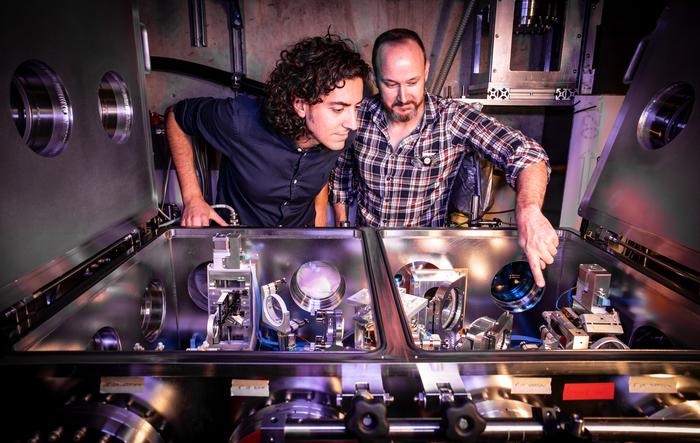
Scientists at the SLAC National Accelerator Laboratory have achieved a groundbreaking milestone in the field of particle physics by creating an ultrashort electron beam that boasts five times more peak current than any other electron beam currently produced on Earth. This advancement not only emphasizes the capabilities of modern accelerator technology but also opens new avenues for exploration in various scientific fields, spanning from quantum chemistry to astrophysics and material science. This innovative achievement has been documented in a recent paper published in the prestigious journal Physical Review Letters, illustrating its significance in addressing one of the paramount challenges in accelerator and beam physics.
The construction and development of powerful electron beams have long posed a complex challenge for physicists, primarily due to the trade-offs between energy and beam quality. Traditionally, electron beams are manipulated using microwave fields that compress and focus the beams. In this method, electrons sequence themselves much like runners in a staggered starting position; those positioned further back possess more energy than those at the front. Subsequently, the beam is sent around a bend to allow the trailing electrons to catch up with those ahead. This focusing technique, while effective, typically results in energy loss due to radiation emission as the electrons accelerate, ultimately leading to a degradation in the quality of the beam.
To overcome this long-standing hurdle, the researchers at SLAC employed laser-based shaping techniques originally conceived for use in X-ray free-electron lasers. The innovation lies in the ability to compress billions of electrons into a length of less than one micrometer. Utilizing lasers significantly enhances the precision of energy modulation, enabling a highly controlled formation of the electron beam. Traditional methods constrained by microwave fields lack the intricacy needed for high-quality, tightly packed electron bunches. As Claudio Emma, a leading scientist in the project, articulately explains, “The big advantage of using a laser is that we can apply an energy modulation that’s much more precise than what we can do with microwave fields.”
However, this complex process is not without its intricacies. The laser interacts with the electron beam in just the first 10 meters of a one-kilometer-long acceleration pathway. The bane of this setting was the challenge of accurately shaping the beam while ensuring that the energy modulation remains intact throughout its transportation over such a lengthy distance. This feat required months of testing, optimization, and meticulous adjustments in the shaping techniques employed by the research team.
After significant refinement and continuous iteration of their laser shaping methodology, the SLAC team has succeeded in repeatedly generating high-energy, femtosecond-duration electron beams with peak powers that dramatically exceed historical benchmarks. The advancements made enable beam currents that are approximately five times higher than previously possible, facilitating new experimental approaches previously unthinkable.
The implications of this enhanced laser-driven electron beam technology are numerous and significant. Researchers now have an incredible new tool to explore a myriad of natural phenomena. In the realm of astrophysics, these ultrashort beams can be directed toward various solid or gaseous targets, allowing scientists to replicate and study processes similar to those occurring in stars. Emma points out the potential for lab-based exploration of phenomena like filament formation, which have traditionally been difficult to replicate or observe in controlled environments.
Moreover, the advancements in beam technology resonate strongly with ongoing projects within the facility, like advancements in plasma wakefield acceleration. The FACET-II researchers are enthusiastic about the prospect of utilizing the powerful new beams to catalyze further innovations in this arena, promoting novel acceleration methods that may redefine paradigms in particle physics. This technology is poised to empower a substantial leap in the capabilities of experimental physics, potentially heralding the advent of new discoveries.
As the SLAC group explores potential applications for these enhanced electron beams, the excitement grows over the opportunities that may emerge from their unique capabilities. Emma foresees the possibility of further compressing these beams to create attosecond light pulses, augmenting SLAC’s existing facilities and enabling groundbreaking studies in quantum physics and material sciences. The dual MPI (mass, photon interaction) probe capability offered by ultrashort electron beams and synchronized light pulses presents an unprecedented prospect for research on a molecular level.
The research team remains enthusiastic about the future, as FACET-II stands ready as a collaborative hub for scientists eager to engage with this extraordinary capability. “We have a really exciting and interesting facility at FACET-II where people can come and do their experiments. If you need an extreme beam, we have the tool for you,” Emma stated, underscoring the laboratory’s invitation for partnership in pioneering research.
The remarkable effort made by the SLAC researchers has garnered support from the Department of Energy (DOE) Office of Science, emphasizing the importance of governmental backing for pioneering scientific endeavors. The extensive collaboration of physicists, engineers, and visionary thinkers is accentuating the importance of shared knowledge and interdisciplinary research in tackling complex scientific questions.
The journey towards achieving such a powerful electron beam embodies not just a technical triumph but also underscores the broader narrative surrounding scientific inquiry. With each advancement in the understanding of particle dynamics, researchers inch closer to unveiling the mysteries of our universe. The potential ramifications of these findings can shape the landscape of research, inspire future innovations, and promote collaborations that span across disciplines and borders.
Scientific progress prompts the constant reevaluation of our existing understanding, igniting vibrant dialogues and discussions in the global scientific community. As this ultrashort electron beam technology continues to evolve, it invites enthusiastic curiosity about its broader implications, paving the way for a deeper understanding of fundamental physics and the universe that surrounds us. As researchers utilize these exceptional tools for exploration, they contribute meaningfully to the tapestry of modern science, ensuring that humanity remains committed to pushing the boundaries of knowledge and discovery for generations to come.
Subject of Research: Electron beam technology
Article Title: Experimental Generation of Extreme Electron Beams for Advanced Accelerator Applications
News Publication Date: 27-Feb-2025
Web References: Physical Review Letters
References: DOI: 10.1103/PhysRevLett.134.085001
Image Credits: Jacqueline Ramseyer Orrell/SLAC National Accelerator Laboratory
Keywords
Particle accelerators, Free electron phenomena, Discovery research, Free electron lasers, Electrons, Accelerator physics, Experimental physics, X ray radiation.
Tags: astrophysics applicationschallenges in accelerator physicsenergy and beam quality trade-offsmaterial science breakthroughsmicrowave fields in electron beam manipulationmodern accelerator technologyparticle physics advancementspeak current electron beamsPhysical Review Letters publicationquantum chemistry researchSLAC National Accelerator Laboratoryultrashort electron beam technology