• HOME
  • NEWS
  • EXPLORE
    • CAREER
      • Companies
      • Jobs
    • EVENTS
    • iGEM
      • News
      • Team
    • PHOTOS
    • VIDEO
    • WIKI
  • BLOG
  • COMMUNITY
    • FACEBOOK
    • INSTAGRAM
    • TWITTER
Saturday, July 4, 2026
BIOENGINEER.ORG
No Result
View All Result
  • Login
  • HOME
  • NEWS
  • EXPLORE
    • CAREER
      • Companies
      • Jobs
        • Lecturer
        • PhD Studentship
        • Postdoc
        • Research Assistant
    • EVENTS
    • iGEM
      • News
      • Team
    • PHOTOS
    • VIDEO
    • WIKI
  • BLOG
  • COMMUNITY
    • FACEBOOK
    • INSTAGRAM
    • TWITTER
  • HOME
  • NEWS
  • EXPLORE
    • CAREER
      • Companies
      • Jobs
        • Lecturer
        • PhD Studentship
        • Postdoc
        • Research Assistant
    • EVENTS
    • iGEM
      • News
      • Team
    • PHOTOS
    • VIDEO
    • WIKI
  • BLOG
  • COMMUNITY
    • FACEBOOK
    • INSTAGRAM
    • TWITTER
No Result
View All Result
Bioengineer.org
No Result
View All Result
Home NEWS Science News Chemistry

Skoltech scientists run a ‘speed test’ to boost production of carbon nanotubes

Bioengineer by Bioengineer
December 1, 2020
in Chemistry
Reading Time: 2 mins read
0
IMAGE
Share on FacebookShare on TwitterShare on LinkedinShare on RedditShare on Telegram

IMAGE

Credit: Pavel Odinev/Skoltech

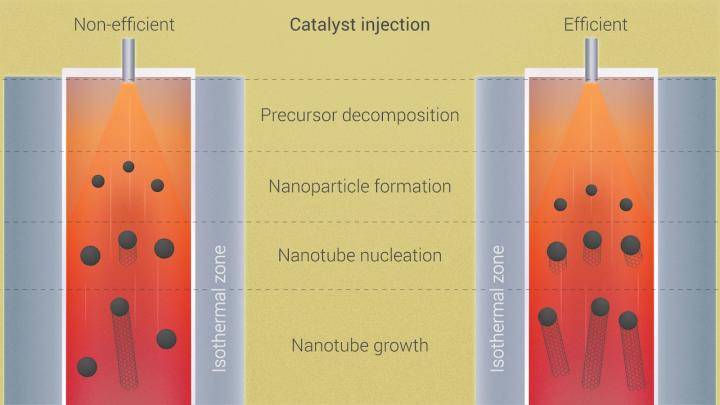
Skoltech researchers have investigated the procedure for catalyst delivery used in the most common method of carbon nanotube production, chemical vapor deposition (CVD), offering what they call a “simple and elegant” way to boost productivity and pave the way for cheaper and more accessible nanotube-based technology. The paper was published in the Chemical Engineering Journal.

Single-walled carbon nanotubes (SWCNT), tiny rolled sheets of graphene with a thickness of just one atom, hold huge promise when it comes to applications in materials science and electronics. That is the reason why so much effort is focused on perfecting the synthesis of SWCNTs; from physical methods, such as using laser beams to ablate a graphite target, all the way to the most common CVD approach, when metal catalyst particles are used to “strip” a carbon-containing gas of its carbon and grow the nanotubes on these particles.

“The road from raw materials to carbon nanotubes requires a fine balance between dozens of reactor parameters. The formation of carbon nanotubes is a tricky and complex process that has been studied for a long time, but still keeps many secrets,” explains Albert Nasibulin, a professor at Skoltech and an adjunct professor at the Department of Chemistry and Materials Science, Aalto University School of Chemical Engineering.

Various ways of enhancing catalyst activation, in order to produce more SWCNTs with the required properties, have already been suggested. Nasibulin and his colleagues focused on the injection procedure, namely on how to distribute ferrocene vapor (a commonly used catalyst precursor) within the reactor.

They grew their carbon nanotubes using the aerosol CVD approach, using carbon monoxide as a source of carbon, and monitored the synthesis productivity and SWCNT characteristics (such as their diameter) depending on the rate of catalyst injection and the concentration of CO2 (used as an agent for fine-tuning). Ultimately the researchers concluded that “injector flow rate adjustment could lead to a 9-fold increase in the synthesis productivity while preserving most of the SWCNT characteristics”, such as their diameter, the share of defective nanotubes, and film conductivity.

“Every technology is always about efficiency. When it comes to CVD production of nanotubes, the efficiency of the catalyst is usually out of sight. However, we see a great opportunity there and this work is only a first step towards an efficient technology,” Dmitry Krasnikov, senior research scientist at Skoltech and co-author of the paper, says.

###

Media Contact
Ilyana Zolotareva
[email protected]

Original Source

https://www.skoltech.ru/en/2020/11/skoltech-scientists-run-a-speed-test-to-boost-production-of-carbon-nanotubes/

Related Journal Article

http://dx.doi.org/10.1016/j.cej.2020.127475

Tags: Biomedical/Environmental/Chemical EngineeringChemistry/Physics/Materials SciencesMaterialsNanotechnology/MicromachinesResearch/DevelopmentTechnology/Engineering/Computer Science
Share12Tweet8Share2ShareShareShare2

Related Posts

Intelligent Microgrid Management Promises Lower Household Energy Bills and Reduced Diesel Emissions — Chemistry

Intelligent Microgrid Management Promises Lower Household Energy Bills and Reduced Diesel Emissions

July 4, 2026
Graz University of Technology Deciphers the Structural Secrets of MOF Thin Films — Chemistry

Graz University of Technology Deciphers the Structural Secrets of MOF Thin Films

July 2, 2026

Breaking Thermodynamic Limits: Wavelength-Driven Catalysis Advances Ammonia Synthesis

July 2, 2026

From Quantum Mechanics to AI-Powered Materials Discovery: MARVEL Marks 12 Years of Transforming Computational Science

July 2, 2026
Please login to join discussion

POPULAR NEWS

  • Detection of EDCs in Breast Milk and Infant Urine Up to Six Months Highlights Early Exposure Risks

    77 shares
    Share 31 Tweet 19
  • Saying Goodbye to PGY-6: Pediatric Fellowship Realities

    103 shares
    Share 41 Tweet 26
  • New Drug Candidate Developed at McMaster Shows Potential for Treating Brain Cancer

    58 shares
    Share 23 Tweet 15
  • KTU Researchers Explore Ultrasound’s Role in Enhancing Blood Flow Beyond Diagnostics

    53 shares
    Share 21 Tweet 13

About

We bring you the latest biotechnology news from best research centers and universities around the world. Check our website.

Follow us

Recent News

Quasi-Bound States Boost Quantum Well Photoresponse

Lysine Pyruvylation Links Glycolysis to Epigenetics

Multiphysics Coupling: Single vs. Multiple DeepONet Branches

Subscribe to Blog via Email

Success! An email was just sent to confirm your subscription. Please find the email now and click 'Confirm' to start subscribing.

Join 83 other subscribers
  • Contact Us

Bioengineer.org © Copyright 2023 All Rights Reserved.

Welcome Back!

Login to your account below

Forgotten Password?

Retrieve your password

Please enter your username or email address to reset your password.

Log In
No Result
View All Result
  • Homepages
    • Home Page 1
    • Home Page 2
  • News
  • National
  • Business
  • Health
  • Lifestyle
  • Science

Bioengineer.org © Copyright 2023 All Rights Reserved.