WASHINGTON – U.S. Naval Research Laboratory scientists launched the second Strontium Iodide Radiation Instrument (SIRI-2) instrument in December 2021 onboard Space Test Program (STP) Sat-6. SIRI-2, a gamma-ray spectrometer, will demonstrate the performance of europium-doped strontium iodide gamma ray detection technology with sufficient active area for Department of Defense (DoD) operational needs.
The first SIRI mission was launched Dec. 3, 2018 onboard STP Sat-5 with a one-year mission to investigate the detector’s response to on-orbit background radiation in low Earth orbit (LEO). The much larger, SIRI-2 instrument is operating in a geosynchronous orbit where the radiation background is significantly different in composition.
“The technology being demonstrated in SIRI-2 will need to detect small radiation signatures or signals in the highly variable background radiation fields found in space,” Lee Mitchell, Ph.D., an NRL Research Physicist said. “The instrument will also study transient phenomena, such as solar flares during the one-year mission.”
The SIRI line of instruments is designed to space-qualify new gamma-ray scintillator materials and readout electronics.
A scintillator is a material that exhibits the property of luminescence when excited by ionizing radiation and is commonly used for radiation detection. Luminescent materials, when struck by incoming particles, absorb its energy and re-emit the absorbed energy in the form of visible light.
The instrument will also test new Silicon Photomultiplier (SiPM) technology which converts the scintillation light to electronic signals and is expected to replace conventional photomultiplier tubes. These materials and electronics, to varying degrees, react differently to the intense on-orbit background radiation.
“We hope to show this technology can be used in space, since it can be difficult for some technologies developed for terrestrial applications to operate in the harsh space environment,” Mitchell said.
The DoD has been utilizing scintillation detectors in space since the 1960’s Vela high-altitude nuclear detection program. Scintillator technology is widely used throughout the scientific community in areas such as astrophysics and solar and earth science.
“While we reduced the cost, weight and power for comparable sized instruments,” Mitchell said. “These improvements led to greater sensitivity and in turn improve source detection and identification.”
SIRI-2 completed on-orbit checkout on Jan. 10. Mitchell said, “So far, the instrument is performing well.”
One thing that has Mitchell and his team excited is seeing the pickup of solar activity. The solar cycle is an 11-year change in the Sun’s activity measured in terms of variations in the number of observed sunspots on the solar surface, and the mission is well aligned with the peak of Solar Cycle 25.
“While the peak of the solar cycle is expected to occur in 2025, it appears the Sun is showing significant activity earlier than expected,” Mitchell said. “Solar flare activity is most active at the peak of the solar cycle, so we hope to not only space-qualify new technology for the DoD but also make significant contributions to solar physics by studying gamma-rays emitted during solar flares.”
A follow on to SIRI-2, SIRI-3 will take knowledge gained from the previous missions to develop a large prototype instrument that is expected to launch in late 2025.
About the U.S. Naval Research Laboratory
NRL is a scientific and engineering command dedicated to research that drives innovative advances for the U.S. Navy and Marine Corps from the seafloor to space and in the information domain. NRL is located in Washington, D.C. with major field sites in Stennis Space Center, Mississippi; Key West, Florida; Monterey, California, and employs approximately 3,000 civilian scientists, engineers and support personnel.
For more information, contact NRL Corporate Communications at (202) 480-3746 or [email protected]l.
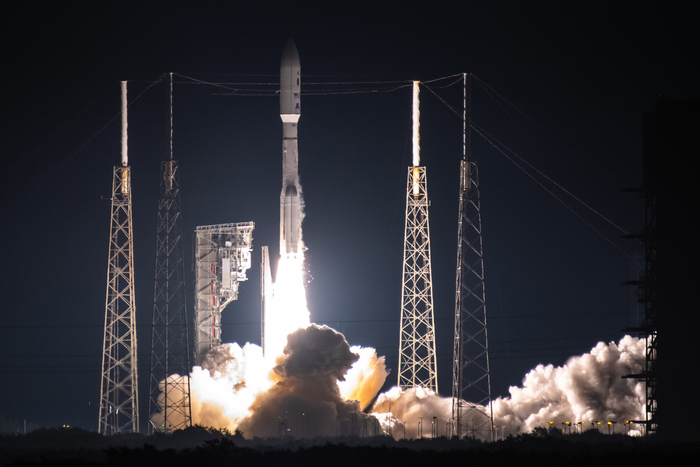
Credit: U.S. Space Force photo by Joshua Conti
WASHINGTON – U.S. Naval Research Laboratory scientists launched the second Strontium Iodide Radiation Instrument (SIRI-2) instrument in December 2021 onboard Space Test Program (STP) Sat-6. SIRI-2, a gamma-ray spectrometer, will demonstrate the performance of europium-doped strontium iodide gamma ray detection technology with sufficient active area for Department of Defense (DoD) operational needs.
The first SIRI mission was launched Dec. 3, 2018 onboard STP Sat-5 with a one-year mission to investigate the detector’s response to on-orbit background radiation in low Earth orbit (LEO). The much larger, SIRI-2 instrument is operating in a geosynchronous orbit where the radiation background is significantly different in composition.
“The technology being demonstrated in SIRI-2 will need to detect small radiation signatures or signals in the highly variable background radiation fields found in space,” Lee Mitchell, Ph.D., an NRL Research Physicist said. “The instrument will also study transient phenomena, such as solar flares during the one-year mission.”
The SIRI line of instruments is designed to space-qualify new gamma-ray scintillator materials and readout electronics.
A scintillator is a material that exhibits the property of luminescence when excited by ionizing radiation and is commonly used for radiation detection. Luminescent materials, when struck by incoming particles, absorb its energy and re-emit the absorbed energy in the form of visible light.
The instrument will also test new Silicon Photomultiplier (SiPM) technology which converts the scintillation light to electronic signals and is expected to replace conventional photomultiplier tubes. These materials and electronics, to varying degrees, react differently to the intense on-orbit background radiation.
“We hope to show this technology can be used in space, since it can be difficult for some technologies developed for terrestrial applications to operate in the harsh space environment,” Mitchell said.
The DoD has been utilizing scintillation detectors in space since the 1960’s Vela high-altitude nuclear detection program. Scintillator technology is widely used throughout the scientific community in areas such as astrophysics and solar and earth science.
“While we reduced the cost, weight and power for comparable sized instruments,” Mitchell said. “These improvements led to greater sensitivity and in turn improve source detection and identification.”
SIRI-2 completed on-orbit checkout on Jan. 10. Mitchell said, “So far, the instrument is performing well.”
One thing that has Mitchell and his team excited is seeing the pickup of solar activity. The solar cycle is an 11-year change in the Sun’s activity measured in terms of variations in the number of observed sunspots on the solar surface, and the mission is well aligned with the peak of Solar Cycle 25.
“While the peak of the solar cycle is expected to occur in 2025, it appears the Sun is showing significant activity earlier than expected,” Mitchell said. “Solar flare activity is most active at the peak of the solar cycle, so we hope to not only space-qualify new technology for the DoD but also make significant contributions to solar physics by studying gamma-rays emitted during solar flares.”
A follow on to SIRI-2, SIRI-3 will take knowledge gained from the previous missions to develop a large prototype instrument that is expected to launch in late 2025.
About the U.S. Naval Research Laboratory
NRL is a scientific and engineering command dedicated to research that drives innovative advances for the U.S. Navy and Marine Corps from the seafloor to space and in the information domain. NRL is located in Washington, D.C. with major field sites in Stennis Space Center, Mississippi; Key West, Florida; Monterey, California, and employs approximately 3,000 civilian scientists, engineers and support personnel.
For more information, contact NRL Corporate Communications at (202) 480-3746 or [email protected]l.
Subject of Research
Not applicable