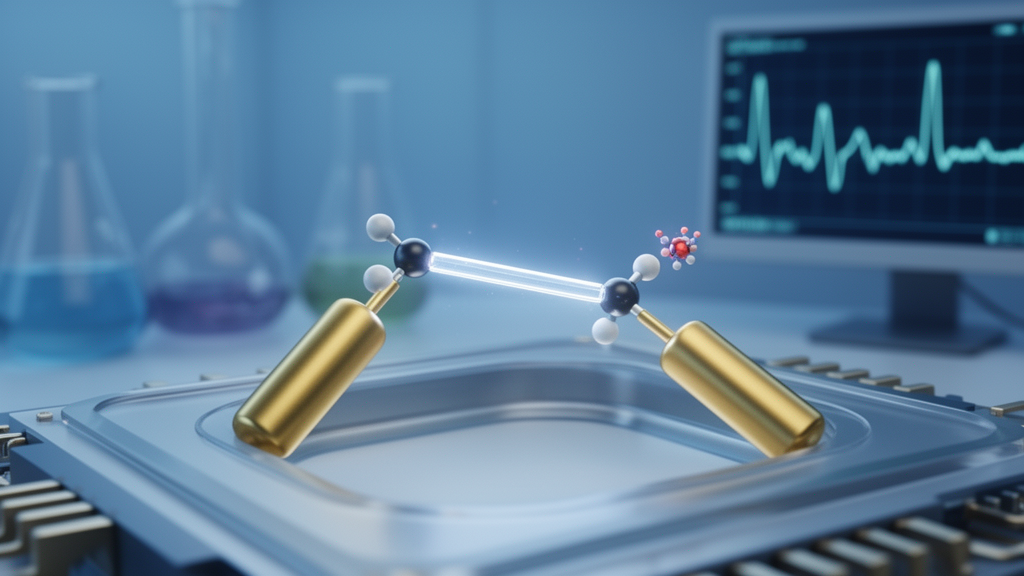
Chemists watching a reaction unfold in a flask usually rely on signals averaged over trillions of molecules: a nuclear magnetic resonance peak that shrinks, an ultraviolet absorption that grows, an infrared band that shifts. Those ensemble methods are superb for extracting rate constants and average structures, but anything fleeting and rare—a short-lived intermediate, a single binding event—can be washed out entirely by the averaging. A team reporting in Discover Molecules has now shown that a scanning tunneling microscope configured as a fixed molecular junction can follow a catalyzed azide-alkyne cycloaddition in water one molecule at a time, converting the birth of each product molecule into a measurable blip of electric current with sub-millisecond time resolution.
The study builds on single-molecule electrical measurement techniques that detect one molecule at a time and translate molecular events into current fluctuations. Graphene-based single-molecule devices, scanning tunneling microscopy break junctions (STM-BJ), and fixed junctions (STM-FJ) all share this principle: a single molecule is captured between two electrodes, and the resulting tunneling current reports on its identity and dynamics. Such measurements can reveal transient and dynamic processes hidden within ensemble measurements. Yet applying them to monitor chemical reactions has remained genuinely difficult, because each molecular species involved in a reaction generally needs to be chemically modified with anchoring groups, such as thiols or amines, to form stable interactions with metal electrodes—most commonly gold. For reactions in aqueous solution the problem is worse: amine anchoring groups are easily protonated at neutral pH and lose their grip on gold electrodes altogether.
The researchers circumvented this bottleneck with a macrocycle-assisted, anchor-free STM-FJ platform they had developed in earlier work. One gold electrode is modified with a macrocyclic host, in this case cucurbit[6]uril, abbreviated CB6. The carbonyl-lined portals of cucurbiturils bind strongly to gold surfaces in water, while the pumpkin-shaped hydrophobic cavity encapsulates small, anchor-free guest molecules from solution. A guest sitting in the cavity of a surface-bound CB6 is thereby incorporated into a stable single-molecule junction without any covalent tethering chemistry. The STM-FJ configuration then transduces molecular state changes—binding, reaction, conformational rearrangement—into real-time electrical signals, making the approach well suited to chemistry in aqueous environments at the single-molecule level.
The reaction chosen for the demonstration is a classic of supramolecular catalysis. Mock and co-workers had previously shown that cucurbit[6]uril accelerates the cycloaddition of propargylamine (PGA) and azidoethylamine (AEA) without any copper or other conventional catalyst. Both substrates are simultaneously encapsulated within the CB6 cavity, where spatial confinement, entropic preorganization, and transition-state stabilization accelerate triazole formation by approximately five orders of magnitude compared with the bulk solution reaction. The host also enforces complete regioselectivity, restricting the product to the 1,4-substituted triazole. That combination—an anchor-free reaction between two amine substrates that resist direct gold binding, catalyzed by a host that itself anchors to gold—made the system an ideal test case for the modified junction.
The experimental preparation was deliberately straightforward. CB6, PGA, and AEA were used as purchased, and all solutions were prepared in deionized water. Gold substrates were fabricated by evaporating a 20-nanometer chromium adhesion layer and a 100-nanometer gold film onto silicon wafers, then annealed under vacuum and flashed with a hydrogen flame to obtain clean, atomically ordered surfaces. The substrate was modified by immersion in a saturated aqueous CB6 solution containing 0.5 mM AEA for 12 hours, producing surface-bound CB6-AEA host-guest complexes together with a minor population of empty CB6 molecules, then rinsed and dried under nitrogen. Gold STM probes were electrochemically etched, cleaned in piranha solution, and insulated with high-density polyethylene so that only the apex remained exposed; the coating kept background leakage current at 0.1 V bias within the picoampere range, negligible against the 20-nanoampere tunneling current and the nanoampere-scale molecular signals.
Before any reaction was attempted, the team calibrated the junction geometry. Using molecular junction mapping in CB6 solution, with a slow 0.5-nanometer-per-second probe retraction capturing plateau features and current switching events, they identified the most probable binding geometry for a single CB6 molecule bridging the electrodes. The baseline conductance peaked at 218 nanosiemens, corresponding to the 20-nanoampere set-point at the applied bias, and the molecular conductance of CB6 was determined as log(G/G0) = −3.35 ± 0.20. Accounting for the 0.91-nanometer height of CB6, a set-point current of 20 nA at 0.1 V bias, sampled at 10 kHz, was selected as the optimal condition for all subsequent fixed-junction measurements.
Next came electrical fingerprinting. The substrate was separately pre-modified with CB6 alone and with each host-guest complex—CB6 with PGA, CB6 with AEA, and CB6 with the triazole product—and conductance histograms were recorded under identical conditions. The host alone gave log(G/G0) = −3.39 ± 0.23, consistent with the mapping result. The CB6-AEA complex measured −3.21 ± 0.25, the CB6-PGA complex −3.72 ± 0.26, and the CB6-triazole product complex −3.56 ± 0.26. No discernible conductance signal appeared when the guest molecules were measured without CB6, confirming that the macrocycle is essential for junction formation—consistent with the protonated amines of PGA, AEA, and the product being unable to bind gold directly under neutral aqueous conditions. The clearly separated values constitute distinct electrical fingerprints for every species the reaction would touch.
The real-time experiment then proceeded in a single step: 500 microliters of 0.5 mM PGA solution was deposited onto the CB6-AEA-modified substrate, and current-time traces were recorded immediately. Three conductance states emerged. In the earliest regime, high-amplitude transient spikes corresponding to state 1, at log(G/G0) = −2.76 ± 0.18, coexisted with two lower states, state 2 at −3.36 ± 0.15 and state 3 at −3.65 ± 0.25. As the reaction progressed, state 1 faded while states 2 and 3 persisted, and after roughly seven minutes the fluctuations were dominated by state 3. States 2 and 3 matched the independently measured fingerprints of empty CB6 and the CB6-triazole product complex, respectively. The gradual disappearance of the high-conductance state and the rise of the product signature indicated completion of the cycloaddition.
The most intriguing assignment concerns state 1. Control experiments confirmed that guest molecules cannot form detectable junctions without CB6, and the high-conductance state matched neither empty CB6 nor any binary host-guest complex with a reactant or product. The authors therefore attribute it to a ternary complex in which both AEA and PGA are simultaneously encapsulated within the CB6 cavity—plausibly a reaction precursor. With the azide and alkyne moieties held in close proximity, strong through-space electronic coupling between their frontier orbitals could provide an efficient, short-lived charge transport pathway, explaining the elevated conductance. Capturing such a precursor directly is precisely the kind of observation that ensemble-averaged spectroscopy would struggle to make, since the species is both rare and fleeting.
The authors are careful about the interpretation limits inherent in the method. STM-FJ measurements are a stochastic sampling process: in solution, empty CB6, reactant complexes, and product complexes coexist, and their probabilities of being captured depend not only on concentration but also on interfacial binding affinities with the gold electrodes. Protonated amines at the portals can weaken CB6-gold interactions, making empty CB6 more likely to be detected than some complexed species even when it is not the dominant population in solution. Species lifetimes in the junction also vary with binding stability—the CB6-triazole complex, with its higher binding affinity, persisted for 18.4 milliseconds versus 5.5 and 9.9 milliseconds for the reactant complexes—and guest molecules may strengthen electrode contact through additional induction and dispersion interactions. Because the triazole product binds CB6 so tightly that it resists displacement by competitive binding, the cavity becomes progressively occupied by product as the reaction proceeds, driving the conductance signal toward the product signature. The demonstration remains a brief report on one model reaction, but the ability to resolve discrete molecular states in water suggests the platform could eventually be extended to monitoring biological processes in situ, such as enzymatic reactions and transmembrane processes.
Subject of Research: Real-time single-molecule electrical monitoring of a cucurbit[6]uril-catalyzed azide-alkyne cycloaddition using an anchor-free STM fixed junction
Article Title: Real-time monitoring of azide-alkyne cycloaddition using scanning tunneling microscope fixed junction
Article References: Xiao, B., Wang, M., Li, Z., Jiang, R., & He, S. (2026). Real-time monitoring of azide-alkyne cycloaddition using scanning tunneling microscope fixed junction. Discover Molecules, 3(1), Article 22. https://doi.org/10.1007/s44345-026-00062-y
Image Credits: AI Generated
DOI: 10.1007/s44345-026-00062-y
Keywords: scanning tunneling microscopy, single-molecule junctions, cucurbit[6]uril, azide-alkyne cycloaddition, click chemistry, supramolecular catalysis, host-guest chemistry, conductance fingerprints, real-time reaction monitoring, aqueous solution, ternary complex, molecular electronics
News Source: Bethany Barker. (October 29, 2026). Single-Molecule Electrical Readouts Track a Catalyzed Cycloaddition Reaction in Real Time. Scienmag.