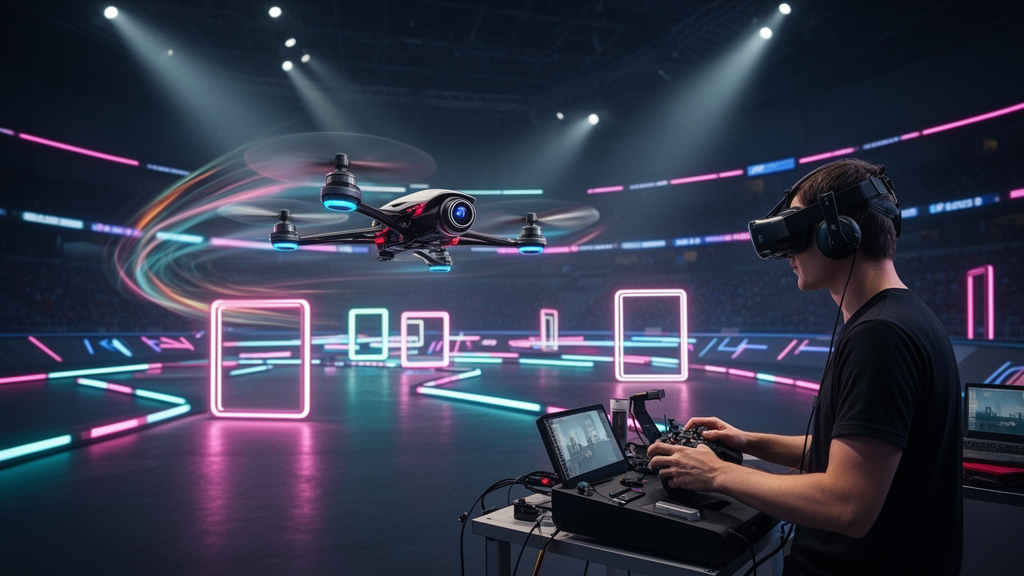
A racing drone developed at Delft University of Technology has done something that until recently seemed reserved for human champions: it flew a demanding racecourse faster than the best pilots on the planet, using nothing more than a single forward-facing camera, a tiny motion sensor and a neural network small enough to run on the drone’s own flight controller. The system, called MonoRace, defeated every other autonomous entrant as well as three former world champion human drone pilots at the 2025 Abu Dhabi Autonomous Drone Racing Competition, reaching speeds of up to 100 kilometres per hour. The research behind the achievement, published in Science Robotics, is now being read not just as a milestone in drone racing but as a demonstration of how compact, efficient artificial intelligence can deliver high-performance control in the messy, unforgiving conditions of the real world.
The central question the Delft team set out to answer was deceptively simple: how much performance can be extracted from a robot with deliberately minimal sensing, computing and energy resources? The question matters because drone racing sits at the extreme end of what autonomous systems can do. At racing speeds, the margin for error shrinks to almost nothing. A delay of even a few tens of milliseconds in perceiving a gate or issuing a control command can mean clipping a gate, colliding with an obstacle, or losing stability entirely and crashing. Any system that can fly reliably under those constraints has solved a problem that transfers directly to other fast-moving robots, from self-driving vehicles to mobile and humanoid platforms.
MonoRace’s most striking feature is what it does without. Previous leading autonomous racing systems have relied on richer sensor suites, often including GPS, external motion-capture tracking or multiple cameras, to pin down the drone’s position with high precision. The Delft system, developed at the university’s Micro Air Vehicles Laboratory in the Faculty of Aerospace Engineering, uses only one forward-facing camera and an inertial measurement unit, or IMU, for everything: perception, navigation and control. There is no GPS and no external tracking. The drone must figure out where it is and where it is going entirely from what it sees and how it feels its own motion, in real time, while hurtling through a course designed by other people.
Seeing the track through a single lens at racing speed is a formidable perception problem. The images arriving at the camera are blurry and deformed by the drone’s rapid motion, and the neural network has only a fraction of a second to identify the racing gates and estimate where the drone sits relative to them. MonoRace handles this by splitting the work between two complementary sources of information. A neural network examines the camera images and detects the gates, while the onboard IMU, combined with a model of the drone’s own dynamics, estimates the vehicle’s position and motion between visual observations. By fusing these streams, the system maintains a reliable picture of its state on the track even when the camera alone would be insufficient. Stavrow Bahnam, the study’s main author, described the challenge plainly: flying at very high speed with only one camera is difficult because the images are blurry and deformed and the AI has very little time to determine precisely where the drone is. The team’s solution, he said, was a robust way of combining what the camera sees with the drone’s own motion information, allowing it to navigate the track at high speed without GPS. The system also had to tolerate the imperfections of real flight, including camera interference and sensor saturation, conditions that rarely appear in simulation but are routine in the air.
The second major innovation lies in how the drone is controlled. Conventional flight stacks are layered: a planner proposes a trajectory, intermediate controllers translate that trajectory into attitude commands, and lower-level loops convert those commands into motor signals. Each layer adds latency and each abstraction discards some information about what the platform can actually do. MonoRace discards the layers. A small neural network, trained with reinforcement learning, takes raw state information and directly generates the commands sent to the drone’s motors. The network runs onboard the flight controller, the tiny computing chip at the heart of the aircraft, and issues control commands 500 times per second. Because it was trained through reinforcement learning, the network internalised the drone’s physical limitations during training, learning to exploit the full capabilities of the airframe without exceeding them. Robin Ferede, an author of the study, explained the rationale: instead of first planning a desired flight path and conventional commands, the neural network learns to directly control the motors, which allows the controller to react extremely quickly and exploit the drone’s capabilities while remaining small enough to run onboard.
That combination of speed and compactness is what makes the result scientifically significant rather than merely spectacular. Reinforcement learning has produced impressive controllers before, but many of them depend on heavyweight networks, powerful onboard computers or offboard infrastructure that cannot be carried by small, energy-constrained robots. MonoRace demonstrates that a network small enough to fit on a standard flight controller, running at 500 hertz, can execute champion-level racing. The efficiency is not an aesthetic choice; it is the enabling condition. A racing drone has strict limits on weight and power, and every gram of computer or battery spent on processing is a gram not spent on performance. The Delft team treated those constraints as the design problem itself rather than as obstacles to be engineered away.
The validation environment was chosen to make the test as unforgiving as possible. The 2025 Abu Dhabi Autonomous Drone Racing Competition was organised and operated externally: the drone hardware and the racing environment were designed and run by the competition organisers, not by the Delft researchers. That meant the system had to perform on equipment and a track the research team did not control, with no opportunity to tune the perception pipeline to familiar gate colours, lighting conditions or course geometry. This is a crucial distinction from laboratory demonstrations, where researchers typically race on courses they built themselves and on hardware they know intimately. Despite those constraints, the TU Delft drone reached speeds of up to 100 kilometres per hour and finished ahead of all other autonomous teams and three former world champion human pilots. Christophe De Wagter, one of the researchers, framed the philosophy behind the effort: rather than giving the robot increasingly powerful sensors and computers, the team wanted to find out how much intelligence could be extracted from very limited resources. Drone racing, he said, provided an extreme environment in which to test these ideas outside the laboratory, pushing the group to develop AI that was not only fast but also robust and able to adapt when external reference measurements were unavailable.
Beating human champions is more than a symbolic victory. Elite human drone pilots fly by integrating visual cues, learned track knowledge and finely tuned reflexes, and at racing speeds their reaction times and anticipatory skills represent a genuine benchmark of dynamic control. An autonomous system that surpasses them while carrying less sensing than a human’s own two eyes suggests that learned neural-network controllers, when trained well and run fast enough, can outperform biological perception-action loops in tasks at the edge of physical feasibility. It also confirms a trend visible across robotics: end-to-end learned control, once dismissed as too brittle for real hardware, can now hold its own in competitive, physical, high-stakes settings.
For Guido de Croon, professor at Delft University of Technology, the significance of the work extends well beyond making drones faster. Autonomous racing, in his view, is a way of pushing robotic AI to its limits. In the current study, the team made an AI efficient enough to control a drone travelling at 100 kilometres per hour using a single camera and a small onboard processor, and the same AI could be applied to many different real-world robotic systems. The optimisation objective, he noted, is flexible: here the researchers optimised for speed, but the same approach could be used to prioritise efficiency or safety, for example by performing smooth, energy-optimal control on systems ranging from small vacuum-cleaning robots to huge ship-to-shore cranes. The point is that the underlying control principles are not specific to racing; they are about making fast, reliable decisions with limited onboard resources, which is the defining constraint of nearly all autonomous robotics.
The broader implications reach across the field. Autonomous road vehicles, delivery drones, inspection robots and future humanoid systems all face versions of the same problem MonoRace solved: perceive the environment with limited sensors, estimate one’s own state without external references, and act quickly enough to matter, all within a tight computing and energy budget. A methodology that extracts champion-level performance from a single camera and a millimetre-scale processor offers a template for doing exactly that. The Delft result suggests that the future of capable autonomous robots may depend less on ever-larger sensor arrays and computers, and more on the intelligence that can be distilled into small, fast, robust networks trained to master the physics of the machines they control. In drone racing, that idea has now been proven at 100 kilometres per hour, in front of the world’s best human pilots, on a course its creators never built.
Subject of Research: Neural-network-based autonomous drone racing control using a single camera
Article Title: The science behind the world’s fastest autonomous racing drone
Article References: The science behind the world’s fastest autonomous racing drone. (n.d.). Original publication
Image Credits: AI Generated
DOI: Not provided
Keywords: autonomous drones, drone racing, MonoRace, neural networks, reinforcement learning, computer vision, TU Delft, Science Robotics, robotics, embedded AI, monocular camera, flight control
News Source: Denise Maddox. (October 15, 2026). Single-Camera AI Drone Outraces Former World Champion Human Pilots at 100 km/h. Scienmag.