For air-breathing animals that returned to the water, sex can be a breathless affair. Males that must surface for air mid-copulation risk losing their mate to rivals, and the interruptions can cost them dearly in the competition to father offspring. A new study of the water scorpion Nepa hoffmanni now shows how one insect solves this problem with a remarkably elegant piece of engineering: an air bubble trapped between its wings and abdomen that functions as a physical gill, allowing males to keep breathing while locked in an underwater embrace that would otherwise suffocate them.
The research, published in iScience by Hyoseul Hyun, Nikolai J. Tatarnic, and Chang S. Han, provides the first clear evidence that gas gill respiration confers a mating advantage on an air-breathing aquatic insect. By combining micro-computed tomography imaging, field surveys, and controlled laboratory experiments, the team demonstrated that the subalar air store of male water scorpions acts as an active gas gill during copulation, and that the efficiency of this gill directly determines how long and how often males can mate.
Water scorpions, members of the family Nepidae, are among the many lineages that abandoned aquatic life for land and then returned to the water. Like most secondarily aquatic animals, they breathe atmospheric oxygen rather than the dissolved oxygen in their environment. Their solution is a respiratory siphon at the tip of the abdomen, a structure made of two straps connected to the terminal abdominal spiracle. When the tip of the siphon is held above the water surface, the insect enjoys continuous access to air. In the wild, N. hoffmanni typically lives in extremely shallow water, with an average depth of just over one centimeter, precisely so that this siphon can reach the surface.
But copulation creates a serious anatomical problem. To mate, the male must twist his abdomen beneath the female’s genitalia, and this maneuver separates the two straps of his siphon while submerging his abdominal spiracle. The siphon becomes completely non-functional, cutting the male off from atmospheric air at the very moment he needs sustained energy for sperm transfer. The female, by contrast, keeps her siphon intact and continues breathing normally throughout. The male’s predicament is therefore independent of water depth: no matter how shallow the pond, his air supply is severed during mating.
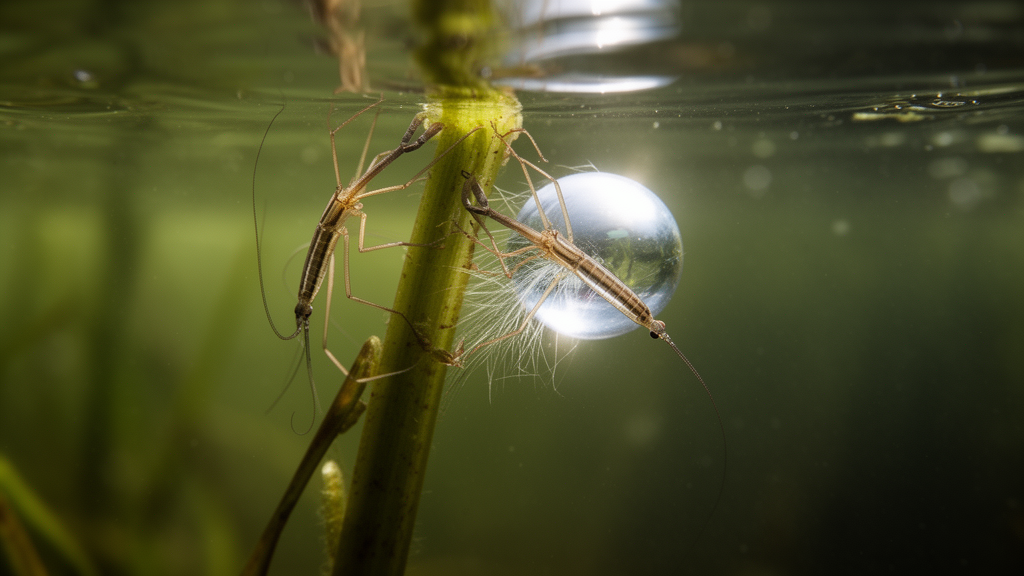
The key to the male’s survival lies in the subalar air store, a bubble of air held between the abdomen and the wings. Earlier work on the related species Nepa cinerea had shown that dissolved oxygen uptake through this store can account for more than half of total oxygen consumption when access to the surface is blocked. Because male N. hoffmanni open a gap between their wings and abdomen during copulation, the researchers hypothesized that this exposure allows the air store to function as an active gas gill rather than a mere static reserve of trapped oxygen.
The physics of a gas gill is subtle and elegant. As the animal consumes oxygen from the bubble, the partial pressure of oxygen inside it falls, and the relative partial pressure of nitrogen rises. This imbalance drives a continuous exchange with the surrounding water: dissolved oxygen diffuses inward from the water, while nitrogen slowly diffuses outward. The bubble gradually shrinks as nitrogen is lost, but as long as it persists, the animal can keep extracting oxygen from the water without ever surfacing. This mechanism, known as plastron or physical gill respiration, is what allows diving insects and even the diving bell spider to remain submerged far longer than their trapped air alone would permit.
To confirm the anatomy, the team used micro-CT imaging on specimens stained with iodine to reveal the tracheal system. In Nepidae, most abdominal spiracles are non-functional, but the dorsal spiracles on the first abdominal segment, located beneath the wing bases, remain open and connect directly to the subalar air store. The imaging confirmed these spiracles in detail, showing the plumbing that links the air bubble to the insect’s tracheal system. Field surveys in Gangneung, South Korea, meanwhile, established that mating pairs occur at an average depth of 1.82 centimeters, and one pair was observed at 9.5 centimeters, deep enough that the siphon could not readily reach the surface at all.
The physiological evidence was striking. Using a fiber-optic oxygen sensor inserted into the subalar air store, the researchers monitored oxygen partial pressure every ten seconds in both live and dead submerged individuals. In live insects, oxygen within the store fell by roughly 40 percent over ten minutes, dropping from an average of 18.31 to 10.96 kilopascals. In dead individuals, the concentration remained essentially unchanged, from 18.69 to 18.49 kilopascals. Only a living, metabolizing animal could draw down oxygen this way, proving that the air store is actively consumed and, by implication, replenished through contact with the surrounding water.
The decisive test came with mating experiments under manipulated dissolved oxygen levels. If the air store were merely a static reservoir, copulation performance would be identical regardless of how much oxygen was dissolved in the water. Instead, the opposite occurred. Pairs kept in oxygen-rich water, at about 25.76 kilopascals, copulated for longer per bout and more frequently than pairs in hypoxic water at about 5.15 kilopascals, and their total copulation duration was significantly greater. The researchers interpret this as evidence that when the gas gill’s efficiency is compromised by low ambient oxygen, males deplete their energy reserves faster, cutting mating short. The pattern echoes findings in gill-breathing animals such as the Atlantic blue crab, which suffers rapid leg fatigue under hypoxic conditions.
Crucially, the study includes a control that makes the interpretation especially robust. After each copulatory bout, the male remains mounted on the female but retracts his genitalia and recombines his separated siphon straps, restoring his ability to breathe atmospheric air during mate guarding. If reduced mating performance in hypoxic water simply reflected a general metabolic depression, guarding duration should have suffered too. It did not: guarding time was statistically indistinguishable across oxygen treatments. The sensitivity to dissolved oxygen is confined to the copulatory phase, exactly where the siphon is disabled and the gas gill must carry the load. The researchers acknowledge that female responses cannot be entirely excluded, but they consider this contribution minimal, since females breathe freely throughout and show no resistance to mating, which is terminated by the male’s voluntary dismounting.
The reproductive stakes are considerable. Although sperm transfer was not measured directly, copulation duration correlates positively with sperm quantity in many insect species, and genital coupling itself serves as a form of mate guarding. Males who can remain submerged and copulate longer therefore stand to gain both greater sperm transfer and reduced risk of their mates being inseminated by rivals. The findings also carry a warning: because reproductive success in these animals depends so tightly on environmental oxygen availability, climate-driven hypoxia in freshwater ecosystems could quietly undermine the mating performance of air-breathing aquatic insects. What looks like a simple bubble under a wing turns out to be the difference between fathering the next generation and fading out of it.
Subject of Research: Gas gill respiration and its role in underwater copulation of the water scorpion Nepa hoffmanni
Article Title: Gas gill respiration enhances underwater copulation in a water scorpion
Article References: Hyun, H., Tatarnic, N. J., & Han, C. S. (2026). Gas gill respiration enhances underwater copulation in a water scorpion. iScience, 29(11), Article 117837. https://doi.org/10.1016/j.isci.2026.117837
Image Credits: AI Generated
DOI: 10.1016/j.isci.2026.117837
Keywords: water scorpion, Nepa hoffmanni, gas gill, plastron respiration, aquatic insects, copulation, mate guarding, dissolved oxygen, micro-CT, respiratory siphon, subalar air store, reproductive ecology
News Source: Gavin Prescott. (October 15, 2026). Water Scorpions Turn an Air Bubble Into a Mating Lifeline Underwater. Scienmag.