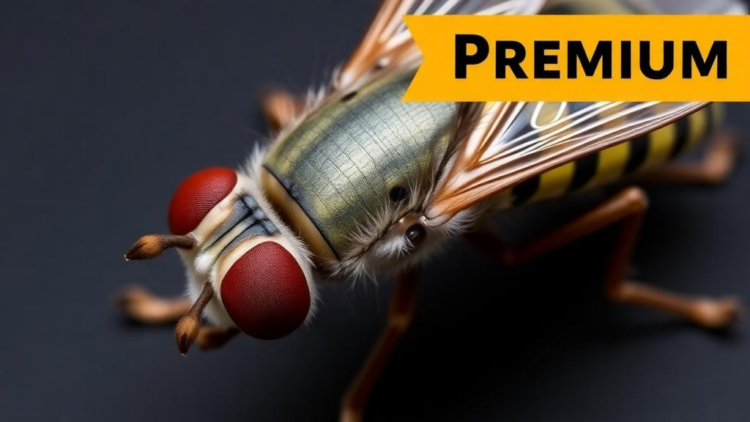
In a finding that could reshape how scientists think about iron buildup in the aging brain, researchers in China have shown that a single amino acid in a fruit fly enzyme acts as a molecular switch separating healthy longevity from neurodegeneration-like decline. The study, published in BMC Biology, focuses on multicopper oxidase-1, or MCO1, a protein in Drosophila melanogaster that the team had previously shown can catalyze two distinct chemical reactions in a test tube. The new work demonstrates that these two activities play sharply different roles inside a living animal, and that disabling just one of them can dramatically extend a fly’s lifespan while disabling the other shortens it.
Iron is essential for life, powering everything from oxygen transport to the electron transport chain in mitochondria, but it is also a double-edged element. When iron accumulates in the wrong form or the wrong place, it drives the Fenton reaction, generating hydroxyl radicals and other reactive oxygen species that damage DNA, proteins and lipids. This iron dyshomeostasis has been implicated in the aging process and in the pathogenesis of numerous neurodegenerative diseases, including Alzheimer’s disease, yet the underlying mechanisms remain largely unknown. In humans, multicopper ferroxidases such as ceruloplasmin and hephaestin convert toxic ferrous iron, Fe2+, into its safer ferric form, Fe3+, which can then be safely loaded onto transport and storage proteins. Whether the fly equivalent of these enzymes performs a similar protective role in the nervous system was an open question.
The research team, led by Minglin Lang of the University of Chinese Academy of Sciences and the College of Life Science at Agricultural University of Hebei, with Xuejiao Chang and Yudie Ma as co-first authors, set out to characterize MCO1’s function in vivo. In earlier work they had determined that MCO1 possesses dual catalytic activity, acting both as a ferroxidase and as an ascorbate oxidase, an enzyme that oxidizes vitamin C. The problem was that these two activities are chemically intertwined in the same protein, making it difficult to know which one matters physiologically. The new study combined a pan-neuronal elav-Gal4 driver for manipulating gene expression in neurons with the CRISPR-Cas9 gene-editing system to generate precisely targeted fly mutants, allowing the team to dissect the contributions of each activity to development, survival and locomotion.
The first clue that MCO1 is a genuine player in iron metabolism came from dietary experiments. When the researchers altered the iron content of the flies’ food, MCO1 expression responded in both the mid-gut and the brain, suggesting the gene is part of a regulated iron-sensing network rather than a bystander. Consistent with this, changing neuronal MCO1 levels significantly affected the expression of key iron metabolic genes, including Malvolio, the fly homolog of the mammalian divalent metal transporter DMT1, and the Transferrins, which encode iron-binding transport proteins. In other words, MCO1 does not merely respond to iron; it sits upstream of the machinery that governs how much iron the nervous system takes up and stores.
To test whether MCO1’s ferroxidase function is evolutionarily conserved, the team turned to yeast. Expressing MCO1 in yeast cells lacking Fet3, the ferroxidase component of the high-affinity iron uptake system, or lacking CCC2, a copper transporter required to load copper onto Fet3, partially rescued the mutant defects. The rescued cells also showed increased iron accumulation, indicating that MCO1 can functionally substitute for a canonical ferroxidase in a heterologous system. This cross-species complementation strengthened the argument that MCO1 is a bona fide member of the multicopper ferroxidase family rather than an enzyme with incidental iron chemistry.
The decisive experiments came from three CRISPR-Cas9 edited fly lines, each designed to impair a different aspect of MCO1’s chemistry. In the MCO1ΔExon IV mutant, deletion of a whole exon abolished both ferroxidase and ascorbate oxidase activities. In the MCO1D380A mutant, a single amino acid substitution at position 380, replacing an aspartate with alanine, specifically disrupted ferroxidase activity while leaving the ascorbate oxidase side of the enzyme intact. In the MCO1H374S mutant, a histidine-to-serine change at position 374 selectively eliminated ascorbate oxidase activity. This elegant trio allowed the researchers to attribute phenotypes to one activity or the other with unusual precision.
The results were striking. Flies lacking both activities, and flies lacking ferroxidase activity alone, accumulated ferrous iron and reactive oxygen species in their aging brains. The damage was not confined to molecular markers: these mutants showed severely impaired development, reduced locomotor performance and shortened lifespan. The D380A flies, in which one aspartate residue was swapped for alanine, recapitulated the full severity of the exon deletion, pinpointing D380 as the residue that makes ferroxidase activity possible. Because ferrous iron is the form that fuels radical production, the failure to oxidize Fe2+ to Fe3+ provides a direct mechanistic link between the enzyme’s active site and the oxidative damage observed in the aging brain.
The surprise came from the opposite direction. When the team eliminated ascorbate oxidase activity alone in the H374S mutant, ferrous iron accumulation was suppressed rather than worsened, and the flies lived substantially longer than normal. This suggests that the two activities of MCO1 are not simply redundant partners but competing forces: the ascorbate oxidase function, which consumes vitamin C, may undermine the antioxidant capacity of the nervous system, while the ferroxidase function detoxifies iron. In the H374S flies, preserving ascorbate appears to tip the redox balance toward protection, extending lifespan without the developmental costs seen in the other mutants.
The technical approach underlying these findings deserves attention in its own right. By pairing tissue-specific Gal4 drivers with CRISPR-edited alleles, the team could distinguish between effects of MCO1 in neurons and effects elsewhere, using quantitative PCR to track iron metabolic genes, colorimetric and fluorescent probes such as dichlorofluorescein diacetate to measure iron species and reactive oxygen species, and standard assays of development, climbing ability and survival. Replicate experiments confirmed the critical role of the D380 residue in development and lifespan, and complete statistical analyses were made available in supplementary tables, reflecting the open-access ethos of the journal.
For the broader field, the study offers a compelling proof of principle that neural iron homeostasis can be genetically tuned at the level of a single amino acid, and that doing so changes how long an organism lives. Iron dyshomeostasis is a hallmark of aging human brains and of diseases such as Alzheimer’s, where excess iron and oxidative stress feed a self-reinforcing cycle of neuronal damage. If mammalian multicopper ferroxidases such as ceruloplasmin are governed by similar structure-function rules, the D380 and H374 positions of MCO1 may point toward residues whose modification could tilt the balance between iron detoxification and antioxidant depletion. The fly work does not yet translate into a therapy, but it identifies ferroxidase activity as a vital, druggable-looking node in the nervous system’s iron economy, and it suggests that modulating the dual activities of multicopper oxidases could become a strategy for slowing brain aging and the progression of neurodegenerative disease.
Subject of Research: The role of the MCO1 ferroxidase residue D380 in regulating neural iron homeostasis, oxidative stress and lifespan in Drosophila
Article Title: The D380 residue in MCO1 regulates neural iron homeostasis and fitness in Drosophila
Article References: Chang, X., Ma, Y., Jiang, S., Gao, H., Xu, R., Ullah, I., & Lang, M. (2026). The D380 residue in MCO1 regulates neural iron homeostasis and fitness in Drosophila. BMC Biology. https://doi.org/10.1186/s12915-026-02733-1
Image Credits: AI Generated
DOI: 10.1186/s12915-026-02733-1
Keywords: MCO1, ferroxidase, iron homeostasis, Drosophila melanogaster, neurodegeneration, reactive oxygen species, ascorbate oxidase, CRISPR-Cas9, aging, lifespan, multicopper oxidase, redox biology
Cite Scienmag News
APA MLA Chicago
Cassandra Pierce. (October 2, 2026). Single Amino Acid in Fly Enzyme Controls Brain Iron and Lifespan. Scienmag. https://scienmag.com/single-amino-acid-in-fly-enzyme-controls-brain-iron-and-lifespan/
Cassandra Pierce. “Single Amino Acid in Fly Enzyme Controls Brain Iron and Lifespan.” Scienmag, 2 October 2026, https://scienmag.com/single-amino-acid-in-fly-enzyme-controls-brain-iron-and-lifespan/. Accessed 2 October 2026.
Cassandra Pierce. “Single Amino Acid in Fly Enzyme Controls Brain Iron and Lifespan.” Scienmag. October 2, 2026. https://scienmag.com/single-amino-acid-in-fly-enzyme-controls-brain-iron-and-lifespan/
Copy citation Download RIS
Tags: Agingamino acid impact on neurodegenerationascorbate oxidaseCRISPR-Cas9Drosophila melanogasterferroxidasefruit fly enzymegenetic factors influencing lifespan in Drosophilairon buildup and agingiron dyshomeostasis in agingIron homeostasisiron metabolism and brain healthlifespanMCO1MCO1 role in brain iron regulationmolecular switch in enzyme activitymulticopper oxidasemulticopper oxidases in lifespan extensionneurodegenerationneurodegenerative disease mechanismsoxidative stress and neurodegenerationreactive oxygen speciesredox biology