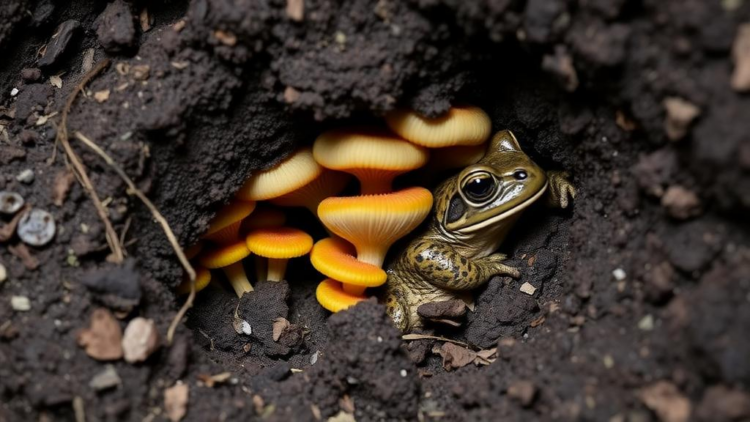
Deep beneath the snow-covered meadows of California’s High Sierra, a silent killer has been hiding in plain sight — or rather, out of sight, in the very places where threatened Yosemite toads retreat to survive the winter. Biologists at the University of California, Los Angeles have discovered that the devastating fungal pathogen Batrachochytrium dendrobatidis, known simply as Bd, is not primarily attacking these amphibians in the ponds and pools where they breed, as scientists long assumed. Instead, the fungus appears to proliferate inside the underground burrows where the toads spend their long winter hibernation, a finding that upends decades of assumptions about how this notorious pathogen operates and has already forced a change in how conservationists reintroduce captive-bred toads to the wild.
Bd is arguably the most destructive pathogen ever documented in wild vertebrates. The chytrid fungus has decimated amphibian populations on every continent where amphibians live, driving scores of species toward extinction and reshaping entire ecosystems in its wake. Because Bd is an aquatic organism that infects its hosts through the skin, researchers and wildlife managers have generally focused their attention on the water bodies where amphibians congregate to breed, treating those brief aquatic gatherings as the principal arenas of transmission. For the Yosemite toad, a species that spends the vast majority of its life on land, this reasoning suggested a comforting conclusion: the toads should be at comparatively low risk, vulnerable only during the short window of the mating season when they enter the water.
The new study, published in Functional Ecology by UCLA ecologist Dave Daversa and colleagues, demolishes that assumption. When the researchers surveyed toads emerging from their winter hibernation burrows, they found previously healthy animals carrying heavy fungal loads. The infections, in other words, were not being acquired in the breeding pools at all. They were building up underground, during the coldest and most hostile months of the Sierra Nevada year, in the abandoned rodent burrows that the toads use as winter refuges. The results of the surveillance study, Daversa said, were completely unexpected, sharply contrasting with the prevailing view that the high-risk season for Bd infection occurs when amphibians are breeding in water.
The Yosemite toad, Anaxyrus canorus, is a small and distinctive resident of the high country, living almost exclusively within Yosemite National Park and neighboring Sequoia and Kings Canyon national parks. The toads measure only about one to three inches long, and they walk rather than hop, an unusual gait that suits their slow, deliberate lifestyle in meadow habitats. Females are larger than males and wear bumpy skin mottled in attractive shades of green, while males are less colorful. The species breeds in small pools formed by snowmelt, but for much of the year the toads keep to land, sheltering from predators and extreme temperatures in burrows abandoned by rodents. When the brutal High Sierra winter arrives, they hibernate in these underground chambers, sometimes buried beneath many feet of snow.
That lifestyle has not shielded the species from decline. Climate change is rendering the toads’ mountain habitats drier and hotter, and fewer tadpoles are surviving to adulthood. Infection with Bd, which is fatal to the toads, is widespread across their range. The combined pressures led the federal government to list the Yosemite toad as threatened under the Endangered Species Act in 2014, and California classifies it as a highest-priority species of special concern. In an effort to bolster wild populations, toads have been reared at the San Francisco Zoo and returned to Yosemite, but until now it was not understood how the fungus might be undermining those reintroduction efforts.
To find out, a team of researchers from UCLA and Yosemite National Park conducted an intensive surveillance program from 2021 through 2023, designed to determine how Bd prevalence and severity varied across seasons and life stages. The researchers compared toads before and after cohorts entered winter dormancy, capturing metamorphs — juvenile toads that had recently completed metamorphosis — from high-altitude locations near Tioga Pass. They took skin swabs from the animals immediately after they emerged from hibernation in May, again during the summer, and once more before hibernation in September. The following spring, during early snowmelt, they returned and sampled the same individual toads as they emerged from hibernation. A parallel survey sampled toads at every phase of the life cycle, producing a total of 1,800 samples collected over three years at six sites.
Each swab was screened for Bd using established molecular techniques, including polymerase chain reaction tests of the same kind that became familiar worldwide during the COVID-19 pandemic. Daversa noted that the pandemic made it easier to explain to hikers he encountered along the trails what he was doing as he swabbed toads. The laboratory results, however, were anything but routine. The data unambiguously identified the winter months of underground dormancy as the key season of rapid Bd proliferation, and the effect was particularly pronounced in metamorphs, the youngest and most vulnerable life stage. Toads that had tested clean or carried only trace infections in the autumn emerged from their burrows in spring bearing strong infections acquired on land.
The finding stunned the research community because it contradicted nearly everything scientists believed they knew about the pathogen’s biology. Bd was thought to grow best under more moderate conditions, and the toads were assumed to be at low risk precisely because they spend so little time in water. The idea that the fungus could not merely survive but actively multiply at the super-low temperatures of a Sierra winter — either above ground or inside the burrows — came as a genuine surprise. UCLA conservation biologist and study co-author Brad Shaffer said it certainly appears that the Bd fungus has the ability to move between individuals, adding that its capacity to increase in number on land at such low temperatures is a real surprise.
Several important questions remain unresolved. The researchers cannot yet say for certain that toads are contracting new infections inside the burrows themselves. An alternative explanation is that the animals enter hibernation carrying very light, undetectable infections, and that for reasons still unknown each individual then develops a heavy fungal load over the winter. Studying the burrows directly during hibernation is extraordinarily difficult because the chambers lie buried beneath deep snow for months at a time. UCLA wildlife disease ecologist and co-author Jamie Lloyd-Smith framed the puzzle in terms of how pathogens persist in host populations with extremely seasonal life histories, observing that this fungus is not supposed to grow happily at such low temperatures. One hypothesis the team speculates about involves the host’s own defenses: the immune state of a hibernating toad may drop even lower than the fungus’s ability to grow, allowing infections to run unchecked while the animal lies dormant and cold-stunned.
Whatever the precise mechanism proves to be, the discovery has already changed conservation practice on the ground. Reintroducing captive-reared toads at the metamorphic stage, or younger, would be cheaper and easier for the program based at the San Francisco Zoo. But because the youngest toads are precisely the ones most at risk of devastating overwinter Bd infections, managers now release animals only after several years of growth, when they have reached a size and maturity at which the winter fungal surge poses less of a threat. Follow-up studies are planned to pin down exactly how the fungus persists and spreads in the burrows, and whether the hibernating toads’ suppressed immune systems hold the key. For a species clinging to survival in one of America’s most beloved national parks, the finding offers something rare: a genuine strategic insight into an enemy that, until now, had been hiding in the toads’ own homes.
Subject of Research: Winter proliferation of the amphibian chytrid fungus Batrachochytrium dendrobatidis in the hibernation burrows of Yosemite toads
Article Title: Yosemite toad killer may be hiding in their own homes
Article References: Yosemite toad killer may be hiding in their own homes. (n.d.). Original publication
Image Credits: AI Generated
DOI: Not provided
Keywords: Yosemite toad, Batrachochytrium dendrobatidis, chytrid fungus, amphibian disease, hibernation, burrows, conservation biology, Endangered Species Act, captive rearing, reintroduction, Sierra Nevada, UCLA
Cite Scienmag News
APA
MLA
Chicago
Roger Howard. (October 2, 2026). Deadly amphibian fungus thrives underground in Yosemite toads’ winter burrows. Scienmag. https://scienmag.com/deadly-amphibian-fungus-thrives-underground-in-yosemite-toads-winter-burrows/
Roger Howard. “Deadly amphibian fungus thrives underground in Yosemite toads’ winter burrows.” Scienmag, 2 October 2026, https://scienmag.com/deadly-amphibian-fungus-thrives-underground-in-yosemite-toads-winter-burrows/. Accessed 2 October 2026.
Roger Howard. “Deadly amphibian fungus thrives underground in Yosemite toads’ winter burrows.” Scienmag. October 2, 2026. https://scienmag.com/deadly-amphibian-fungus-thrives-underground-in-yosemite-toads-winter-burrows/
Copy citation
Download RIS
Tags: amphibian diseaseBatrachochytrium dendrobatidisburrowscaptive rearingchytrid fungusconservation biologyEndangered Species ActhibernationreintroductionSierra NevadaUCLAYosemite toad