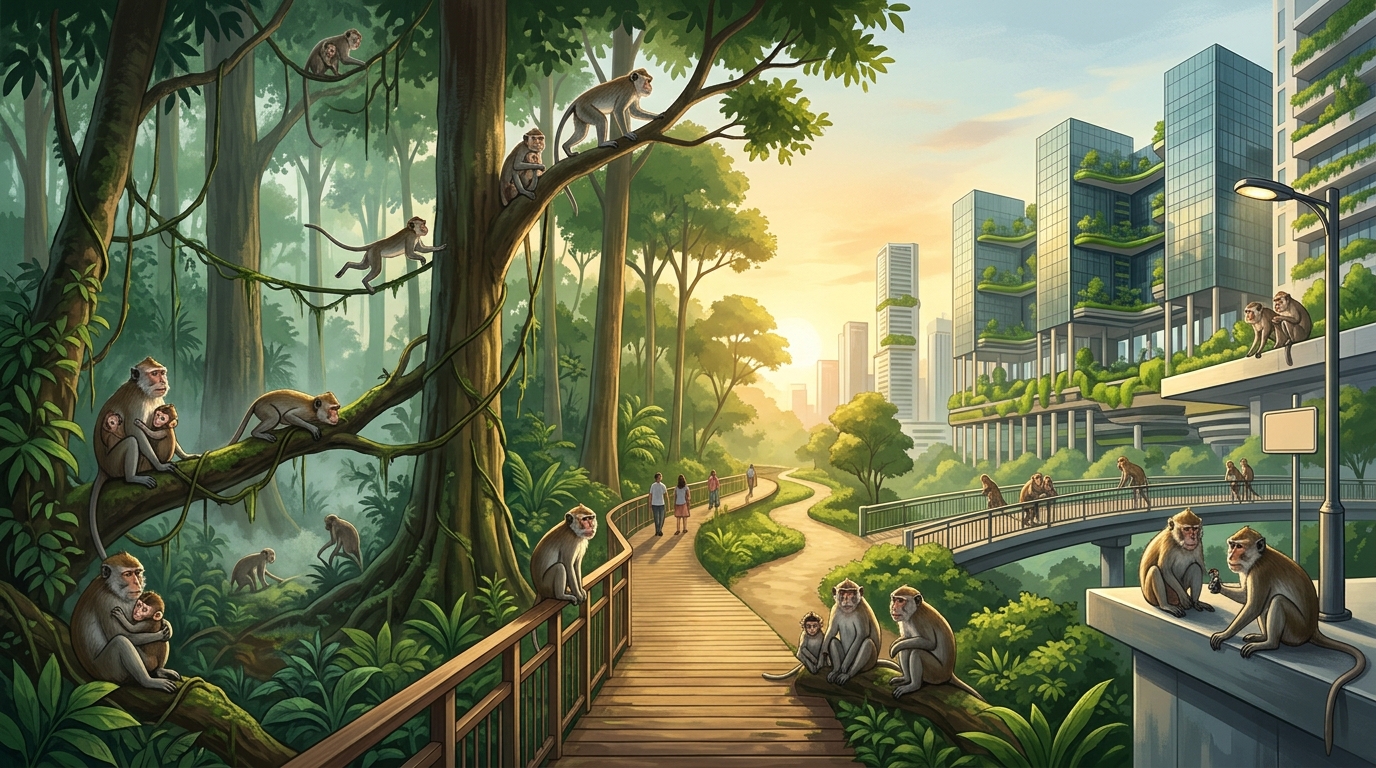
Singapore’s long-tailed macaques are not one uniform city-dwelling population but a set of genetically distinct family lines whose diets and gut microbes change sharply as their habitat shifts from forest to city, according to a study published in Nature Cities. Researchers analyzed DNA from more than 350 fecal samples collected across a wild–urban gradient in the highly urbanized island state, combining population structure, diet and microbiome data in a single multidimensional framework.
The genetic analysis showed that the macaques fall into eight distinct matrilines, each with its own habitat associations. This kin-based structure means that related females tend to share the same parts of the landscape, a pattern the authors suggest could interact with social learning to shape how different family groups exploit the city’s mosaic of parks, forests and built-up areas.
Diet emerged as a clear marker of urbanization. The total diversity of plants in the macaques’ fecal samples was higher in wild areas than in urban ones, and the diversity of an important group of exotic fruiting plants decreased markedly along the wild–urban gradient. In other words, the closer a group lives to human-modified habitat, the narrower its botanical menu becomes, with ornamental and introduced species apparently replacing the richer variety found in forest interiors.
The gut microbiome followed a parallel trajectory. Total bacterial diversity, including that of potentially pathogenic bacteria, showed steep declines from wild to urban habitat. The study’s authors interpret this as evidence that the wild–urban gradient produces measurably different pathogenic and dietary environments for the same species within a single small territory, rather than a simple loss of microbes with distance from people.
Because fecal DNA captures what an animal has recently eaten, the microbes it carries and the maternal line it belongs to, the approach avoids the need to trap or observe every individual. The samples were gathered across Singapore, an island whose dense urban core is interspersed with forest patches and parks, making it an unusually sharp natural experiment in how wildlife adjusts to anthropogenic landscapes.
The findings carry practical weight for a city where long-tailed macaques regularly encounter residents. By mapping which matrilines use which habitats and what they eat there, the authors argue that managers and city planners can take kinship, habitat-use patterns and dietary preferences into account when designing interventions, from buffer plantings to waste management, aimed at facilitating human–macaque coexistence.
The work also frames urbanization as a stratifying force rather than a uniform pressure. Instead of a single ‘urban macaque’ strategy, the data point to a gradient along which diet breadth, microbial communities and pathogen exposure all shift in step with habitat disturbance, with kinship and learning proposed as mechanisms that may allow different family groups to adapt to the city’s diverse landscape in distinct ways.
For urban ecology more broadly, the study offers a template: a non-invasive, multidimensional sampling design that links genetics, diet and microbiome across an environmental gradient. The authors suggest such approaches can open avenues for understanding how animals adjust to human-dominated environments in general, using Singapore’s macaques as a model system for the ecological sorting that urbanization can impose on a single wild population.
Subject of Research: Population structure, diet and gut microbiome of long-tailed macaques along a wild–urban gradient in Singapore
Article Title: Wild–urban gradient leads to ecological stratification in Singapore’s long-tailed macaques
Article References: Ganguly, A., Chin, L. N., Sha, J. C. M., Yeo, D., Mohan, R., Lee, B. P. Y. H., Ang, A., Soh, M. C. K., Srivathsan, A., Meier, R., & Rheindt, F. E. (2026). Wild–urban gradient leads to ecological stratification in Singapore’s long-tailed macaques. Nature Cities. https://doi.org/10.1038/s44284-026-00535-8
Image Credits: AI Generated
DOI: 10.1038/s44284-026-00535-8
Keywords: long-tailed macaques, urban ecology, Singapore, population structure, matrilines, fecal DNA, diet diversity, gut microbiome, pathogens, human–wildlife coexistence, wild–urban gradient, Wild
News Source: Juliet Wilcox. (November 4, 2026). Singapore’s macaques split into eight matrilines along a wild–urban gradient. Scienmag.