• HOME
  • NEWS
  • EXPLORE
    • CAREER
      • Companies
      • Jobs
    • EVENTS
    • iGEM
      • News
      • Team
    • PHOTOS
    • VIDEO
    • WIKI
  • BLOG
  • COMMUNITY
    • FACEBOOK
    • INSTAGRAM
    • TWITTER
Saturday, June 27, 2026
BIOENGINEER.ORG
No Result
View All Result
  • Login
  • HOME
  • NEWS
  • EXPLORE
    • CAREER
      • Companies
      • Jobs
        • Lecturer
        • PhD Studentship
        • Postdoc
        • Research Assistant
    • EVENTS
    • iGEM
      • News
      • Team
    • PHOTOS
    • VIDEO
    • WIKI
  • BLOG
  • COMMUNITY
    • FACEBOOK
    • INSTAGRAM
    • TWITTER
  • HOME
  • NEWS
  • EXPLORE
    • CAREER
      • Companies
      • Jobs
        • Lecturer
        • PhD Studentship
        • Postdoc
        • Research Assistant
    • EVENTS
    • iGEM
      • News
      • Team
    • PHOTOS
    • VIDEO
    • WIKI
  • BLOG
  • COMMUNITY
    • FACEBOOK
    • INSTAGRAM
    • TWITTER
No Result
View All Result
Bioengineer.org
No Result
View All Result
Home NEWS Science News Chemistry

Simulations show extreme opinions can lead to polarized groups

Bioengineer by Bioengineer
April 7, 2020
in Chemistry
Reading Time: 3 mins read
0
IMAGE
Share on FacebookShare on TwitterShare on LinkedinShare on RedditShare on Telegram

By incorporating the social science concept of ‘rigidity of the extreme’ into a popular opinion dynamics model, work in chaos theory points to the effects the strongly opinionated have on those around them
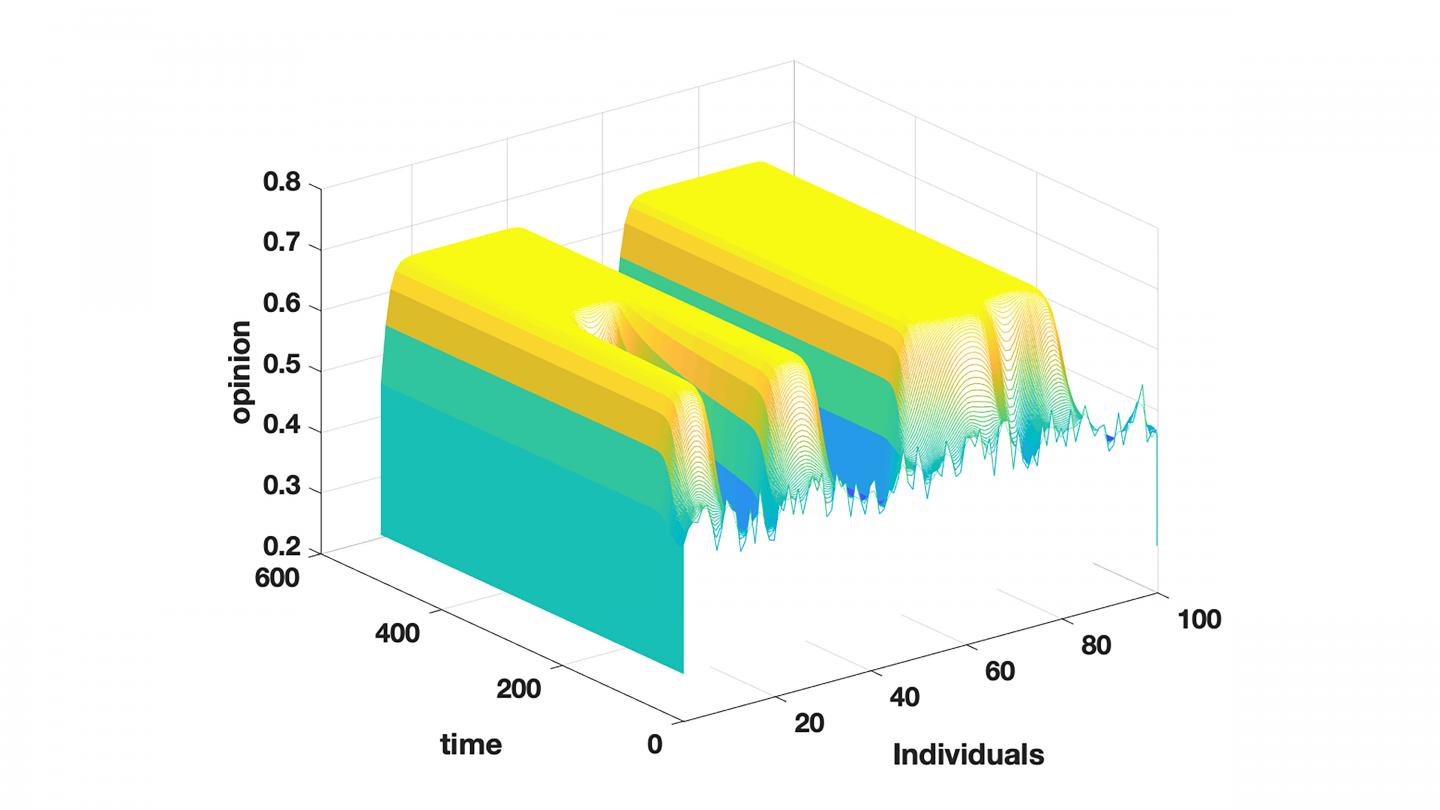
IMAGE

Credit: Desmond J. Higham

WASHINGTON, April 7, 2020 — In recent years, chaos theory and other forms of computational modeling have sought to leverage findings in the social sciences to better describe — and maybe one day predict — how groups of people behave. One approach looks to update a widely used model to examine how changes in political opinions ripple through a group and how polarization can arise.

In this week’s Chaos, from AIP Publishing, researchers at the University of Edinburgh and the University of Central Florida use a theoretical model for how political opinions evolve in a population to examine what effect those with more extreme views have on making the entire system more polarized. The group’s network-based model extends a popular approach for studying opinion dynamics, called the Cobb model, and is based on the hypothesis that those with opinions farther from the middle of a political spectrum are also less influenced by others, a trait known to social scientists as “rigidity of the extreme.”

“We have laws to understand gravity or chemical kinetics, but people don’t always behave rationally, and the laws are much more difficult to pin down,” said author Desmond Higham. “So, it’s a fascinating but somewhat slippery area to try to work in. Anything that adds to our understanding with a simple model that captures behavior is worth pursuing.”

In the simplest version of the model, members of a society are arranged in a line, each of whom can sway the two on either side of them. Each simulated person is assigned a starting number between 0 and 1 that describes how strongly they initially aligned to either end of a hypothetical political spectrum.

“These kinds of effects occur in patches in society and can be difficult to identify,” said author Alexander Mantzaris. “They can evolve in segments that grow over time.”

The simulations produced periods of what the researchers called bistability, where most members of a simulated society chose two extreme, competing opinions. In simulations that randomly connected individuals, the pair found the potential for taking extreme sides happened more rapidly.

The researchers believe their work can help inform other work on networks outside of political opinion, such as understanding how wealth affects handling finances, how international policymakers influence each other and even how we affect each other’s music tastes.

They hope to expand the model by using new types of connectivity structures and to apply real-world data.

###

The article, “A network model for polarization of political opinion,” is authored by Desmond J. Higham and Alexander V. Mantzaris. The article will appear in Chaos on April 7, 2020 (DOI: 10.1063/1.5131018). After that date, it can be accessed at https://aip.scitation.org/doi/10.1063/1.5131018.

ABOUT THE JOURNAL

Chaos is devoted to increasing the understanding of nonlinear phenomena in all areas of science and engineering and describing their manifestations in a manner comprehensible to researchers from a broad spectrum of disciplines. See https://aip.scitation.org/journal/cha.

Media Contact
Larry Frum
[email protected]

Related Journal Article

http://dx.doi.org/10.1063/1.5131018

Tags: Algorithms/ModelsChemistry/Physics/Materials SciencesMathematics/StatisticsPolitical ScienceSocial/Behavioral ScienceSystems/Chaos/Pattern Formation/Complexity
Share12Tweet8Share2ShareShareShare2

Related Posts

AI and Physics Collaborate to Design Advanced Hydrogen Storage Materials

June 25, 2026

International Team Including Dresden Scientists Develops Novel Designer Proteins for Advanced Study of Living Tissue

June 25, 2026

New Study Uncovers Key Factors Driving Water Chemistry in Nanoscale Environments

June 25, 2026

Plasma Technology Extends Catalyst Lifespan in Hydrogen Production

June 24, 2026
Please login to join discussion

POPULAR NEWS

  • Saying Goodbye to PGY-6: Pediatric Fellowship Realities

    103 shares
    Share 41 Tweet 26
  • Multi-Hospital Study Reveals Long Covid Burden Is Twice as High as Current Estimates

    92 shares
    Share 36 Tweet 23
  • Detection of EDCs in Breast Milk and Infant Urine Up to Six Months Highlights Early Exposure Risks

    77 shares
    Share 31 Tweet 19
  • New Drug Candidate Developed at McMaster Shows Potential for Treating Brain Cancer

    58 shares
    Share 23 Tweet 15

About

We bring you the latest biotechnology news from best research centers and universities around the world. Check our website.

Follow us

Recent News

Tracking Lanthanide-Labeled Microplastics in Plants

POSTECH Researchers Slash Cost of Reconstituted Cell-Free Systems by 95%

AI and Physics Collaborate to Design Advanced Hydrogen Storage Materials

Subscribe to Blog via Email

Success! An email was just sent to confirm your subscription. Please find the email now and click 'Confirm' to start subscribing.

Join 82 other subscribers
  • Contact Us

Bioengineer.org © Copyright 2023 All Rights Reserved.

Welcome Back!

Login to your account below

Forgotten Password?

Retrieve your password

Please enter your username or email address to reset your password.

Log In
No Result
View All Result
  • Homepages
    • Home Page 1
    • Home Page 2
  • News
  • National
  • Business
  • Health
  • Lifestyle
  • Science

Bioengineer.org © Copyright 2023 All Rights Reserved.