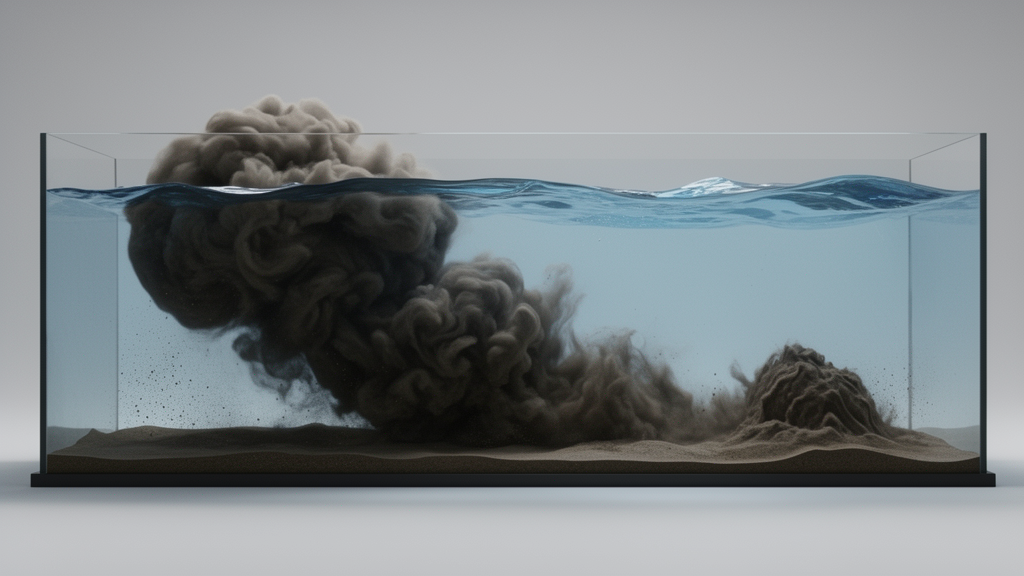
Dense currents that surge along the seafloor or race beneath atmospheric fronts owe much of their destructive power to a single, bulging structure at their leading edge. A new large-eddy simulation study has now dissected that structure in unprecedented detail, showing that a coherent Kelvin-Helmholtz vortex governs how the front of a gravity current grows, draws in surrounding fluid and finally stabilizes.
Gravity currents arise whenever a dense fluid intrudes into a lighter one, whether as a river plume spilling into the ocean, a saline underflow creeping along a canyon floor, or a sea breeze pushing across a coastline. The advancing front is an elevated, bulging head that resuspends dust and sediment from erodible beds and exerts impact forces on structures in the atmosphere and the ocean. Prandtl proposed a vortex model of this head as early as 1952, and Berson’s 1958 field measurements of sea breeze and cold fronts linked the intense winds observed behind atmospheric fronts to that same vortex picture. Yet the internal structure of the head has remained poorly understood, largely because laboratory measurements are limited to frontal speed and head elevation.
The researchers simulated a current sustained by a continuous buoyancy flux on a horizontal bed in a deep ambient fluid, a configuration relevant to sustained discharges such as mine tailings and hypersaline brine from desalination plants, as well as river plumes, oceanic overflows and sediment-laden turbidity currents in submarine canyons. Six simulations were performed, spanning density excesses of 0.007 for a Boussinesq current and 1.0 for a non-Boussinesq current, and source Froude numbers of 1.33, 2.05 and 3.77, all within the mixing-layer regime. The computational domain was designed to mirror the laboratory experiments of Sher and Woods, with tank-to-inlet height and length ratios of 15 and 100 respectively.
The simulations reveal that mixing between the current and its surroundings occurs primarily through a Kelvin-Helmholtz vortex forming at the current’s leading edge. Entrained ambient fluid rolls up, folds back and joins the source fluid, producing a maximum flow through a neck that connects the head to the trailing current. This confluence creates a velocity maximum below the vortex that consistently exceeds the frontal speed. For the Boussinesq case, the maximum-to-frontal speed ratio ranged from 1.67 to 1.77 over the simulated period, while the non-Boussinesq case gave ratios between 1.58 and 1.62. These values fall squarely within the range of 1.6 to 2.0 that Berson measured in atmospheric sea breeze and cold fronts, which remain the only field velocity data for the coherent turbulence behind such fronts.
By tracking the volume flux in the forward direction along the current, the team identified the neck of the head as the location where this flux reaches a sharp maximum. The neck flowrate grows with the vortex, reaching a pinnacle discharge before the vortex collapses. The pinnacle discharges, normalized by the source volume flux, ranged from 1.762 to 2.614 across the six cases, occurring at times and positions that scale with the source Froude number. Averaged over an interval around the pinnacle time, the frontal velocity normalized by the inlet velocity fell from 0.842 at the lowest Froude number to 0.441 at the highest, while the maximum velocity through the neck declined more modestly, from about 1.6 to about 1.19.
Remarkably, the terminal speeds depended almost entirely on the Froude number and hardly at all on the density contrast. The non-Boussinesq current, with a density excess 143 times greater than the Boussinesq case, produced terminal frontal and maximum velocities nearly coincident with those of its Boussinesq counterpart at the same Froude number. The maximum-to-frontal velocity ratios varied between 1.6 and 2.7 across all six simulations, a range consistent with Berson’s atmospheric observations and with an inviscid model of the current head that predicted a ratio of about 2.6. This maximum velocity, significant for sediment resuspension and impact forces on structures, has scarcely been addressed in the existing literature.
The study also quantified how the vortex stabilizes. As the Kelvin-Helmholtz vortex grows, stable density stratification eventually arrests its development. Computing an overall Richardson number across the vortex at its pinnacle, the authors obtained critical values between 0.30 and 0.42 across the six cases, comparable to the critical Richardson number for parallel shear flow established in classical laboratory work. The vortex grows, reaches its pinnacle when the neck discharge peaks, and then collapses, marking the transition of the front to a terminal state in which the frontal speed and vortex size attain their peak values.
Perhaps the most striking result concerns where the entrainment happens. More than eighty percent of the turbulent entrainment of ambient fluid into the current occurs within the current head as the vortex reaches its pinnacle; the fraction into the head alone averaged 0.823 with a deviation of 0.020 across all cases, while the trailing current behind the head rapidly settles into a quasi-steady state in which flow force and buoyancy flux remain essentially constant. Enetration into progressively denser layers is far weaker: fluid crossing the interface defined by a volume fraction of 0.2 accounts for only 12 to 27 percent of the total entrainment, meaning that dilution occurs mainly in an upper layer whose density is nearly that of the ambient fluid, leaving a dense, poorly mixed layer beneath.
When the frontal velocity and entrainment rates are normalized by the pinnacle neck discharge, the data from all six simulations collapse onto nearly constant values, revealing a structure-similarity relationship for the coherent turbulence in the front. The normalized frontal velocity is 0.85 with a spread of 0.02, the total entrainment coefficient normalized by the pinnacle discharge is 0.680 with a spread of 0.033, and the head’s share of entrainment normalized the same way is 0.560 with a spread of 0.039. The authors identify the pinnacle neck discharge as a robust internal scale that links frontal velocity, entrainment efficiency and head structure across density regimes spanning a factor of 143 and Reynolds numbers differing by more than an order of magnitude.
The numerical approach was validated through a mesh-refinement study showing fractional errors below three percent in volume flux calculations and below five percent in the pinnacle discharge, and by comparison with the laboratory observations of Sher and Woods, whose dye-concentration measurements of entrainment through the interface at a volume fraction of 0.05 were closely reproduced by the simulation. The authors caution that the source fluid in these simulations is uniform in density, whereas natural gravity currents often involve sediment suspension, resuspension and deposition, and that large-eddy simulation cannot resolve every turbulent scale; a future direct numerical simulation of the entire head could probe the finer scales, though at far greater computational cost. Extending the method to sediment-laden currents on an erodible bed, they suggest, would be a worthwhile next step toward understanding how these powerful fronts reshape the seabed and the atmosphere above them.
Subject of Research: Turbulent frontal dynamics of gravity currents driven by a continuous buoyancy flux, studied with non-Boussinesq large-eddy simulation
Article Title: The turbulent front of a current on a horizontal bed driven by a continuous buoyancy flux in deep water
Article References: Ramezani, S., & Chu, V. H. (2026). The turbulent front of a current on a horizontal bed driven by a continuous buoyancy flux in deep water. Discover Fluid Mechanics, 2(1), Article 5. https://doi.org/10.1007/s44369-026-00009-3
Image Credits: AI Generated
DOI: 10.1007/s44369-026-00009-3
Keywords: gravity currents, large-eddy simulation, Kelvin-Helmholtz vortex, turbulent entrainment, Richardson number, Boussinesq approximation, OpenFOAM, density stratification, current head, Froude number, turbidity currents, fluid mechanics
News Source: Violet Maxwell. (October 29, 2026). Simulations Reveal How Turbulent Gravity Currents Grow, Entrain and Collapse. Scienmag.