• HOME
  • NEWS
  • EXPLORE
    • CAREER
      • Companies
      • Jobs
    • EVENTS
    • iGEM
      • News
      • Team
    • PHOTOS
    • VIDEO
    • WIKI
  • BLOG
  • COMMUNITY
    • FACEBOOK
    • INSTAGRAM
    • TWITTER
Monday, October 5, 2026
BIOENGINEER.ORG
No Result
View All Result
  • Login
  • HOME
  • NEWS
  • EXPLORE
    • CAREER
      • Companies
      • Jobs
        • Lecturer
        • PhD Studentship
        • Postdoc
        • Research Assistant
    • EVENTS
    • iGEM
      • News
      • Team
    • PHOTOS
    • VIDEO
    • WIKI
  • BLOG
  • COMMUNITY
    • FACEBOOK
    • INSTAGRAM
    • TWITTER
  • HOME
  • NEWS
  • EXPLORE
    • CAREER
      • Companies
      • Jobs
        • Lecturer
        • PhD Studentship
        • Postdoc
        • Research Assistant
    • EVENTS
    • iGEM
      • News
      • Team
    • PHOTOS
    • VIDEO
    • WIKI
  • BLOG
  • COMMUNITY
    • FACEBOOK
    • INSTAGRAM
    • TWITTER
No Result
View All Result
Bioengineer.org
No Result
View All Result
Home NEWS Science News Health

Simulations characterize turbulence caused by common connection for dialysis

Bioengineer by Bioengineer
September 27, 2019
in Health
Reading Time: 3 mins read
0
IMAGE
Share on FacebookShare on TwitterShare on LinkedinShare on RedditShare on Telegram

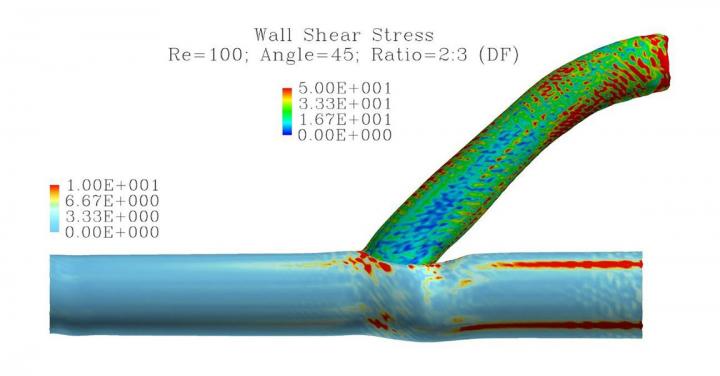
A new model incorporating the shape changes of veins and the arteriovenous grafts connecting to them shows much of the blood turbulence can be mitigated by improving AVGs
IMAGE

Credit: Zengding Bai

WASHINGTON, D.C., September 27, 2019 — Patients with kidney failure often require arteriovenous grafts to be connected to dialysis machines for their lifesaving treatment. However, one common problem with the artificial tubes is they can induce dangerous blood clotting.

The complex interplay among the AVGs, the vessels they connect, and the blood they transport has been difficult to simulate with computers. One new method provides a way to model such relationships.

Zengding Bai and Luoding Zhu from the Indiana University-Purdue University Indianapolis report their findings in Physics of Fluids, from AIP Publishing, on a series of simulations that reconstructed the fluid dynamics affected by the insertion of an AVG. The researchers used a model that considered the ability of AVG tubes and blood vessels to deform and found much of the disrupted flow could be mitigated by this flexibility.

The work marks one of the first uses of a flexible vein-graft anastomosis model that accounts for several variables that differ from patient to patient. Most research on the flow simulation involving AVGs has assumed that blood vessels and grafts are rigid and immobile.

Bai and Zhu previously developed a model in which dialyzed blood from a simulated, deformable AVG enters a deformable vein. It allows the team to control features, such as blood flow rate, attachment angle, diameters, and Reynolds number, a quantity that relates a fluid’s viscosity, density and velocity to how turbulent the flow might be.

After numerous simulations, the researchers found the AVG — not the vein — took the most impacts of flow disturbances.

While their simulations don’t point to an optimal design for grafts yet, Zhu said the results suggest several options exist for improving AVGs.

“We hope this model might point people manufacturing these grafts in a direction for making better grafts,” he said. “Today, grafts are more rigid than veins, so you might try to make them more flexible than veins.”

By finding ways to reduce AVG-related thrombosis, the group surmises that design grafts can be used for longer periods of time. Zhu said a typical AVG tube lasts at most two to three years, and that many patients thus require several salvage procedures or replacements throughout their lives.

The researchers look to find more ways to improve model accuracy, including better modeling for tissue surrounding blood vessels.

###

The article, “Simulation of blood flow past a distal arteriovenous-graft anastomosis at low Reynolds numbers,” is authored by Zengding Bai and Luoding Zhu. The article appeared in Physics of Fluids (DOI: 10.1063/1.5099635) and can be accessed at http://aip.scitation.org/doi/full/10.1063/1.5099635.

ABOUT THE JOURNAL

Physics of Fluids is devoted to the publication of original theoretical, computational, and experimental contributions to the dynamics of gases, liquids, and complex or multiphase fluids. See https://aip.scitation.org/journal/phf.

Media Contact
Larry Frum
[email protected]

Related Journal Article

http://dx.doi.org/10.1063/1.5099635

Tags: BiologyBiomechanics/BiophysicsChemistry/Physics/Materials SciencesInternal MedicineMedicine/HealthSurgeryTechnology/Engineering/Computer Science
Share12Tweet8Share2ShareShareShare2

Related Posts

Midazolam Alone Often Fails in End-of-Life Sedation, French Cohort Reveals

Midazolam Alone Often Fails in End-of-Life Sedation, French Cohort Reveals

October 5, 2026
c-MET Signaling Reshapes the Lung Cancer Immune Landscape in Space and Metabolism

c-MET Signaling Reshapes the Lung Cancer Immune Landscape in Space and Metabolism

October 5, 2026

AI Chatbot Beats Web Search at Helping Laypeople Diagnose Respiratory Illness

October 5, 2026

Physics-Meets-AI Model Reads Muscle Fatigue Signals for Back Pain Rehab

October 5, 2026
Please login to join discussion

POPULAR NEWS

  • Alloys That Shrink Their Own Grains: New PIX Mechanism Refines Metals With Heat Alone

    Alloys That Shrink Their Own Grains: New PIX Mechanism Refines Metals With Heat Alone

    29 shares
    Share 12 Tweet 7
  • Endurance Exercise Reshapes the Liver in Males and Females Through Distinct Molecular Routes

    29 shares
    Share 12 Tweet 7
  • Single Transcription Factor PU.1 Rapidly Converts Fibroblasts into Macrophage-Lineage Cells

    29 shares
    Share 12 Tweet 7
  • New Scale Measures How Ready Nurse Educators Really Are for the AI Era

    29 shares
    Share 12 Tweet 7

About

We bring you the latest biotechnology news from best research centers and universities around the world. Check our website.

Follow us

Recent News

Alloys That Shrink Their Own Grains: New PIX Mechanism Refines Metals With Heat Alone

Endurance Exercise Reshapes the Liver in Males and Females Through Distinct Molecular Routes

Single Transcription Factor PU.1 Rapidly Converts Fibroblasts into Macrophage-Lineage Cells

Subscribe to Blog via Email

Success! An email was just sent to confirm your subscription. Please find the email now and click 'Confirm' to start subscribing.

Join 85 other subscribers
  • Contact Us

Bioengineer.org © Copyright 2023 All Rights Reserved.

Welcome Back!

Login to your account below

Forgotten Password?

Retrieve your password

Please enter your username or email address to reset your password.

Log In
No Result
View All Result
  • Homepages
    • Home Page 1
    • Home Page 2
  • News
  • National
  • Business
  • Health
  • Lifestyle
  • Science

Bioengineer.org © Copyright 2023 All Rights Reserved.