A four-year longitudinal study tracking undergraduate nursing students through their degree program has revealed that high-fidelity simulation training produces a pronounced psychological benefit during their initial year of training, but produces no statistically detectable improvements in subsequent academic years. The research, published in the journal Advances in Simulation by an academic investigative team led by Geert Van de Weyer at Karel de Grote University of Applied Sciences and Arts in Antwerp, Belgium, followed a single developmental cohort of nursing students to evaluate how repeated annual simulation sessions influence clinical decision-making self-confidence and related anxiety. While earlier cross-sectional literature widely endorsed the immediate educational utility of mannequin-based exercises for technical competence, this empirical investigation systematically monitored psychological determinants over an entire four-year bachelor curriculum. The findings demonstrate that although first-year novices experience substantial gains in confidence and meaningful reductions in apprehension when executing clinical judgments, identical annual interventions delivered later in the program fail to yield additional statistically significant psychological advantages beyond natural developmental progression.
Clinical decision-making represents an essential core competency in nursing practice that requires practitioners to systematically evaluate complex patient conditions, deliberate over potential healthcare interventions, and select appropriate therapeutic courses of action. Throughout undergraduate healthcare curricula, nursing students frequently encounter challenges when required to formulate independent clinical judgments, often experiencing compromised self-confidence alongside heightened levels of performance anxiety. Within pedagogical frameworks, self-confidence operates as a primary enabling attribute that allows learners to place trust in their own clinical judgment, translate theoretical classroom concepts into active patient care, and preserve professional competence under severe acute stress. Conversely, anxiety manifests as an adverse emotional state marked by cognitive tension, apprehensive ideation, and physiological autonomic arousal, including an accelerated heart rate, which can directly disrupt critical reasoning faculties and impair the mental retrieval of essential clinical knowledge during emergency decision-making scenarios. Simulation-based educational modalities were integrated into formal nursing education specifically to bridge the persistent gap separating classroom theory from demanding clinical wards.
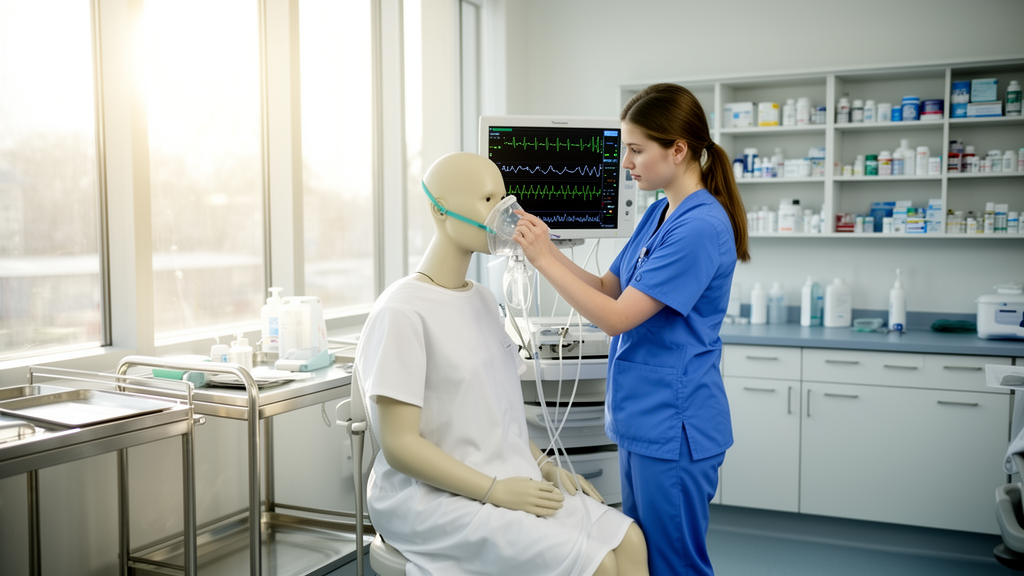
Among the diverse educational modalities deployed across contemporary healthcare training, high-fidelity simulation represents the most sophisticated and technologically immersive format, utilizing life-size, computer-controlled patient mannequins configured to generate dynamic, realistic physiological responses. The educational effectiveness of this simulated clinical environment depends directly upon four distinct dimensions of operational fidelity identified by the investigators: physical fidelity, cognitive fidelity, psychomotor fidelity, and psychological fidelity. Physical fidelity pertains to the anatomical and environmental realism of the diagnostic equipment and hospital setting, while cognitive fidelity mirrors the authenticity of clinical reasoning, diagnostic cue recognition, and deliberative decision pathways required during patient management. Psychomotor fidelity governs the precision and tactile realism of procedural motor skills, whereas psychological fidelity captures the authenticity of the emotional atmosphere, interpersonal communication, teamwork dynamics, and acute stress experienced by practicing clinicians. By harmonizing these four foundational pillars, high-fidelity simulation creates an emotionally authentic yet psychologically safe testing ground where students can practice complex clinical decision-making without endangering actual patient welfare.
To capture how repeated exposure to immersive simulation shapes learner psychology over time, the researchers established a longitudinal cohort design tracking Bachelor of Nursing students across four full academic years from May 2018 through May 2021. Rather than exposing participants to an intensified or cumulative training regimen, the curricular model provided each student with one structured high-fidelity simulation session per academic year, thereby evaluating year-specific intervention responses along an ongoing educational developmental trajectory. The analytical sample comprised 143 students who completed initial Year 1 assessments and participated in at least one subsequent year, drawn from an initial enrollment of 238 first-year students. Demographically, the baseline participant group exhibited a mean age of 20.10 years with a median age of 19 years and an interquartile range spanning 18 to 20 years. Women constituted 89.6 percent of the student sample, while nearly one-quarter of the cohort, representing 24.3 percent of participants, entered the degree program with prior work experience in the professional healthcare sector.
The training intervention occurred entirely within dedicated simulation suites, requiring each cohort member to attend an annual four-hour training session consisting of three distinct clinical scenarios without utilizing standardized human patient actors. In each fifteen-minute scenario, three students actively engaged inside the clinical room, with two learners assuming direct responsibility as practicing nursing students while a third peer portrayed a family member accompanying the mannequin. Non-participating cohort members observed the clinical action via a synchronous video livestream from an adjacent educational observation room. Each active scenario was immediately succeeded by a mandatory forty-five-minute structured group debriefing facilitated by a certified simulator instructor, allowing all students to cycle through the primary nursing role. The instructional scenarios were engineered with progressively advancing cognitive, psychomotor, and metacognitive complexity across the four curriculum years, starting with basic communication cases in Year 1, advancing to family conflict and patient deterioration in Year 2, dynamic acute hypoglycemia and bed-fall crises in Year 3, and advanced emergency defibrillation in Year 4.
Psychological outcomes were evaluated using the Dutch adaptation of the Nursing Anxiety and Self-Confidence with Clinical Decision-Making for High-Fidelity Simulation questionnaire, an instrument based on White’s validated psychometric assessment scale. The questionnaire comprises two separate subscales containing nineteen individual items each, rated on a six-point Likert scale ranging from one, signifying complete disagreement, to six, indicating complete agreement. Prior psychometric evaluation demonstrated exceptional internal consistency for both domains within the target educational population, yielding Cronbach’s alpha values of 0.955 for self-confidence and 0.956 for anxiety. For self-confidence, factorial structures capture gathering information, viewing broader clinical contexts, and executing timely actions; anxiety factors encompass information processing under pressure and active communication. Students completed electronic survey questionnaires through the Qualtrics platform one week prior to their scheduled simulation session and immediately following the structured debriefing. Individual student tracking numbers enabled precise pre-to-post matching and multi-year trajectory mapping while preserving complete participant pseudonymity throughout the data processing procedures.
To accurately evaluate longitudinal changes while managing the nested hierarchical data structure, the investigative team executed linear mixed-effects models using restricted maximum likelihood estimation in Python. The statistical models accommodated repeated observations within individual participants across academic years, incorporating categorical terms for year, time point, and their interaction, while applying random intercepts to control for baseline individual variability. Covariate adjustments accounted for age brackets and prior healthcare employment, with anxiety models additionally controlling for baseline self-confidence levels. Diagnostic testing confirmed that self-confidence data adhered to assumptions of normality and homoscedasticity; however, the anxiety distribution exhibited significant violations through Shapiro-Wilk and Breusch-Pagan assessments, prompting the calculation of robust bootstrapped confidence intervals across one thousand iterations. Net intervention effects were rigorously computed by isolating immediate pre-to-post gains from underlying natural maturation across academic years. Sensitivity analyses conducted exclusively on forty participants who maintained flawless completion across all four years corroborated the stability and directional validity of the primary analytical sample findings.
The statistical modeling demonstrated that high-fidelity simulation induced immediate, significant psychological benefits exclusively during the first academic year of undergraduate study. In Year 1, student self-confidence increased by an adjusted net coefficient of 6.64 points, with a 95 percent confidence interval from 4.17 to 9.12, reflecting a statistically significant standardized effect size of 0.223. Concurrently, Year 1 post-intervention anxiety dropped by 2.90 points, with a bootstrap 95 percent confidence interval spanning minus 5.27 to minus 0.68 and an effect size of minus 0.10. However, in Years 2 through 4, adjusted net intervention effects revealed no statistically significant pre-to-post improvements for either outcome measure. Longitudinal fixed effects revealed a steady, natural curriculum-wide baseline progression, with pre-intervention confidence increasing significantly in Year 2 by 3.96 points, Year 3 by 4.42 points, and Year 4 by 10.77 points, while pre-intervention anxiety naturally declined. Furthermore, students possessing prior healthcare work experience reported significantly lower post-intervention confidence scores, while higher baseline self-confidence consistently served as a powerful negative predictor of learner anxiety.
The authors contextualized these empirical observations through prominent educational theories, primarily Albert Bandura’s social cognitive framework, Patricia Benner’s novice-to-expert trajectory, and David Kolb’s experiential learning cycle. Under Bandura’s social cognitive model, high-fidelity simulation operates as a powerful mastery experience, reinforcing task-specific self-efficacy by providing novice students with a psychologically safe, realistic environment to witness immediate consequences of their clinical decisions. In early training, novelty and moderate emotional arousal maximize engagement, fostering substantial gains in perceived personal competence. However, as students progress along Benner’s continuum from rule-dependent novices to contextual practitioners, the psychological impact of annual mannequin exercises diminishes. The investigators hypothesized that ceiling effects in self-confidence scales, reduced simulation novelty, and habituation to debriefing routines contributed to the observed plateau. Furthermore, advancing learners develop heightened metacognitive awareness and more rigorous internal performance benchmarks, judging their clinical performance with greater scrutiny. Through Kolb’s learning perspective, repetitive annual formats may stall after initial reflection, lacking sufficient cognitive friction to trigger deeper conceptual reorganization.
To contextualize the findings, the researchers highlighted several structural and methodological limitations inherent to the investigation’s empirical design. The single-center implementation at an individual Belgian educational institution inherently limits the universal generalizability of the outcomes across distinct institutional curricula. Additionally, the lack of an unsimulated concurrent control group precludes definitive causal attribution, leaving potential historical confounders unmeasured, while exclusive reliance on self-report questionnaires introduces potential risks of social desirability and testing habituation. Importantly, delivering only a single four-hour simulation session per academic year represents a relatively sparse instructional dosage that may have proven insufficient to alter entrenched developmental trajectories among upper-level nursing students. Consequently, the research team recommended that nursing faculty progressively adapt scenario complexity to match evolving learner competence, incorporate interprofessional exercises and standardized patient interactions, and expand simulation frequency across all curricular stages. Such pedagogical adjustments could maintain necessary cognitive challenge, prevent psychological plateaus, and effectively support decision-making development throughout the entire four-year undergraduate journey.
Subject of Research: Longitudinal effects of high-fidelity simulation on nursing students' clinical decision-making confidence and anxiety
Article Title: Self-confidence and anxiety in clinical decision-making among nursing students during high-fidelity simulation training: a longitudinal study
Article References: Van de Weyer, G., Haegdorens, F., Vleminckx, S., Hilderson, D., & Franck, E. (2026). Self-confidence and anxiety in clinical decision-making among nursing students during high-fidelity simulation training: a longitudinal study. Advances in Simulation, 11(1), Article 50. https://doi.org/10.1186/s41077-026-00445-8
Image Credits: AI Generated
DOI: 10.1186/s41077-026-00445-8
Keywords: high-fidelity simulation, nursing education, clinical decision-making, self-confidence, anxiety reduction, longitudinal study, undergraduate nursing, linear mixed-effects models, simulation training, Bandura self-efficacy, Benner novice-to-expert, Kolb experiential learning, debriefing, mannequin simulation, healthcare education, student nurse competency, psychological fidelity
News Source: Courtney Benton. (November 13, 2026). Simulation Training Enhances Decision Confidence Only for First-Year Nursing Students. Scienmag.