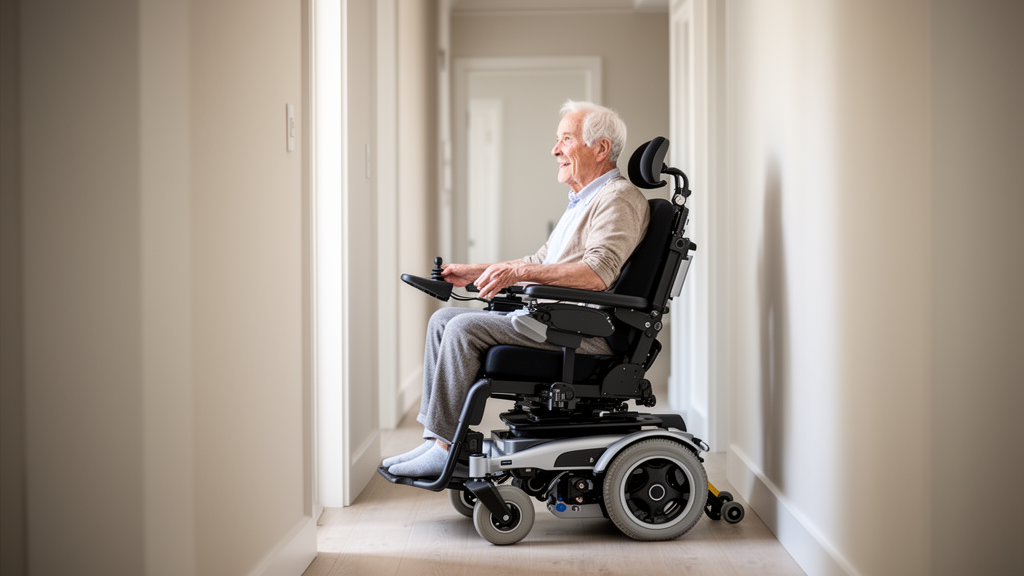
An experimental investigation evaluating the impact of electric activity chairs on daily living tasks reveals that the assistive devices do not produce uniform improvements in occupational performance. Researchers examining first-time adult users in their home environments determined that while specialized seating can ease physical strain during specific actions such as reaching, lifting, and carrying, it simultaneously introduces logistical challenges that can hinder maneuvering and lengthen the time required to complete everyday household routines. The findings emphasize that assistive technology alters the fundamental demands of an activity rather than serving as a simple mechanical substitute for impaired body functions, meaning the overall benefit depends heavily on individual physical capabilities and the layout of the living space.
Assistive technology is currently required by an estimated 2.5 billion individuals globally, with projections anticipating this figure to expand to 3.5 billion by the year 2050. These devices are provided under the premise that supporting daily activities enhances independence, social participation, and overall quality of life. Within occupational therapy, occupational performance denotes the ability to execute meaningful daily activities, while the quality of occupational performance reflects the effort, efficiency, safety, and independence exhibited during those tasks. However, historical research surrounding assistive technology has predominantly focused on body function metrics, such as walking speed, or on usage rates, user satisfaction, and device abandonment. Rigorous investigations directly tracking how assistive equipment changes the quality and execution of real-world activities remain scarce.
To evaluate these operational dynamics under authentic living conditions, investigators conducted a single-case experimental study employing an alternating treatments design across six female participants. Traditional randomized controlled trials often demand homogeneous cohorts, standardized intervention protocols, and rigid clinical settings that do not capture the individualized nature of assistive technology provision or the diverse needs of users. Furthermore, withholding needed assistive equipment from a control group poses significant ethical concerns. In contrast, the alternating treatments single-case framework allowed researchers to gather repeated, high-frequency measurements within the participants’ own homes, enabling each individual to serve as their own control while directly comparing task performance with and without the assistive device.
The study cohort consisted of six women with a mean age of 57 years recruited from four Danish municipalities. All participants had been approved to receive an electric activity chair for the first time, were older than 25 years, resided in standard residential dwellings without formal home care, and possessed varied physical limitations alongside different baseline mobility aids. Four individuals were retired, one was on sick leave, and one worked in subsidized employment. Each user received a VELA Tango 700E electric activity chair equipped with powered height adjustment, seat tilt mechanisms, a central braking lever, and small castors intended to facilitate seated, foot-propelled mobility. An experienced specialist conducted individualized home delivery, setup adjustments, and occupation-based instruction, supplemented by follow-up check-ins at two and nine weeks.
Performance was rigorously evaluated across five dedicated home visits conducted at intervals of one, three, five, nine, and thirteen weeks post-delivery. During each session, participants completed two distinct activities chosen collaboratively with an occupational therapist from standardized options in the Assessment of Motor and Process Skills framework, including meal preparation, cleaning, laundry, and table setting. To eliminate confounding effects from fatigue or procedural familiarity, the order of conditions was randomized for every visit using established sequences. In the intervention condition, participants utilized the activity chair across all feasible stages of the activity. In the control condition, they executed the identical task using their habitual pre-intervention strategies, such as standing, employing conventional dining chairs, utilizing walkers, or requesting informal assistance.
Direct observations were quantified using the Assessment of Motor and Process Skills, a standardized instrument scored by a calibrated occupational therapist to calculate overall motor and process skill levels in logits alongside ratings across 36 discrete performance components. Motor skills evaluate the physical effort, posture, and coordination involved in an activity, while process skills assess organizational efficiency, logical sequencing, and spatial adaptation. These clinical measurements were accompanied by stopwatch recordings of total task duration and a study-specific questionnaire evaluating perceived effort, efficiency, safety, satisfaction, and independence on an 11-point numerical rating scale. Visual pattern analysis was paired with statistical evaluations, including permutation tests on the Average Difference between Successive Observations and paired non-parametric tests on discrete operational actions.
Analysis of standardized observational data revealed no consistent pattern of improvement in overall motor or process skills across the cohort. Only one participant exhibited steady, meaningful gains in motor skill scores when utilizing the activity chair, accompanied by an upward trajectory over successive visits. The remaining five participants showed overlapping scores between the chair and non-chair trials, characterized by marked fluctuations from session to session. For process skills, average scores were consistently lower or demonstrated minimal divergence when using the activity chair across all six participants, though these differences did not reach formal statistical significance. The small observed differences indicated that the mechanical presence of the chair did not inherently streamline the broader organizational flow of household work.
In contrast to the indeterminate aggregate scores, detailed evaluations of specific motor and process components demonstrated statistically significant shifts in how tasks were physically navigated. When seated in the activity chair, participants achieved significantly higher ratings for actions involving bending, reaching, lifting, and transporting objects. Conversely, participants scored significantly higher without the chair during actions requiring positioning, moving, and environmental navigation. Maneuvering the wheeled chair around furniture, aligning it with countertops, and avoiding obstacles proved physically and cognitively cumbersome, frequently causing the chair base or braking mechanism to collide with cupboards and narrow doorframes.
Self-reported outcomes further illustrated the trade-offs between physical relief and operational friction. Four of the six participants consistently reported lower physical effort when executing chores in the activity chair, citing reductions in bodily fatigue, shortness of breath, and clumsiness. However, perceived efficiency and overall satisfaction yielded divergent responses. Several participants registered greater satisfaction and efficiency during unassisted trials, noting that managing the mechanical chair added unwanted complexity. Furthermore, stopwatch measurements showed that five of the six participants took approximately 1 to 2.5 minutes longer to complete activities when using the activity chair, as adjusting seat height, engaging brakes, and maneuvering within tight domestic quarters introduced extra procedural steps into routine chores.
The researchers noted that the findings strongly support a transactional model of assistive technology, wherein therapeutic efficacy is not an intrinsic feature of a device but the product of dynamic interactions among the user, the activity, the equipment, and the surrounding physical environment. While the activity chair successfully reduced mechanical demands during reaching and lifting, it shifted operational burdens onto spatial navigation and task pacing. Additionally, informal reports indicated that municipal provisions were frequently granted via telephone without pre-delivery home evaluations, and two participants eventually returned their chairs after the study concluded.
Methodological dynamics within the experimental protocol also shaped the observed outcomes, particularly regarding task selection and baseline functioning. Because participants were required to complete each designated task twice within a single session, once with the chair and once without, the researchers prioritized safety and avoided excessive physical exhaustion by excluding activities that could not be executed safely under both conditions. This constraint may have restricted overall task difficulty, thereby diminishing the sensitivity required to detect pronounced differences between conditions. Indeed, several participants reported high levels of independence and satisfaction during baseline performance without the chair, demonstrating potential ceiling effects that left minimal headroom for measurable gains. By comparison, the single participant who demonstrated substantial motor improvements had reported notably lower baseline independence and satisfaction without the chair, aligning with previous observations that assistive technologies provide the greatest demonstrable utility when enabling activities that users otherwise struggle to accomplish independently.
The investigators also highlighted trade-offs inherent in the outcome measures and data collection procedures. While the standardized Assessment of Motor and Process Skills is designed to evaluate quality of performance across diverse tasks, allowing participants to choose personally relevant household chores across different visits introduced substantial contextual variation. Fluctuating task demands between sessions likely contributed to within-participant variability and may have obscured gradual performance improvements that typically arise as individuals become more familiar with operating complex equipment over time. Additionally, although the study-specific five-question rating scale provided valuable insight into subjective user experiences, its measurement properties have not undergone formal psychometric validation, leaving open the possibility of response bias, ceiling effects, or social desirability influencing participants’ self-reported satisfaction and effort ratings.
Finally, the authors addressed considerations surrounding generalizability and sample composition. While six participants represents a robust cohort for a single-case experimental design adhering to established quality benchmarks, the exclusively female sample restricts broader applicability. Prior Danish surveys indicate that approximately 20 percent of activity chair recipients are men, a demographic distinction that may impact device utilization and functional outcomes. Furthermore, because different categories of assistive equipment, such as manual wheelchairs, rollators, or shower seats, alter functional demands in fundamentally distinct ways, the findings cannot be extrapolated to all assistive technologies. The researchers emphasized that establishing broader clinical validity will ultimately require systematic replication across more diverse patient cohorts, varied domestic environments, and alternative assistive devices.
Subject of Research: Efficacy of electric activity chairs on occupational performance in home environments
Article Title: Exploring the Efficacy of Assistive Technology on the Quality of Occupational Performance: a Single-Case Experimental Design Study of the Use of the Activity Chair
Article References: Bjørnskov, S., Mortenson, W. B., Petersen, K. S., & Helle, T. (2026). Exploring the Efficacy of Assistive Technology on the Quality of Occupational Performance: a Single-Case Experimental Design Study of the Use of the Activity Chair. Scandinavian Journal of Occupational Therapy, 33(1), Article 14. https://doi.org/10.1007/s44474-026-00014-2
Image Credits: AI Generated
DOI: 10.1007/s44474-026-00014-2
Keywords: assistive technology, activity chair, occupational performance, occupational therapy, single-case experimental design, alternating treatments design, Assessment of Motor and Process Skills, home environment, motor skills, process skills, environmental barriers, task completion time, physical effort, rehabilitation engineering, activities of daily living, assistive devices, clinical ergonomics
News Source: Ophelia Keating. (November 13, 2026). Activity Chairs Ease Physical Effort but Complicate Navigation in Daily Tasks. Scienmag.