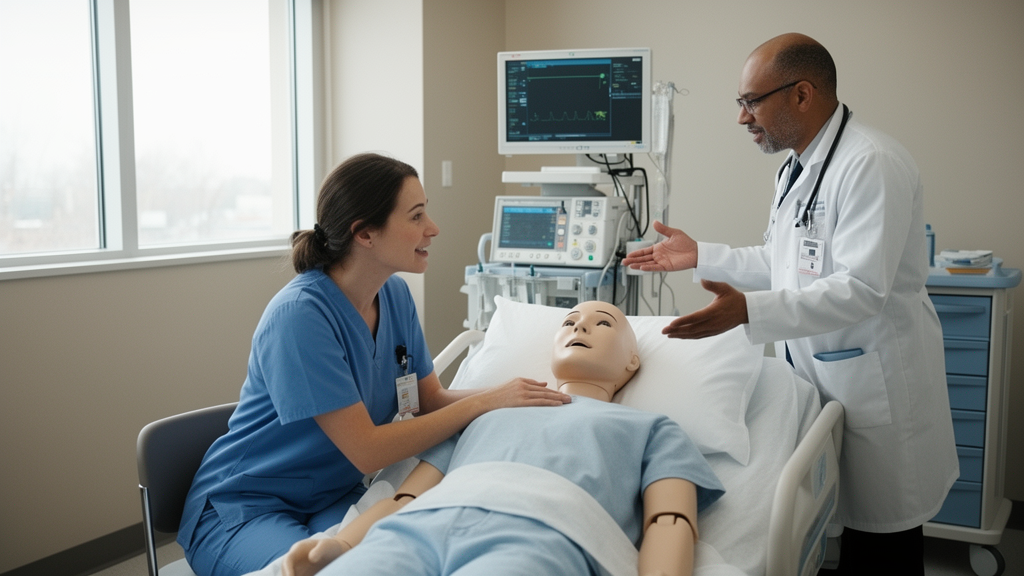
Communication in anesthesiology happens in brief, vulnerable, and technically complex moments around surgery, yet simulation training in the specialty has historically concentrated on crisis management rather than on conversations with patients and families. Researchers now report the development of an AIDET-informed simulation curriculum for third-year anesthesiology residents, designed to make these perioperative conversations observable, rehearsable, and debriefable. The work, published open access in Advances in Simulation on 28 August 2026, presents the program as a practice-oriented strategy with a preliminary local evaluation rather than as definitive evidence of effectiveness.
AIDET stands for acknowledge, introduce, duration, explanation, and thank. In this curriculum it served as an organizing communication frame rather than a script to be memorized. The curriculum was built by a team combining anesthesiology faculty, communication specialists, simulation educators, and role-player trainers. It combined four perioperative scenarios, trained simulated participants, structured observation, and facilitated debriefing, giving residents a structured opportunity to practice and refine difficult conversations before encountering them in clinical practice.
The evaluation used a single-center historical-control design. The 2021 cohort received standard communication teaching in January and February 2024 and completed an objective structured clinical examination, or OSCE, in June 2024. The 2022 cohort instead received the AIDET-informed simulation curriculum in January and February 2025 and completed its OSCE assessment in June 2025. Sixty residents were included in total, with 30 in each cohort.
According to the local evaluation data, the intervention cohort achieved higher simulated communication performance scores and received more favorable ratings from the simulated participants. Residents in the intervention group also reported lower stress and higher confidence in difficult conversations. These outcomes were measured in simulated settings, so they reflect performance in rehearsal conditions rather than observed changes in actual workplace communication with real patients and families.
The authors interpret the findings cautiously, and the design limitations they identify are substantial. Allocation occurred by cohort rather than by randomization, meaning the two groups were separated by training year as well as by the intervention. The evaluation took place at a single center, limiting how far the results can generalize. And because outcomes were assessed in simulations rather than in clinical practice, the study cannot establish that the curriculum changes real-world patient communication.
The article also documents the practical machinery behind the curriculum, including learner flow, role-player preparation, evaluation methods, and implementation lessons. The authors describe boundary conditions and offer the design logic explicitly to support adaptation by other simulation educators, positioning the report as a transferable template rather than a prescription.
The publication appears under Springer Nature’s open access model, and the version shared carries a permanent DOI while noting that it is subject to further edits before the final Version of Record. The article has so far recorded modest early attention, with 75 accesses listed on the publisher’s metrics page.
For simulation educators in anesthesiology and adjacent specialties, the report addresses a recognized gap: the specialty’s simulation tradition has emphasized crisis management, while clinician-patient-family communication during the perioperative period has received less structured training attention. By framing AIDET as an organizing structure rather than a rigid script, and by pairing scenarios with trained simulated participants and facilitated debriefing, the curriculum offers one concrete model for bringing these conversations into the simulation suite.
The authors’ own framing sets the appropriate expectations. The findings come from a preliminary, single-center, historically controlled evaluation with simulated endpoints, and the article explicitly presents the curriculum as a practice-oriented simulation strategy, not as definitive effectiveness evidence. Whether the approach improves communication with actual patients and families in the operating room and perioperative environment remains a question for future evaluation.
Subject of Research: An AIDET-informed simulation curriculum for training anesthesiology residents in perioperative communication, evaluated in a preliminary single-center historical-control study.
Article Title: Advancing perioperative communication training in anesthesiology: an AIDET-informed simulation curriculum with preliminary local evaluation
Article References: Guo, N., Guo, J., Xing, W., Huang, W., Zhang, Z., & Liang, Y. (2026). Advancing perioperative communication training in anesthesiology: an AIDET-informed simulation curriculum with preliminary local evaluation. Advances in Simulation. https://doi.org/10.1186/s41077-026-00482-3
Image Credits: AI Generated
DOI: 10.1186/s41077-026-00482-3
Keywords: anesthesiology, simulation, AIDET, perioperative communication, medical education, residents, OSCE, historical control, debriefing, simulated participants, communication training, Advancing
News Source: Courtney Benton. (October 29, 2026). Simulation Curriculum Uses AIDET Framework to Train Anesthesiology Residents in Patient Communication. Scienmag.