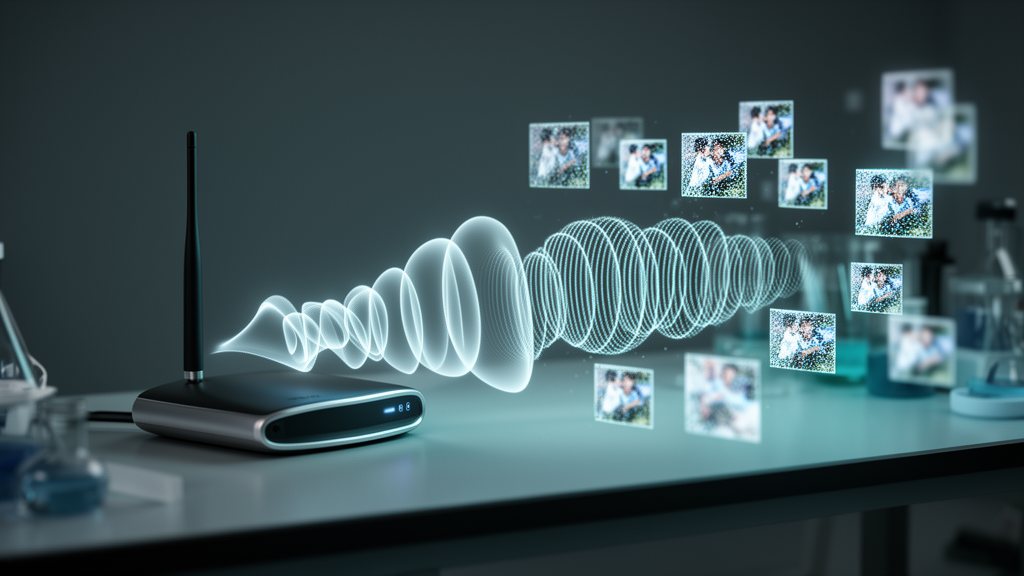
A simulation study of image transmission over simulated wireless channels found that the proposed CLEAR framework outperformed five semantic-communication baselines across additive white Gaussian noise, Rayleigh fading and time-varying channels. CLEAR combines deep joint source–channel coding with an adaptive diffusion denoising model conditioned on receiver-side channel state information, including impulse response, Doppler shift and phase noise.
The experiments, reported in a 2026 research article, used CIFAR-10, CIFAR-100, DIV2K and Kodak24 images. CIFAR-10 supplied 50,000 training and 10,000 test images at 32 by 32 pixels. DIV2K supplied 800 training and 100 test images cropped to 256 by 256 pixels, while the 24 Kodak24 images, measuring 768 by 512 pixels, were used only for evaluation. These were simulation tests rather than trials on a physical wireless network or real-world radio traces.
CLEAR contains a semantic encoder, a simulated channel module, the adaptive diffusion denoising model and a semantic decoder. The encoder converts an image into a compact representation that passes through the channel. At the receiver, the denoising model iteratively estimates and removes noise before the decoder reconstructs the image. The channel model included six multipath components, Doppler shifts, phase noise and additive Gaussian noise, with a carrier frequency of 2.4 GHz.
Unlike methods that adapt mainly to signal-to-noise ratio, CLEAR uses a structured channel embedding derived from estimated impulse-response statistics, Doppler shift and phase-noise level. A lightweight multilayer perceptron converts this information into an embedding, which modulates the denoising network at every diffusion step through feature-wise linear modulation. The reported results used estimated rather than perfect channel state information: a zero-mean Gaussian error with a standard deviation equal to 5% of each parameter’s dynamic range was added to the channel information used during training and evaluation.
All models were trained for 200 epochs with a batch size of 128 and Adam optimization. The learning rate began at 10−4 and was halved every 50 epochs. The diffusion schedule used 50 steps in both training and inference, while training signal-to-noise ratios ranged from 1 to 25 dB and testing covered 0 to 30 dB. Compression ratios of 0.3, 0.5 and 0.6 were evaluated. Experiments were repeated five times with different random seeds, and results were reported as means with standard deviations; the stated statistical comparison used a paired t-test.
Under complex time-varying conditions with a Doppler parameter of 0.5, phase-noise parameter of 0.5 and compression ratio of 0.5, CLEAR achieved the best reported results on all three metrics. On DIV2K, it improved on DeepJSCC-V by 2.31 dB in peak signal-to-noise ratio, 0.041 in structural similarity and 0.041 in learned perceptual image patch similarity. The PSNR difference was reported as statistically significant at p<0.01. CLEAR also led SCAN by 2.05 dB in PSNR on that dataset.
The pattern extended to other image sets. On CIFAR-100, CLEAR recorded 24.12 dB PSNR, 2.19 dB above DeepJSCC-V and 1.94 dB above SCAN. On Kodak24, it reached 27.13 dB PSNR, a 2.32 dB improvement over DeepJSCC-V. Reconstruction quality generally increased with signal-to-noise ratio and fell as Doppler shift and phase-noise levels increased. The authors also observed a temporary performance dip near a test signal-to-noise ratio of 5 dB in some curves and attributed it to mismatch between training and test channel statistics, although they described that mechanism as an interpretation requiring further study.
Ablation results indicated that the diffusion denoiser was more effective than a five-layer residual CNN denoiser of comparable parameter count. With 50 diffusion steps, the adaptive model exceeded the CNN alternative by 1.56 dB PSNR and 0.027 SSIM while using fewer parameters. A 10-step version retained a 0.81 dB advantage and added 1.7 ms of latency. Removing individual channel-information components reduced performance: the reported losses relative to full conditioning were 0.63 dB without Doppler shift, 0.51 dB without phase noise and 0.43 dB without impulse-response statistics.
The principal limitation is the reliance on simulated channel distributions. The study did not evaluate CLEAR on a deployed radio system or real-world channel traces, and its conclusions therefore apply to the tested datasets, compression ratios and modeled impairments. Inference also has a cost: the 50-step version required 12.8 milliseconds on an NVIDIA RTX 3090 for 256-by-256-pixel images, approximately 5.6 times the DeepJSCC-V latency, although this measurement excluded data loading, preprocessing and channel-state estimation. The authors identify testing with software-defined-radio traces, extending the method to audio and video, and reducing latency as future work.
Subject of Research: Simulation testing of a channel-aware semantic communication framework for wireless image reconstruction
Article Title: Channel learning and enhanced adaptive reconstruction for robust image transmission over complex time varying wireless channels
Article References: Pan, H., Zu, T., Wang, L., Wu, S., & He, X. (2026). Channel learning and enhanced adaptive reconstruction for robust image transmission over complex time varying wireless channels. Discover Artificial Intelligence, 6(1), Article 1453. https://doi.org/10.1007/s44163-026-02499-z
Image Credits: AI Generated
DOI: 10.1007/s44163-026-02499-z
Keywords: wireless image transmission, semantic communication, diffusion denoising, deep joint source–channel coding, channel state information, Doppler shift, phase noise, image reconstruction, multipath fading, simulation study, Channel, learning
News Source: Denise Maddox. (October 20, 2026). Simulated wireless-channel tests show CLEAR improves image reconstruction under fading, Doppler shift and phase noise. Scienmag.