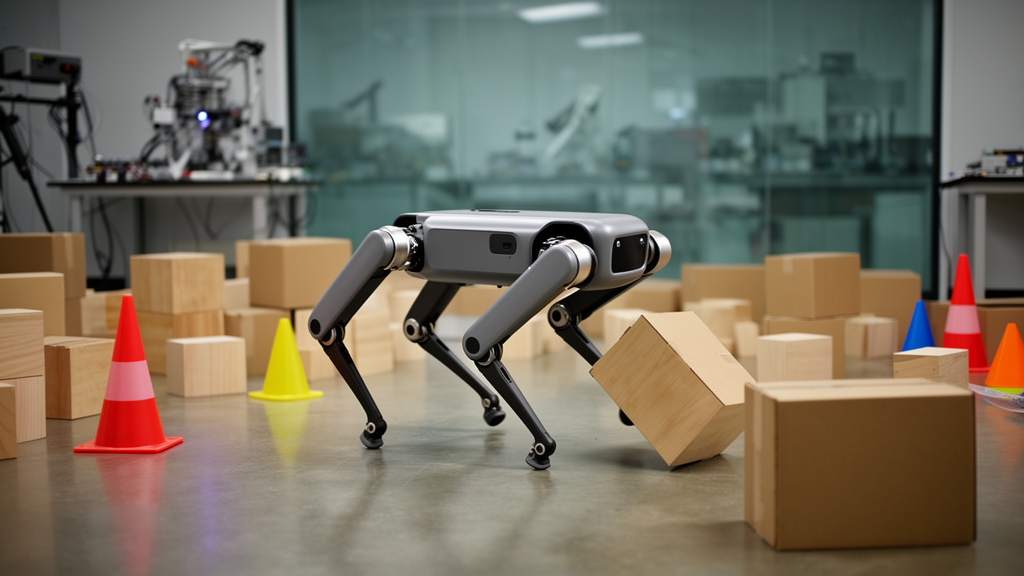
A simulation study of a differential-drive mobile robot navigating a cluttered two-dimensional environment has quantified both the promise and the pitfalls of a hybrid navigation scheme that pairs a classical PID controller with reactive obstacle evasion. The work, published in Frontiers in Control Engineering by Fabian N. Murrieta-Rico of the Universidad Autonoma de Baja California in Mexicali, modeled obstacle detection and avoidance entirely in software, so its findings describe simulated kinematics rather than the performance of a physical robot in the real world.
The architecture rests on a state machine with two operating modes. When proximity threats appear, a 16-ray virtual sensor array triggers a reactive evasion mode. This mode weights directions using inverse-square repulsion, meaning that obstacles registered by closer rays exert disproportionately stronger influence on the steering response, pushing the robot away from danger.
The quantitative evaluation examined the robot’s spatial trajectory, velocity profiles, and clearance margins. On the positive side, the simulated robot completed a 35.13-meter course in 202.6 seconds without any physical collision. It maintained an absolute minimum clearance of 1.00 meter throughout the run, a figure that demonstrates the evasion logic did its core safety job even under pressure.
That safety, however, came at a steep price in efficiency. The ideal safety margin for the system was set at 2.0 meters, and the robot breached it, dipping to the 1.00-meter floor. More strikingly, the average speed fell to just 0.17 meters per second, a crawl that reflects how much time the robot spent maneuvering defensively rather than making progress toward its goal.
The study also documented two characteristic failure modes of purely reactive navigation. In addition, the robot experienced prolonged stagnation in local minima, geometric traps where repulsive forces from surrounding obstacles balance out and leave the robot stuck despite an available route around the blockage.
These results carry a clear message for robotics designers: relying solely on local reactive rules heavily penalizes performance in confined spaces.
The author argues, from a theoretical and geometric standpoint, that future implementations would benefit from coupling the local PID loop with a global predictive path planner.
The scope of the conclusions should be read carefully. This was a simulation study in a 2D environment with static obstacles, and the paper's abstract presents the planner coupling as a suggestion for future work rather than a demonstrated improvement. Nonetheless, by reporting concrete numbers for course time, clearance, speed, and control behavior, the study offers a useful benchmark for anyone weighing the trade-off between the simplicity of reactive obstacle avoidance and the efficiency that global planning can provide.
For the broader field of autonomous navigation, the work illustrates a recurring lesson: integrating discrete avoidance logic with continuous motion control remains a practical challenge, and safety and efficiency often pull in opposite directions. A robot that never crashes but crawls and stalls is only half a solution, and the next step, hybrid architectures with global foresight, is where the study points.
Subject of Research: Simulation of hybrid PID and reactive obstacle avoidance for a differential-drive mobile robot
Article Title: Modeling and simulation of obstacle detection for a mobile robot
Article References: Murrieta-Rico, F. N. (2026). Modeling and simulation of obstacle detection for a mobile robot. Frontiers in Control Engineering, 7, 1928428. https://doi.org/10.3389/fcteg.2026.1928428
Image Credits: AI Generated
DOI: 10.3389/fcteg.2026.1928428
Keywords: mobile robot, obstacle avoidance, PID controller, reactive navigation, simulation, path planning, A*, RRT, local minima, differential drive, autonomous navigation, control engineering
News Source: Denise Maddox. (October 29, 2026). Simulated Robot Navigates Obstacles but Reveals the Cost of Purely Reactive Control. Scienmag.