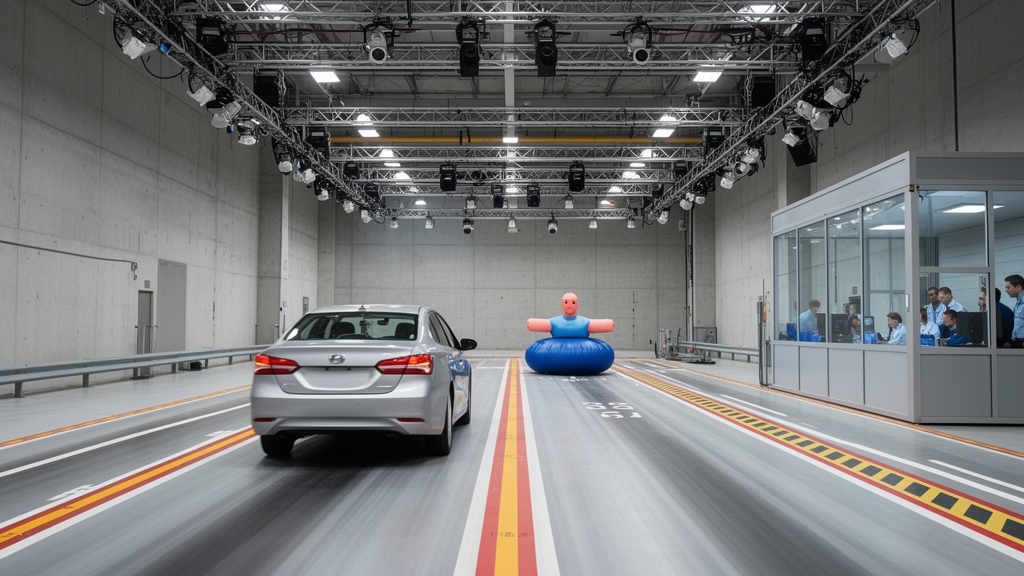
Automated vehicles promise safer highways, but the hardest moments are often the simplest ones: a car ahead braking suddenly, a stationary obstacle appearing in a fast lane, or a traffic jam forming faster than a planner can react. A new open-access study in Autonomous Intelligent Systems tackles exactly those moments, not on real roads but inside a detailed simulation environment, and reports how an adaptive emergency braking (AEB) system performs when the pressure is on.
The paper, authored by Ricardo Ribeiro, Catarina Gonçalves and Nuno Pombo, presents a Matlab Simulink-based test bench designed to evaluate an AEB system across a range of highway conditions. The work adheres to the ISO 8855 standard for vehicle dynamics and coordinate representation, and models the ego vehicle with a three-degrees-of-freedom (3DOF) bicycle model from the Matlab Vehicle Dynamics Blockset, capturing longitudinal displacement, lateral displacement and yaw rotation while remaining computationally efficient.
Three scenario families structure the evaluation, all drawn from the standard AEB ontology: Car-to-Car Rear Moving (CCRm), where all vehicles travel at constant speed; Car-to-Car Rear Stationary (CCRs), where a stationary obstacle blocks the lane; and Car-to-Car Rear Braking (CCRb), where lead vehicles decelerate, sometimes abruptly. Test cases were generated by combinatorial sampling of velocity, initial position and lane assignment, with scenarios run at 18, 20, 22 and 24 metres per second. The study deliberately restricted itself to avoidable collisions, where sufficient time and space exist for corrective action; unavoidable scenarios were excluded, although the system applies a maximum damage mitigation strategy when detection occurs too late for full avoidance.
At the heart of the framework sits a hierarchical control architecture. A path planning module generates collision-free trajectories using a Frenet coordinate system and fifth-order polynomial trajectory generation, recalculating every second and balancing lateral deviation, time and velocity costs. An adaptive Model Predictive Control (AMPC) controller, combining adaptive cruise control and lane-keeping functions, tracks the chosen trajectory and regulates longitudinal and lateral dynamics. Crucially, the AEB subsystem operates independently as a supervisory safety layer, monitoring relative distance, relative velocity and time-to-collision (TTC), and overriding nominal control only when predefined safety thresholds are breached and no safe corrective maneuver remains available within the time horizon.
The braking logic itself is staged rather than binary. A forward collision warning triggers first, calibrated with an assumed driver reaction time of roughly 1.2 seconds, followed by three escalating braking stages: Partial Braking 1 at 5.8 m/s², Partial Braking 2 at 7.3 m/s² and Full Braking at 9.8 m/s². The system computes the time needed to stop at each deceleration level and compares it against TTC, escalating through the stages as risk grows. In extreme cases, such as a vehicle cutting in abruptly, stages can be skipped and full braking engaged directly. After a partial braking event, a Recovery Velocity mechanism gradually restores the ego vehicle’s speed once the situation has eased, handing control back to the MPC only when the selected lane is safe.
The results, aggregated by scenario category and speed, show a consistent pattern. The AEB-equipped model outperformed the non-AEB configuration across all tested scenarios and velocities, achieving a 100 percent collision avoidance rate in low-velocity CCRm and CCRs scenarios. Performance dipped slightly at higher speeds, which the authors attribute to reduced reaction times and more complex vehicle interactions, but the AEB system still maintained superior safety and significantly lower collision rates than the non-AEB baseline. In several high-speed deadlock cases, non-AEB models collided because they could not brake or change lanes in time, while the AEB configuration braked to create opportunities for safe lane changes.
The scenario detail illustrates why the distinction matters. In CCRm1D, a deadlock scenario at 24 m/s, the AEB system braked to avoid collisions and enabled safe lane changes, whereas non-AEB models failed to navigate the situation. In CCRs1C, one variant saw successful avoidance by both configurations, but in another only the AEB system prevented a collision. In CCRb3D, the AEB system prevented a rear-end collision by synchronizing braking with a decelerating lead vehicle, while the non-AEB model’s delayed reaction led to failure. The authors also note a trade-off: because AEB prioritizes proximity risks, the AEB-equipped ego vehicle sometimes progressed more slowly than the non-AEB configuration, which ignored proximity and assumed consistent trajectories of other vehicles.
The framework has honest boundaries, and the authors state them plainly. The reliance on simulation may not capture the complexity and unpredictability of real-world driving. The 3DOF model omits tire dynamics, road irregularities and complex lateral interactions. Predefined scenarios assume controlled vehicle behaviors and structured traffic, limiting representation of heterogeneous drivers, sensor uncertainty, adverse weather and mixed traffic. The evaluation compares only against a non-AEB configuration, without benchmarking against alternative AEB strategies or large-scale statistical robustness analyses. The authors also acknowledge limitations related to real-world unpredictability and computational demands, noting that scenarios requiring rapid decision-making challenged the path planning system’s predictive accuracy when the environment changed abruptly.
Those caveats matter because the findings are simulation results, not road-test evidence. The study used standard Matlab/Simulink components as validated building blocks, and the authors locate their novelty in the design, integration and evaluation of a customized AEB framework combining adaptive control, multi-stage braking, recovery behavior and scenario-based validation, rather than in modified libraries. Within that scope, the work offers a structured, reproducible way to stress-test emergency braking logic against deadlocks, sudden deceleration and dense multi-lane conditions before any hardware is involved.
Future work, the authors write, will address the current limitations through naturalistic driving datasets, broader baseline comparisons and large-scale scenario generation, alongside refining the integration of advanced path planning strategies and predictive algorithms. Key improvement areas include handling unpredictable target vehicle behavior, modeling more complex vehicle dynamics and accounting for varying environmental factors. For now, the study provides a documented framework for evaluating how adaptive braking, path planning and supervisory safety layers interact in simulated highway traffic, a combination the authors describe as insufficiently explored in prior research, particularly in dynamic scenarios involving traffic deadlocks, sudden braking maneuvers and limited lane-change opportunities.
Subject of Research: A Matlab Simulink simulation framework for evaluating an adaptive emergency braking system in highway car-to-car scenarios
Article Title: Adaptive emergency braking for highway safety: a simulation framework for performance and reliability evaluation
Article References: Ribeiro, R., Gonçalves, C., & Pombo, N. (2026). Adaptive emergency braking for highway safety: a simulation framework for performance and reliability evaluation. Autonomous Intelligent Systems, 6(1), Article 19. https://doi.org/10.1007/s43684-026-00140-5
Image Credits: AI Generated
DOI: 10.1007/s43684-026-00140-5
Keywords: automated vehicles, emergency braking, AEB, highway safety, simulation, Matlab Simulink, model predictive control, path planning, collision avoidance, ISO 8855, 3DOF vehicle model, autonomous driving
News Source: Denise Maddox. (October 28, 2026). Simulated highway test bench puts adaptive emergency braking through its paces. Scienmag.