The study, led by Ruixin Liang of The Hong Kong Polytechnic University together with colleagues from several Hong Kong institutions, recruited 17 women aged 40 or older who had undergone mastectomy without breast reconstruction. Participants were drawn from a preliminary questionnaire survey of 113 respondents conducted by the same research team, and those willing to discuss their post-mastectomy experiences in depth were invited to join. The researchers divided the women into three focus groups, interviewing them in Cantonese between January and July 2025. Each session lasted roughly an hour and was co-facilitated by an experienced qualitative researcher and a female research student. To ground the conversation in concrete realities, the moderators brought physical samples: two breast prostheses made of different materials and five sports bras of varying fabrics, strap widths and closure styles, which participants could touch, weigh and examine.
Using thematic analysis, the team distilled the transcripts into four interconnected themes. The first concerned physiological comfort and functional needs, the second psychological and emotional support, the third behavioral adaptation and habit change, and the fourth innovation opportunities and suggestions. Together, the researchers argue, these themes describe a holistic framework in which physical design, mental well-being and everyday behavior are inseparable, and in which a prosthesis and its supporting bra must be understood as a single wearable system rather than two separate medical accessories.
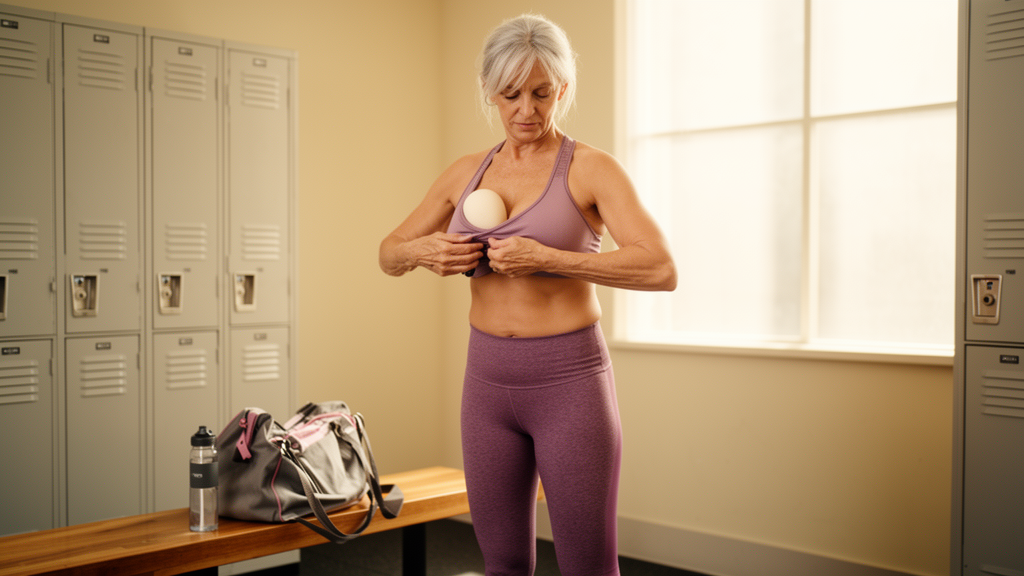
Fifteen of the 17 participants reported that nurses or physicians had advised them to wear an external prosthesis after mastectomy to maintain spinal balance and prevent long-term postural problems such as shoulder drooping or scoliosis. The weight of a silicone prosthesis does provide balance when the body is still, but during movement the prosthesis and bra frequently failed to work together. Commercial mastectomy bras were often not supportive enough to hold the heavy prosthesis firmly against the chest during activity. One participant described how the prosthesis shifted to an unnatural position whenever she raised her arms during yoga, forcing constant readjustment that she found both frustrating and embarrassing in a group setting. Another said she had completely stopped dancing because no bra felt secure enough, and the constant worry about shifting was too distracting.
The non-porous silicone used in most permanent prostheses acts as a thermal insulator, trapping body heat against the chest wall, while the multi-layered fabric pockets built into mastectomy bras add thickness that further restricts airflow. Participants reported sweat accumulation, itching and even skin breakdown, especially among those whose skin had been sensitized by radiation therapy. One woman said that wearing a silicone prosthesis for hours against radiation-darkened skin felt suffocating, like a constant reminder of the surgery. In response, some devised makeshift solutions, tucking soft gauze or small cotton cloths between the prosthesis and the skin to absorb sweat. One participant recounted that a nurse praised her ingenuity when she spotted the improvised barrier during a check-up, but the women widely recognized such adaptations as inadequate substitutes for genuinely breathable, moisture-wicking materials.
Because a prosthesis never changes while a natural breast does, survivors navigating weight fluctuations, hormonal shifts and aging faced a moving target. One participant explained that after gaining a few kilograms following treatment, her natural side became fuller while the prosthetic side stayed exactly the same, creating a noticeable asymmetry. Some women improvised layered solutions, combining ordinary foam padding with silicone pieces that could be added or removed as their bodies changed. The researchers note that these self-directed adaptations underscore the need for adjustable, modular systems that can accommodate the changing bodies of survivors rather than assuming a static postoperative form.
Participants described prostheses and bras as crucial to restoring a sense of normalcy and femininity, but only when the aids remained undetectable to others. Being able to blend in without explanation was repeatedly cited as a source of emotional relief; one woman recalled going out for tea with her mother three weeks into treatment, her mother having no idea she was undergoing therapy. Yet anxiety about exposure was common, particularly with tight-fitting clothing that might reveal the artificial nature of the prosthesis, and this concern narrowed wardrobe choices and eroded confidence in appearance. Exercise, meanwhile, served as a vital emotional outlet: 13 of the 17 participants described it as an important part of rehabilitation, helping them feel supported and reconnect with their bodies. When product limitations made participation difficult, the therapeutic benefits were undermined along with the physical ones.
Those limitations also reshaped behavior. Survivors broke household chores into smaller tasks, avoided lifting heavy objects and steered clear of strenuous exercise, often without professional guidance about which activities were actually safe. Many sought information and encouragement from outside sources, including healthcare professionals, cancer foundations and support groups, family and peers, and retail staff. Foundations such as the Breast Cancer Foundation provided free prostheses, educational sessions and peer sharing, though demand sometimes meant waiting lists. But participants identified a persistent gap in commercial support: sales staff focused on how the prosthesis looked in the mirror rather than how it felt in daily wear, leaving women’s real physical struggles overlooked. One participant summarized the frustration bluntly, saying the salesperson simply offered a mirror and praised how balanced and beautiful the result appeared, without understanding what it truly feels like to live in that body.
From these experiences the participants generated concrete design priorities. For prostheses, they wanted proper fit to support body balance and spinal health, customization for a natural shape, lightweight construction to reduce shifting, and affordable, natural-looking aesthetics. For sports bras, they prioritized secure support, breathability, adjustability and versatile multi-purpose designs, favoring simple styles in neutral colors and front closures over back closures, especially for those with limited range of motion after surgery. On the service side, they called for professionalized fitting delivered by staff trained in breast cancer and post-treatment bodily changes, dressing rooms with space to move so users could test products in motion, and retail display alongside ordinary lingerie rather than in medical-supply corners to normalize the buying experience. Cost remained decisive: ten of the 17 women considered roughly 500 Hong Kong dollars, about 65 US dollars, an acceptable price for a prosthesis, and around 300 Hong Kong dollars, about 39 US dollars, for a bra, and they argued that as medical devices these items should be covered by insurance.
The authors frame their findings through Norman’s Emotional Design framework, organizing survivor needs into visceral, behavioral and reflective levels: appearance and tactile qualities, functional performance during movement, and the deeper psychosocial meaning of the devices. They acknowledge the study’s limitations, noting that as a pilot study its small sample limits generalizability and that no prototypes were developed, so usability could not be assessed. Future work, they suggest, should evaluate prototype prosthesis-bra systems using both user feedback and objective measures enabled by textile-integrated sensing technologies.
Subject of Research: Post-mastectomy supportive wear needs of breast cancer survivors
Article Title: Exploring multidimensional needs of breast cancer survivors for external breast prostheses and sports bras
Article References: Liang, R., Law, D., Zheng, L., Yu, H.-T., Kwong, A., Suen, D., Yuen, L. W., Chan, K. L., Yick, K.-L., & Yip, J. (2026). Exploring multidimensional needs of breast cancer survivors for external breast prostheses and sports bras. Fashion and Textiles, 13(1), Article 38. https://doi.org/10.1186/s40691-026-00485-8
Image Credits: AI Generated
DOI: 10.1186/s40691-026-00485-8
Keywords: breast cancer survivors, external breast prostheses, mastectomy sports bras, thematic analysis, qualitative interviews, Hong Kong, physical activity, thermal comfort, product design, fitting services, body image, lymphedema
News Source: Nathaniel Bowman. (October 28, 2026). Breast Cancer Survivors Say Prostheses and Sports Bras Fail Them When They Move. Scienmag.