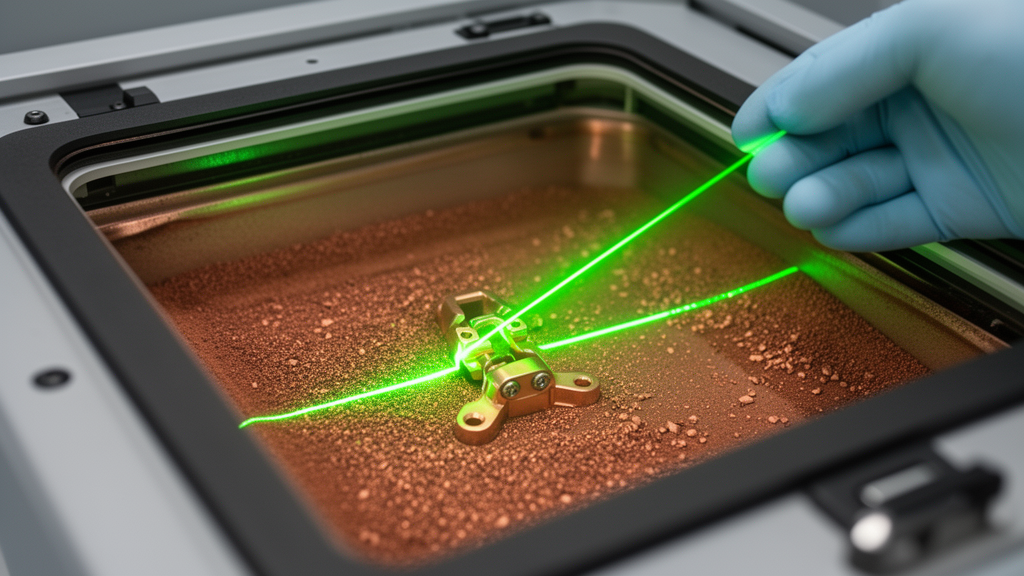
Green laser powder bed fusion can build dense, useful parts from pure copper, one of the most reflective and difficult metals to process with conventional infrared lasers, but a new study reports that the technique’s success depends on something a single energy metric cannot capture. Researchers who printed pure copper blocks with a 535 nm green laser found that different combinations of laser power and scan speed, even when they delivered similar volumetric energy density, produced markedly different defect patterns, densities and performance. The work, published in the Journal of Materials Science, argues that the process should be optimized over an integrated power–scan speed window rather than by a single energy-density criterion.
The team, led by Shengjie Zhou, Qirui Zhang, Liangjie Jin, Xiaopeng Lin, Fengguang Li, Shang Dai and Luhai Liao, fabricated pure copper specimens and systematically varied the pairing of laser power and scan speed. Volumetric energy density, a widely used parameter that combines power, speed, hatch spacing and layer thickness into one number, is often treated as a master variable in laser powder bed fusion. Yet in these experiments, combinations at similar energy density values yielded distinct relative densities and different defect morphologies, indicating that the metric fails to fully capture track continuity and bonding between layers.
The defect types shifted in a systematic way with the processing regime. Low-power conditions promoted irregular lack-of-fusion defects, the kind of voids that arise when melted material fails to fuse completely with neighboring tracks or underlying layers. High-power conditions outside the favorable range instead favored near-spherical pores, while excessive scan speed promoted discontinuities between layers. Each regime leaves a different fingerprint in the solidified metal, and those fingerprints carried through to the mechanical and electrochemical behavior of the finished parts.
Within the parameter space explored, one window stood out. Samples printed at 460 watts of laser power with scan speeds between 550 and 650 millimeters per second showed the best combination of relative density, surface quality, tensile properties and electrochemical response. In that range, the ultimate tensile strength reached 203 to 213 megapascals, elongation reached 38.3 to 42.9 percent, and the strength–ductility product, a measure combining load-bearing capacity with the ability to deform before failure, reached 8.2 to 8.8 gigapascal-percent.
Corrosion behavior was assessed alongside the mechanical testing. In the favorable window, the charge transfer resistance ranged from 1453 to 1651 ohm square centimeters, while the corrosion current density ranged from 5.71 to 8.07 microamperes per square centimeter. These electrochemical values indicate how the printed copper resists corrosive attack in service, a property that depends on the microstructure and defects left behind by the printing process.
To understand why the central condition performed best, the researchers turned to electron backscatter diffraction and transmission electron microscopy on representative samples. The specimen printed at 460 watts and 600 millimeters per second, near the center of the favorable range, showed pronounced dislocation interactions and locally organized dislocation structures. Dislocations are line defects in the crystal lattice that interact with each other during deformation, and their arrangement strongly influences how a metal strengthens and stretches before it breaks.
The study’s central message is a caution against over-reliance on volumetric energy density. Because that number folds power and speed together, it can mask the physical differences between a slow, high-power melt track and a fast, low-power one, even when the arithmetic yields the same value. The experiments show that track stability, interlayer bonding and the resulting defect population depend on the actual pairing of the two parameters, not on their combined energy figure alone.
The findings matter for applications that rely on high-purity copper components, from electrical contacts and heat exchangers to induction coils and other conductive parts where density, strength and corrosion resistance must be achieved together. Green lasers at 535 nm are absorbed far more efficiently by copper than infrared light, which is why the green wavelength has become an effective route for printing this highly reflective metal, and the new results map out where within that route the process window actually lies.
According to the authors, optimizing green laser powder bed fusion of pure copper should proceed through an integrated power–scan speed range that considers defects, dislocation substructures and mechanical–electrochemical responses together, rather than through a single volumetric energy density criterion. The work was published online on 2 September 2026, and the underlying data will be made available on request.
Subject of Research: Power–scan speed matching effects on defects, dislocation substructures and mechanical–corrosion performance in green laser powder bed fusion of pure copper
Article Title: Power–scan speed matching governs defect formation, substructure evolution, and mechanical–corrosion performance in green laser powder bed fusion of pure copper
Article References: Zhou, S., Zhang, Q., Jin, L., Lin, X., Li, F., Dai, S., & Liao, L. (2026). Power–scan speed matching governs defect formation, substructure evolution, and mechanical–corrosion performance in green laser powder bed fusion of pure copper. Journal of Materials Science, 61(41), 32041-32063. https://doi.org/10.1007/s10853-026-13654-3
Image Credits: AI Generated
DOI: 10.1007/s10853-026-13654-3
Keywords: green laser powder bed fusion, pure copper, volumetric energy density, lack-of-fusion defects, dislocation substructures, tensile strength, corrosion current density, charge transfer resistance, EBSD, TEM, 535 nm laser, process optimization
News Source: Denise Maddox. (October 28, 2026). Green laser 3D printing of pure copper hinges on power–speed matching, study finds. Scienmag.