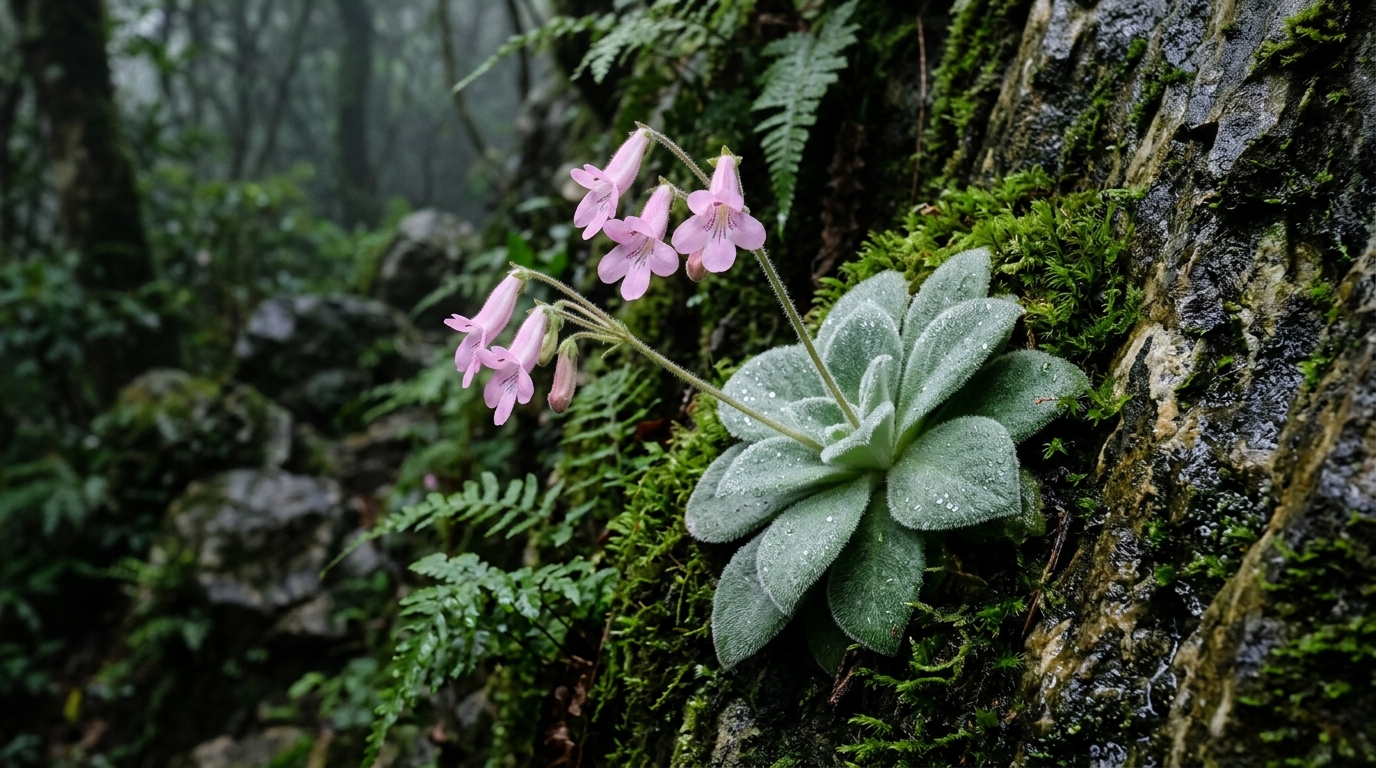
Botanists surveying a forest farm in Zijin County, in China’s Guangdong Province, have described a previously unknown species of flowering plant in the family Gesneriaceae. The plant, now formally named Oreocharis zijinensis, was first noticed in April 2021 during a field survey, when researchers encountered an unfamiliar Gesneriaceae specimen whose leaves were covered with silvery-white hairs. Living plants were brought into cultivation at the Gesneriad Conservation Center of China and the National Gesneriaceae Germplasm Bank, and a return visit to the site in April 2024, when the plants were flowering with pink blossoms, allowed the team to complete the morphological work needed to establish that the species was genuinely new to science.
The confirmation rested on the plant’s reproductive organs. According to the researchers, the species shows two fertile stamens with fused anthers, a capsule that is straight in relation to the pedicel and much longer than the calyx, and a capsule that dehisces loculicidally to the base, with two straight, untwisted valves. That combination of characters placed the plant firmly within Oreocharis, a genus that has become one of the more significant and morphologically diverse groups in the family after being redefined and enlarged in earlier taxonomic work.
Oreocharis in its broad sense comprises approximately 155 species, excluding infraspecific taxa, distributed across the mountainous areas of southern China. The genus has three recognized diversity centers: the Hengduan Mountains and their adjacent areas, the Wuling Mountains and the Nanling Mountains. A small number of species extend southward to the northern edge of the Indochina Peninsula and northward to Japan. The genus has been a productive one for discovery in recent years; in the past three years alone, eight new species of Oreocharis have been documented in China, and the new species from Zijin County adds to that tally.
The formal description is based on plants collected at the type locality in Guzhu Town, Dongjiang Forest Farm, at roughly 118 meters elevation, with the holotype and isotypes deposited in the Herbarium of Guangxi Institute of Botany, Chinese Academy of Sciences. Oreocharis zijinensis is a perennial, rhizomatous herb with leaves arranged in a basal rosette. The leaf blades are elliptic, oblong-ovate to ovate, measuring 3 to 12 centimeters long and 2 to 4 centimeters wide. The upper surface is green and densely covered with silvery-white hairs, while the lower surface is pale green with white villous hairs concentrated especially along the veins. The leaf apex is acute, the base attenuate to cuneate, the blade slightly asymmetric, and the margin coarsely dentate-serrate, with 5 to 10 lateral veins on each side of the midrib.
The flowering architecture is equally distinctive. Each plant produces one to nine axillary inflorescences, each a dichasial cyme carrying one to ten flowers on peduncles 6 to 15 centimeters long. The corolla is pink at the apex and pale purple to white at the base, 12 to 15 millimeters long overall, with a cylindric to narrowly campanulate tube that is slightly enlarged at the mouth and measures 10 to 12 millimeters long and 3 to 5 millimeters in diameter. The limb is distinctly two-lipped, with five equal, triangular semiorbicular lobes that are acute at the apex. The two stamens are about 10 millimeters long, and the three staminodes are nearly equal, linear structures of roughly 6.0 millimeters. The pistil is 1.4 to 1.6 centimeters long, and the capsules are linear, pubescent, and 2 to 3 centimeters long. Flowering occurs from March to April, with fruiting from May to June.
To test whether the plant was truly distinct, the team compared it in detail with its closest morphological relative, Oreocharis acaulis. The two species share corolla shape and color and the same number of staminodes, but they diverge in a suite of characters. O. zijinensis has larger leaf blades, 3 to 12 by 2 to 4 centimeters against 1.7 to 7 by 1.1 to 3 centimeters in O. acaulis, with a different blade shape, a silvery-white upper indumentum and white villous lower surface rather than the brownish puberulent surfaces of its relative, and more lateral veins, 5 to 10 versus 4 to 5. The corolla tube of the new species is cylindric to narrowly campanulate and slightly swollen at the mouth, whereas the tube of O. acaulis is strongly laterally compressed and not swollen. The new species’ corolla is longer, 12 to 15 millimeters against 7 to 10, its stamens are about 10 millimeters long against roughly 3.7, and its three nearly equal staminodes of about 6.0 millimeters contrast with the unequal staminodes of O. acaulis, in which the adaxial one measures about 2.0 millimeters and the abaxial ones about 3.2.
Molecular evidence was brought to bear as well. The researchers sampled 61 species of Oreocharis, represented by 62 samples with the new species included through two accessions, and added outgroup taxa to reconstruct the genus-wide phylogeny. Leaf samples collected from the place of origin were dried in silica gel for DNA extraction, and two DNA regions, the internal transcribed spacer region known as ITS and the chloroplast trnL-F region, were sequenced and aligned. The combined data matrix contained 1518 characters, of which 490 were parsimony informative and 796 variable. Substitution saturation testing showed no significant saturation, and the dataset was partitioned with models selected under the Akaike information criterion corrected for small sample sizes.
Phylogenies were inferred with both maximum likelihood, using 1,000 bootstrap replicates, and Bayesian inference, run as two independent analyses of four chains for 10 million generations each. The resulting trees showed congruent topologies, and both methods placed the new species in the same position: the two specimens of O. zijinensis cluster together and are recovered as sister to Oreocharis acaulis and Oreocharis dinghushanensis, with strong support, a Bayesian posterior probability of 1.00 and a bootstrap value of 85 percent. The 62 samples of Oreocharis together form a monophyletic clade, and the placement of the new species within that clade, combined with the morphological differences, supports its recognition as a distinct species.
The species is so far known only from its type locality. It is endemic to Zijin County in central Guangdong Province, where it grows on moist rock walls on both sides of streams under subtropical evergreen broad-leaved forests at an altitude of approximately 118 meters. Only one population has been confirmed, comprising about 800 mature individuals restricted to an area of 0.4 square kilometers. The distribution area lies within a protected area and is covered by local protection policies, but the population has shrunk slightly following drought in 2022. Applying the IUCN Red List Categories and Criteria, the authors provisionally assess the species as Vulnerable, a designation that reflects both its extremely restricted range and the demonstrated vulnerability of its single population to climatic stress.
The species epithet zijinensis refers to Zijin County, the locality where the plant was found, and the Chinese name is Zǐ Jīn Mǎ Líng Jù Tái. Beyond its taxonomic interest, the discovery underscores how much diversity remains undocumented even within well-studied genera in southern China’s mountainous regions, and how field surveys combined with herbarium comparison and molecular phylogenetics can resolve the status of a single unusual population. For Oreocharis, a genus whose diversity centers lie in the Hengduan, Wuling and Nanling mountains, a new species from the low-elevation streamside rocks of central Guangdong broadens the known geographic and ecological spread of the group and highlights the conservation value of the subtropical evergreen broad-leaved forest fragments that harbor such narrow endemics.
Subject of Research: Description of a new Gesneriaceae plant species, Oreocharis zijinensis, from Guangdong, China
Article Title: Oreocharis zijinensis ( Gesneriaceae ), a new species from Guangdong, China
Article References: Zhu, G.-L., Xiong, C., Xu, Y.-C., Tan, J.-J., Xin, Z.-B., Qian, X.-M., Tan, K., Wen, F., & Bai, X.-X. (2026). Oreocharis zijinensis (Gesneriaceae), a new species from Guangdong, China. PhytoKeys, 281, 77-88. https://doi.org/10.3897/phytokeys.281.204573
Image Credits: AI Generated
DOI: 10.3897/phytokeys.281.204573
Keywords: Oreocharis zijinensis, Gesneriaceae, new species, Guangdong, China, taxonomy, phylogenetics, morphology, conservation, Vulnerable, endemic plant, Zijin County
News Source: Drew Townsend. (November 6, 2026). Silvery-leaved pink flower joins Gesneriaceae as new species from Guangdong. Scienmag.