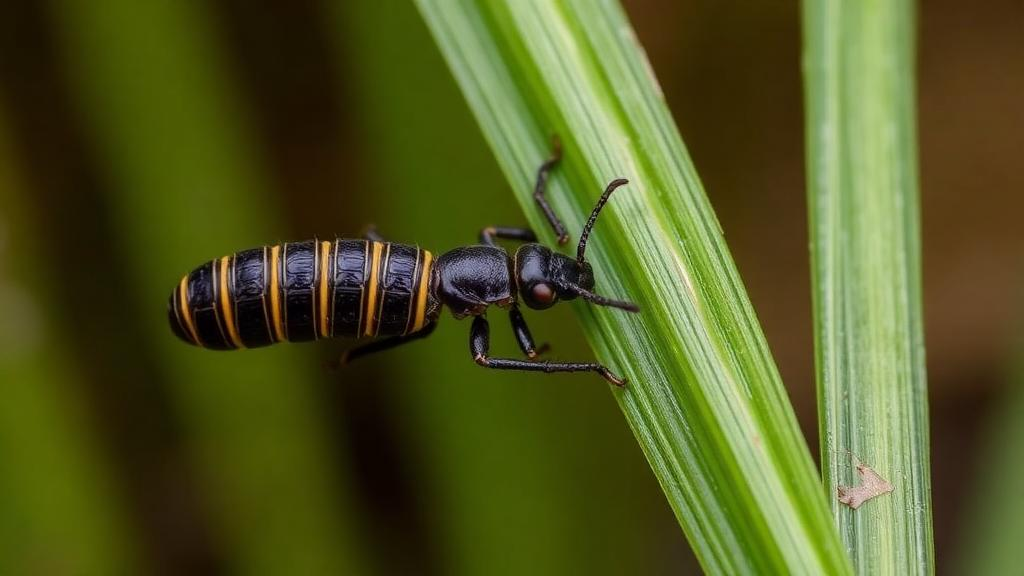
Silicon, the second most abundant element in Earth’s crust, has long been regarded as a quiet workhorse of plant biology. Rice, one of the world’s staple crops, can draw so much of it from the soil that silicon makes up as much as ten percent of the plant’s dry matter. A new study published in the journal Plant and Soil has now traced, at the level of individual genes, exactly how this humble element helps rice fend off one of the most destructive invasive insects on the planet: the fall armyworm, Spodoptera frugiperda. The findings suggest that silicon does far more than simply toughen leaves. It orchestrates a coordinated transcriptional program that allows plants to defend themselves while still finding the resources to grow.
The research team, led by Jyoti Sharma and Michael J. Stout of Louisiana State University Agricultural Center, together with colleagues at Oregon State University and the United States Department of Agriculture, took an unusual approach. Rather than simply adding silicon fertilizer to rice fields, they used a set of rice mutant lines that differ naturally in their ability to take up silicon from the soil. These lines, generated by chemical mutagenesis of the reference variety Nipponbare, carry mutations in OsLsi1, the gene encoding the first silicon influx transporter ever identified in rice roots. By comparing a severely silicon-deficient line, an intermediate line, and lines with near-normal silicon accumulation, the researchers could isolate the effects of the element itself rather than of external supplementation.
The biochemical measurements confirmed that the mutations had the intended effect. The wild-type plants and one mutant line accumulated silicon at roughly 3.5 percent of leaf dry weight, the intermediate mutant reached about 1.9 percent, and the severely deficient line managed only 0.04 percent, a mere five percent of the wild-type level. That difference translated directly into plant performance. Silicon-rich lines produced substantially greater shoot biomass, and when fall armyworm caterpillars were allowed to feed on them for a week, the high-silicon plants lost far less tissue. Most strikingly, two weeks after the attack, the silicon-rich plants had completely compensated for the damage, regrowing to the biomass of uninjured controls, while the silicon-deficient line showed essentially no recovery at all.
The insects noticed the difference too. Fall armyworm larvae reared from hatching to pupation on the low-silicon line gained significantly more weight, developed faster, and emerged as heavier pupae than larvae fed on any of the higher-silicon lines. Short-term feeding assays on excised leaves pointed to the same conclusion: larvae on silicon-poor foliage consumed more food and grew faster, while their digestive efficiency remained unchanged. This detail matters, because it indicates that silicon does not poison the insect’s gut chemistry. Instead, it appears to act as a physical and structural barrier that makes leaves harder and less palatable, reducing how much the caterpillars can eat in the first place.
Perhaps the most surprising result concerned what silicon did not do. The researchers measured the activities of peroxidase, polyphenol oxidase, and trypsin protease inhibitors, three classic defense proteins implicated in rice resistance, as well as the defense hormones jasmonic acid and salicylic acid. Silicon content had no effect on any of these, either before or after herbivore attack. In fact, the low-silicon plants showed higher peroxidase activity and more sustained enzyme induction after injury, suggesting they were mounting a compensatory biochemical defense to make up for what they lacked structurally. Volatile emissions, the chemical signals plants release to attract the natural enemies of herbivores, told a similar story: total emission surged after caterpillar feeding in all lines, but silicon content did not change the strength of that response.
To understand what was happening beneath these biochemical measurements, the team turned to transcriptomics, sequencing the RNA of all four rice lines both before and after fall armyworm feeding. The results were dramatic. When injured plants were compared with uninjured plants of the same genotype, the two high-silicon lines activated roughly 2,700 to 2,800 differentially expressed genes, while the two low-silicon lines mounted a response about forty percent weaker. In other words, silicon-deficient plants were transcriptionally less equipped to respond to attack. Gene ontology analysis revealed a consistent pattern: the low-silicon lines upregulated stress and chemical defense pathways, including phenylpropanoid metabolism and jasmonate signaling, while suppressing genes for growth, photosynthesis, and cell wall construction.
This pattern reflects one of the central tensions in plant biology, the well-known trade-off between growth and defense. Plants cannot maximize both simultaneously, because the resources spent on defensive chemistry are unavailable for building new tissue. The study suggests that silicon changes the economics of this trade-off. Silica deposited in tissues as phytoliths provides a cheap, mineral-based physical defense that does not compete with growth for carbon and nitrogen. Silicon-deficient plants, lacking this low-cost armor, are forced to divert scarce resources into carbon-intensive alternatives such as lignin, which the researchers observed through elevated expression of the lignin biosynthesis gene OsCCR20. The result is a plant that invests heavily in defense yet still ends up vulnerable, because the biochemical defenses it activates are not enough to stop a determined caterpillar.
By integrating whole-genome sequencing with the expression data, the team also identified candidate genes that may underpin silicon-mediated resistance. Genes including the transcription factor OsbHLH024, the silicon transporter OsLsi1 itself, the DNA repair gene OsMSH3, the chloroplast division gene OsARC5, the cytokinin oxidase OsCKX2, and the light-regulated factor OsBBX3 all carried coding mutations and showed altered expression in the susceptible low-silicon line. Quantitative PCR confirmed the sequencing results for most of the genes tested. These candidates offer breeders a molecular toolkit for developing rice varieties that accumulate silicon more efficiently, potentially reducing reliance on insecticides against a pest that has swept across Africa and Asia in recent years and devastates maize, rice, sorghum, and cotton.
The authors propose a conceptual model that captures the full picture. When silicon levels are adequate, rice plants can mount effective constitutive defenses through silica-reinforced tissues while retaining the capacity for compensatory regrowth after damage, achieving a genuine balance between defense and development. When silicon is lacking, plants shift resources toward chemical defense at the expense of growth, yet the defense remains ineffective because the mechanical barrier is absent. The intermediate line in the study was particularly instructive: it achieved fall armyworm resistance similar to the wild type, suggesting that only a threshold amount of silicon is needed for protection, but it paid for that resistance with reduced growth. Only plants with full silicon accumulation managed to have both.
For agriculture, the implications are considerable. Silicon is not classified as an essential plant nutrient, yet this study reinforces a growing body of evidence that it functions as something close to one for grasses, shaping everything from tissue mechanics to gene expression. Silicon fertilization is already practiced in some rice-growing regions, and the new work provides a mechanistic rationale for those practices while pointing toward genetic solutions that could make silicon-rich rice varieties a reality. As the fall armyworm continues its global expansion and pesticide costs climb for smallholder farmers, an element as ordinary as sand may prove to be one of the most powerful tools in the fight to protect the world’s rice harvest.
Subject of Research: Silicon-mediated resistance to the fall armyworm in rice through transcriptional reprogramming of growth and defense
Article Title: Silicon-mediated resistance to Spodoptera frugiperda in rice modulates growth and defense processes via transcriptional reprogramming
Article References: Sharma, J., Chaudhary, C. K., Pruthi, R., Kondi, R. K. R., Gaffke, A., Subudhi, P. K., Tai, T. H., & Stout, M. J. (2026). Silicon-mediated resistance to Spodoptera frugiperda in rice modulates growth and defense processes via transcriptional reprogramming. Plant and Soil. https://doi.org/10.1007/s11104-026-09012-6
Image Credits: AI Generated
DOI: 10.1007/s11104-026-09012-6
Keywords: silicon, rice, fall armyworm, Spodoptera frugiperda, plant defense, transcriptomics, OsLsi1, growth-defense trade-off, phytoliths, jasmonic acid, plant breeding, pest resistance
News Source: Alan Morgan. (October 13, 2026). Silicon Gives Rice a Hidden Edge Against the Fall Armyworm, Study Finds. Scienmag.