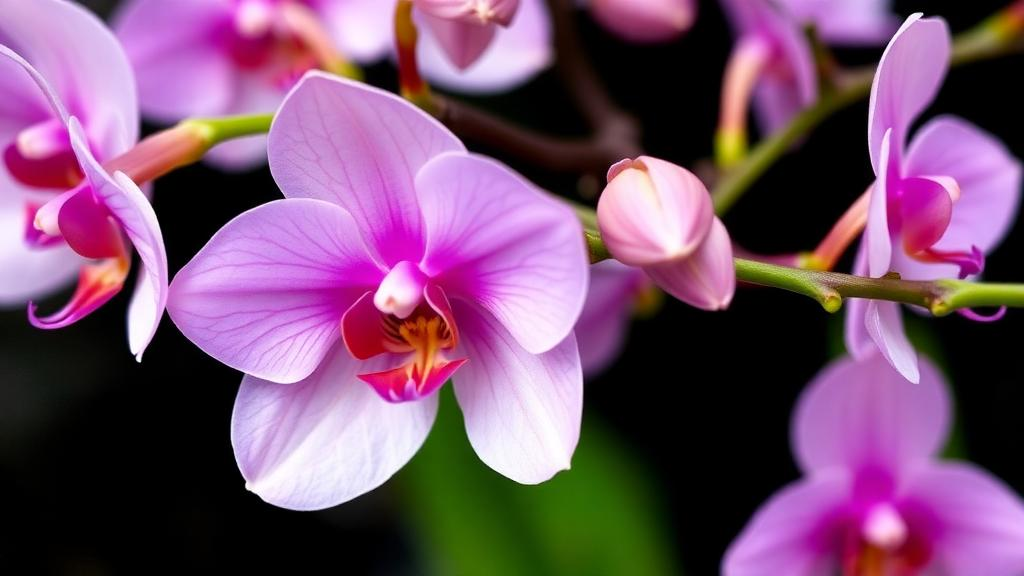
A prized medicinal orchid has just surrendered one of its best-kept secrets. In a sweeping genome-wide analysis published in BMC Plant Biology, researchers in China have catalogued the complete cytochrome P450 enzyme superfamily of Dendrobium nobile, the orchid species behind the traditional Chinese medicine known as Shihu. The team identified 242 P450 genes, organized them into 39 families across nine evolutionary clans, and linked a striking cluster of them to the production of picrotoxane-type sesquiterpene alkaloids, bioactive compounds with documented pharmacological interest. The work, led by Jianling Wang and Chunli Luo of Guizhou University together with colleagues, also reveals how these genes respond to drought, temperature swings, and the plant hormone methyl jasmonate, offering a molecular roadmap for anyone hoping to breed or engineer orchids with richer chemical profiles.
Cytochrome P450s are often described as the chemistry set of the plant world. These heme-containing enzymes catalyze an extraordinary range of oxidation reactions, decorating simple carbon skeletons with hydroxyl groups and other modifications that transform them into hormones, pigments, fragrances, and defensive toxins. In humans, P450s are famous for metabolizing drugs; in plants, they are the architects of specialized metabolism, the vast chemical repertoire that helps a rooted organism attract pollinators, deter herbivores, and cope with a hostile environment. Because a single P450 can redirect an entire biosynthetic pathway, knowing exactly which P450 genes a species carries, and where they sit in the genome, is a powerful starting point for understanding and eventually manipulating its chemistry.
Dendrobium nobile makes an especially compelling target. As one of the most valued species in traditional Chinese medicine, it accumulates a suite of alkaloids and sesquiterpenes whose biosynthesis has remained largely unmapped at the genetic level. Picrotoxane-type sesquiterpene alkaloids, in particular, share structural themes with picrotoxin, a compound long used in neuroscience research to block inhibitory receptors. Yet the enzymatic steps that assemble these molecules in the orchid, and the genes that perform the late-stage oxidation chemistry, have been almost entirely unknown. The new study set out to close that gap by treating the entire P450 superfamily as a searchable inventory rather than chasing individual enzymes one at a time.
The scale of the inventory is itself notable. Using the published D. nobile genome, the researchers systematically scanned for P450 sequences and confirmed 242 functional genes, which they named DnCYPs according to standard nomenclature. Phylogenetic analysis sorted these proteins into 39 families distributed across the nine major clans that define the plant P450 landscape, from the sprawling CYP71 clan, which specializes in defensive and aromatic compounds, to the CYP86 and CYP97 clans involved in cuticle lipids and carotenoid metabolism. Motif analysis and gene-structure comparisons showed the expected conserved architecture, including the oxygen-binding pocket and heme-binding signature that define the family, while chromosomal mapping revealed that the genes are not scattered randomly across the orchid’s chromosomes but cluster in hotspots shaped by duplication.
Those duplication patterns tell an evolutionary story. The team documented tandem duplication events, in which a gene is copied side by side with its original, in several families, most prominently CYP71, CYP72, CYP76, CYP81, CYP92, and CYP704. Tandem duplicates are evolutionarily significant because they can diverge rapidly, with one copy retaining the ancestral function while the other drifts toward a new substrate or expression pattern. In plants known for chemical novelty, this process is a classic engine of metabolic innovation. The finding suggests that D. nobile’s capacity to synthesize unusual alkaloids may rest, in part, on repeated local expansions of its P450 arsenal during the orchid lineage’s history.
One discovery stands out as a genuine orchid-specific signature. Among all the species the researchers compared, genes of the CYP71K subfamily were detected only in orchids, and D. nobile carried more of them than the other Dendrobium species analyzed. This lineage-restricted expansion hints that CYP71K enzymes may underpin chemical traits unique to the orchid family, possibly including the alkaloid chemistry for which Dendrobium is prized. Subfamily-level specificity of this kind is exactly the kind of clue metabolic biologists look for when hunting for the enzymes responsible for a plant’s most distinctive molecules, because a gene family present only in the species that makes the compound is a natural suspect.
The strongest leads came from combining genome position with expression data. Five genes, DnCYP71K30, DnCYP71K32, DnCYP71K33, DnCYP71K34, and DnCYP71B1, all reside on chromosome 15, and their transcript levels across different tissues rose and fell in step with upstream genes of the picrotoxane-type sesquiterpene alkaloid pathway, including DnHMGR, a key enzyme of the mevalonate pathway that supplies the building blocks for sesquiterpenes, and various DnTPS terpene synthases that assemble the carbon skeletons. Coordinated expression is not proof of function, but it is a powerful filter: enzymes acting in the same biosynthetic route are typically switched on together in the tissues where the compound accumulates. The researchers also measured picrotoxane-type sesquiterpenoid alkaloid content in stems and flowers, anchoring the expression patterns to actual chemistry.
Stress added a second dimension to the story. RNA sequencing under four treatments, methyl jasmonate application, drought, low temperature, and high temperature, identified a subset of DnCYP genes whose transcript abundance shifted in response to these challenges. Scanning the DNA sequences upstream of these genes, the team found putative stress-responsive cis-regulatory elements, the short motifs that transcription factors recognize to dial gene expression up or down under environmental pressure. For selected genes, quantitative reverse-transcription PCR confirmed the direction of the expression changes seen in the RNA-seq data, a standard validation step that strengthens confidence in the sequencing results. Together, these findings suggest that some of the same enzymes that build medicinal compounds may also participate in the orchid’s response to a changing environment, a dual role increasingly recognized in plant specialized metabolism.
The practical implications reach from the greenhouse to the laboratory bench. For breeders and growers in Guizhou and beyond, the study provides candidate markers that could eventually be used to select orchid lines with higher alkaloid content or improved stress tolerance, both traits of direct economic value in a crop whose quality is judged by its chemistry. For synthetic biologists, the chromosome 15 cluster and the orchid-specific CYP71K expansion offer a shortlist of enzymes to test for roles in assembling picrotoxane-type scaffolds, work that could one day enable production of these molecules in engineered microbes or plant hosts. The authors are careful to note the essential caveat: every candidate identified here is a hypothesis. Biochemical function must be confirmed directly, through heterologous expression and enzyme assays or gene editing, before any of the 242 DnCYPs can be assigned a definitive role.
Even so, the study illustrates how a systematic, family-wide approach can transform an obscure biosynthetic puzzle into a tractable research program. Rather than waiting for chemists to isolate an enzyme from orchid stems, the Guizhou team inverted the process, using the genome to nominate suspects and expression patterns to rank them. As genome sequences accumulate for other medicinal plants, this strategy, catalogue the enzyme superfamily, map the duplications, correlate expression with chemistry, and stress-test the candidates, is likely to become the standard playbook. For Dendrobium nobile, an orchid that has been prized for two thousand years, the genetic instructions for its most valuable chemistry are finally coming into focus, one P450 at a time.
Subject of Research: Cytochrome P450 gene family evolution and specialized metabolism in the medicinal orchid Dendrobium nobile
Article Title: Genome-wide characterization of the cytochrome P450 superfamily reveals candidate genes associated with specialized metabolism and abiotic stress responses in Dendrobium nobile
Article References: Genome-wide characterization of the cytochrome P450 superfamily reveals candidate genes associated with specialized metabolism and abiotic stress responses in Dendrobium nobile. (n.d.). https://doi.org/10.1186/s12870-026-10026-6
Image Credits: AI Generated
DOI: 10.1186/s12870-026-10026-6
Keywords: Dendrobium nobile, cytochrome P450, specialized metabolism, sesquiterpene alkaloids, picrotoxane, abiotic stress, gene duplication, orchid genomics, methyl jasmonate, terpene synthase, gene expression, plant biotechnology
News Source: Juliet Wilcox. (October 13, 2026). Orchid Genome Study Uncovers 242 Enzyme Genes Behind Medicinal Compounds and Stress Survival. Scienmag.