Waveguide design lets silicon compete with glass in frequency comb generation
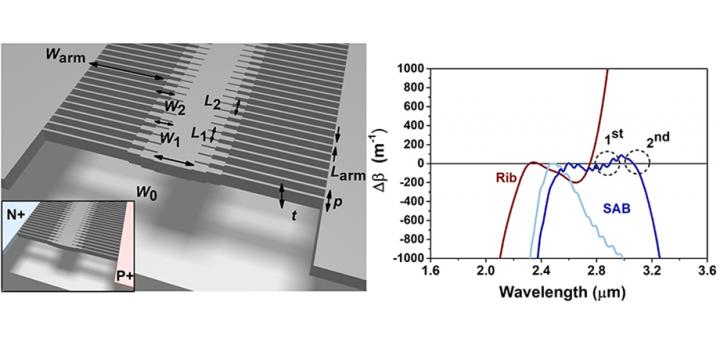
Credit: Zhang et al.
Frequency combs are becoming one of the great enabling technologies of the 21st century. High-precision atomic clocks, and high-precision spectroscopy are just two technologies that have benefited from the development of highly precise frequency combs. However, the original frequency comb sources required a room full of equipment. And it turns out that if you suggest that a room full of delicate equipment is perfect for a commercial application, the development engineer makes a beeline for the nearest exit.
These disadvantages would be solved by making chip-based devices that are actually robust enough to withstand the rigors of everyday use. To do that, scientists have to balance material properties with the behavior of light in a waveguide. This balance is easier to engineer in glass, while for applications and integration with existing devices, it would be better to use silicon.
It is difficult to make very wide frequency combs from silicon waveguides, but clever waveguide engineering may be about to make that task a bit easier. Zhang and colleagues, reporting in Advanced Photonics, have shown a way to make a graded index waveguide that allows the width of a frequency comb to be more than doubled (compared to a normal waveguide).
Peak alignment for a broader comb?
A frequency comb is a light spectrum that consists of many very sharply defined frequencies that are equally spaced. A power spectrum looks rather like a comb, hence the name.
Frequency comb generation is a delicate balance between the material properties that allow light to generate new colors of light (referred to as the optical nonlinearity), the configuration of the path the light follows (the optical resonator), and the dispersion (how the speed of light varies with wavelength in the material). The last item, dispersion, is usually the killer, and this is where the work of Zhang and colleagues focuses. To generate a very broad frequency comb, the colors that make up the comb must all stay in phase with each other. Put concretely: if two waves at one point have their peaks lined up, then at some point further along in space and time, those peaks should still line up. But, ordinarily, this never happens, and the peaks slip past each other, preventing any new frequencies from being generated.
Engineering to the rescue
To compensate for the material dispersion, researchers often turn to waveguide engineering. Since waveguides are made of materials, they have dispersion, and the confinement of the waveguide itself introduces another type of dispersion. This dispersion depends on the shape of the waveguide, the dimensions, as well as the materials that are used. This allows engineers to counter material dispersion through their waveguide design.
But, this is tough work in silicon. The silicon core has a large refractive index compared to the glass cladding. The large difference between the two creates a strong dispersion that overcompensates for the material dispersion.
The insight of Zhang and colleagues is that the interface between the glass cladding and the silicon core doesn’t have to be sharp. They have designed a waveguide that has a silicon core with a fishbone structure that extends outwards into the glass cladding. The effective refractive index in the mixed region is the average of the glass and silicon, which gradually transitions from silicon to glass: a graded index waveguide.
In the graded index, red colors spread out to occupy a wider area of waveguide, while bluer colors are more tightly confined. The net effect is that the different wavelengths behave as if they are traveling in different width waveguides, while they are actually traveling together in the same waveguide. The researchers refer to this effect as a self-adaptive boundary. They explored different configurations for the fishbone structure. Each configuration increased the wavelength range over which the dispersion was small.
To confirm that their graded index waveguides would result in better frequency combs, the team modeled frequency comb generation in standard and graded index waveguides. They showed that the frequency spectrum was extended from about 20 THz to about 44 THz.
Turn on the light
So far the researchers have only calculated and modeled their structures. However, the proposed structures have all been chosen with fabrication in mind, so once they get their bunny suits, test devices should be on their way. Then silicon frequency combs can really strut their stuff. A good example: silicon is transparent over a broad range of the infrared, which is also the wavelength range needed for spectroscopic identification of molecules. A chip-based frequency comb will enable high precision and high sensitivity compact spectrometers.
Read the original article in the peer reviewed, open access journal Advanced Photonics: J. Zhang et al., Adv. Photonics 2(4), 046001 (2020), doi 10.1117/1.AP.2.4.046001.
###
Media Contact
Daneet Steffens
[email protected]
Original Source
https:/
Related Journal Article
http://dx.