• HOME
  • NEWS
  • EXPLORE
    • CAREER
      • Companies
      • Jobs
    • EVENTS
    • iGEM
      • News
      • Team
    • PHOTOS
    • VIDEO
    • WIKI
  • BLOG
  • COMMUNITY
    • FACEBOOK
    • INSTAGRAM
    • TWITTER
Sunday, June 14, 2026
BIOENGINEER.ORG
No Result
View All Result
  • Login
  • HOME
  • NEWS
  • EXPLORE
    • CAREER
      • Companies
      • Jobs
        • Lecturer
        • PhD Studentship
        • Postdoc
        • Research Assistant
    • EVENTS
    • iGEM
      • News
      • Team
    • PHOTOS
    • VIDEO
    • WIKI
  • BLOG
  • COMMUNITY
    • FACEBOOK
    • INSTAGRAM
    • TWITTER
  • HOME
  • NEWS
  • EXPLORE
    • CAREER
      • Companies
      • Jobs
        • Lecturer
        • PhD Studentship
        • Postdoc
        • Research Assistant
    • EVENTS
    • iGEM
      • News
      • Team
    • PHOTOS
    • VIDEO
    • WIKI
  • BLOG
  • COMMUNITY
    • FACEBOOK
    • INSTAGRAM
    • TWITTER
No Result
View All Result
Bioengineer.org
No Result
View All Result
Home NEWS Science News Biology

Shuffling bubbles reveal how liquid foams evolve

Bioengineer by Bioengineer
February 6, 2021
in Biology
Reading Time: 3 mins read
0
IMAGE
Share on FacebookShare on TwitterShare on LinkedinShare on RedditShare on Telegram

Distinct ‘relaxation’ identified in foams
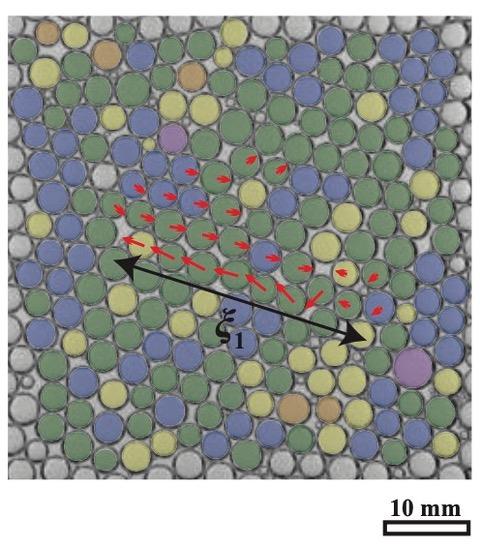
IMAGE

Credit: Tokyo Metropolitan University

Tokyo, Japan – Researchers from Tokyo Metropolitan University studied the dynamics of foams. When a drop of water was added to a foam raft, the bubbles rearranged themselves to reach a new stable state. The team found that bubble movement was qualitatively different depending on the range of bubble sizes present. Along with analogies with soft-jammed materials, these findings may inspire the design of new foam materials for industry.

Foams are everywhere. Whether it’s soaps and detergents, meringues, beer foam, cosmetics or insulation for clothing and building, we’re surrounded by everyday materials featuring a foam material. The application of foams tends to take advantage of their unique structure, which is why understanding how their structure can change over time is so important.

A team led by Prof. Rei Kurita of Tokyo Metropolitan University have been studying liquid foams, like those made with detergent and water at home. They were interested in understanding how the bubbles of a foam rearrange themselves. While previous studies usually applied a force to the foam with a prod to the side, the team adopted the much gentler method of adding a tiny amount of water, preserving the bubbles but changing the conditions enough for the bubbles to rearrange themselves and find a new stable state. This made it much easier to see how subtle environmental nudges or perturbations lead to small, isolated bubble relaxation events.

By filming the bubbles rearranging themselves, the team showed for the first time that rearrangements were fundamentally different depending on the range of bubble sizes present in the foam. When the bubbles were roughly the same size, or monodisperse, they arranged themselves in a hexagonal, honeycomb formation. Upon adding water, the bubbles that moved tended to shuffle in the same direction over long distances, along the lines of the honeycomb. Conversely, when there were many small and large particles, the initial arrangement was much less ordered. Rearrangements in this polydisperse foam were random, with adjacent bubbles moving in all sorts of directions. The videos they took allowed the team to extract a dynamical correlation length, the length scale over which bubbles move in similar directions. Tracking how this length changes under different conditions is crucial to placing foam materials within the broad framework of condensed matter physics. Interestingly, the unique correlated motion observed in the hexagonal foam didn’t depend on adjacent bubbles being in contact: they simply needed to be close enough to form well-ordered patterns.

The team went on to compare this behavior to simulations of packings of soft particles with different ranges of sizes. They found very similar behavior, showing clearly that this was not a quirk of liquid foams, but a general feature of soft particles that have been jammed together. These insights into how foams react to the subtlest of environmental cues may one day inform how foams are kept stable or fluid, and how soft jammed materials are handled in industrial processes.

###

This work was supported by a JSPS Research Fellowship for Young Scientists (20J11840) and JSPS KAKENHI Grants-in-Aid for Scientific Research (17H02945 and 20H01874).

Media Contact
Go Totsukawa
[email protected]

Related Journal Article

http://dx.doi.org/10.1038/s41598-021-82267-4

Tags: BiologyBiomedical/Environmental/Chemical EngineeringChemistry/Physics/Materials SciencesIndustrial Engineering/ChemistryMathematics/StatisticsNanotechnology/MicromachinesTechnology/Engineering/Computer Science
Share13Tweet8Share2ShareShareShare2

Related Posts

Breakthrough Non-Invasive Prenatal Test Matches Invasive Methods in Accuracy, Offering Enhanced Safety and Reduced Costs — Biology

Breakthrough Non-Invasive Prenatal Test Matches Invasive Methods in Accuracy, Offering Enhanced Safety and Reduced Costs

June 12, 2026
Identifying Retinal Cell Subgroups May Boost Success of Cell Transplants — Biology

Identifying Retinal Cell Subgroups May Boost Success of Cell Transplants

June 12, 2026

New Study Uncovers How the Brain Revises Its Predictions

June 12, 2026

Decoding Ebola Persistence in Human Brain Organoids

June 12, 2026
Please login to join discussion

POPULAR NEWS

  • ESMO 2025: mRNA COVID Vaccines Enhance Efficacy of Cancer Immunotherapy

    325 shares
    Share 130 Tweet 81
  • Saying Goodbye to PGY-6: Pediatric Fellowship Realities

    99 shares
    Share 40 Tweet 25
  • Multi-Hospital Study Reveals Long Covid Burden Is Twice as High as Current Estimates

    91 shares
    Share 36 Tweet 23
  • Common Food Preservatives Associated with Elevated Blood Pressure and Increased Heart Disease Risk

    59 shares
    Share 24 Tweet 15

About

We bring you the latest biotechnology news from best research centers and universities around the world. Check our website.

Follow us

Recent News

GPR84 Drives Lung Inflammation via ZBP1-PANoptosome Activation

Drosophila Nucleostemin 1 Loss Triggers Apoptosis Mechanism

Turkish Pharmacists’ Insights on Elderly Medication Management

Subscribe to Blog via Email

Enter your email address to subscribe to this blog and receive notifications of new posts by email.

Join 82 other subscribers
  • Contact Us

Bioengineer.org © Copyright 2023 All Rights Reserved.

Welcome Back!

Login to your account below

Forgotten Password?

Retrieve your password

Please enter your username or email address to reset your password.

Log In
No Result
View All Result
  • Homepages
    • Home Page 1
    • Home Page 2
  • News
  • National
  • Business
  • Health
  • Lifestyle
  • Science

Bioengineer.org © Copyright 2023 All Rights Reserved.