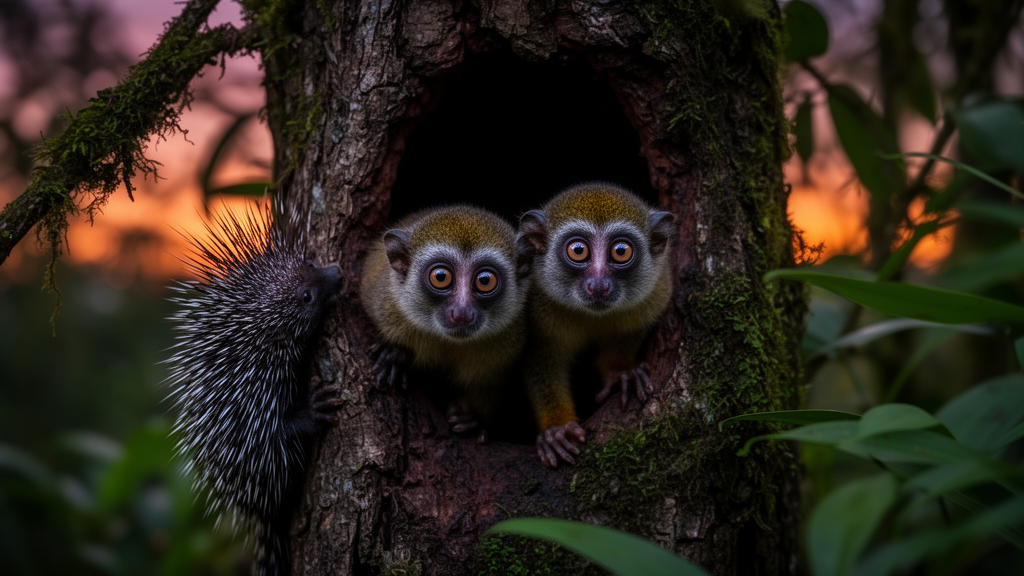
A short field observation in an agricultural landscape in Caldas, Colombia, documented Caribbean night monkeys (Aotus griseimembra) and Quichua porcupines (Coendou quichua) sharing an avocado-tree cavity for daytime rest. The episode included one agonistic encounter, during which a night-monkey infant fell from the tree, but the animals continued to occupy different parts of the cavity without another recorded confrontation.
The observation took place at La Camelia farm in the municipality of Victoria, on the eastern slope of Colombia’s Central Cordillera. The site is at approximately 650 m above sea level, at 5°20.55′N, 74°54.03′W. Its landscape combines small-scale avocado, cacao, banana, plantain, citrus and cassava crops with fragments of forest and isolated shade trees. The initial event was documented on March 18, 2024, and the animals continued sharing the site through March 21.
The shared sleeping site was a cavity approximately 2.5 m long in an avocado tree (Persea americana) about 10 m high. The same group of night monkeys had used the site for more than eight years. The group comprised an adult male, an adult female, one subadult and one juvenile of unknown sex. The cavity had two openings: a lower entrance about 3.5 m above ground and approximately 25 cm wide by 80 cm high, and an upper entrance about 6 m above ground and approximately 30 cm wide by 40 cm high.
At 05:45, researchers were waiting for the monkeys to arrive at their usual sleeping site. At 05:57, the group attempted to enter through the lower opening as a Quichua porcupine emerged. The porcupine used its quills defensively against the adult male, which was carrying the infant. During the interaction, the infant fell approximately four meters to the ground. The other three monkeys moved to lower branches of a nearby bush, after which the adult male retrieved the infant, placed it on his back and rejoined the group at the upper entrance. The porcupine then re-entered through the lower opening.
During an inspection at 12:39, the researchers found the porcupine resting in the center of the cavity between the two entrances, while a night monkey was visible in silhouette at the upper entrance. When the researchers returned at 17:45, all four monkeys emerged from the upper entrance at 18:20, with the infant still on the adult male’s back. A second porcupine, distinct from the first, moved from the base of the cavity toward the lower opening at 18:23. The first porcupine followed, and the two met at the lower entrance at 18:36. They entered the lower part of the cavity and vocalized for about 30 seconds.
On the three days following the first observation, the night monkeys continued to rest at the upper entrance during the day. The porcupines also remained at the site: one rested near the center of the cavity and the other near its base. No further agonistic events were recorded during this period. On March 22, the night monkeys were observed resting in the lower entrance, but no porcupines were present, marking the end of the reported period of simultaneous use.
The spatial separation resembled earlier observations reported from the Peruvian Amazon involving the night monkey Aotus vociferans, the porcupine C. bicolor and other mammals. In those cases, night monkeys occupied the portion of a cavity nearest an entrance while co-occupants rested farther inside. A similar timing pattern was described: A. vociferans reportedly left a shared site earlier and returned later than other mammals. In the Colombian observation, the night monkeys departed around dusk and returned around dawn, while the porcupines were present after dusk and before dawn. The researchers stated that these differences may relate to nocturnal activity patterns, which can be influenced by ambient light, seasonality and resource availability.
The researchers suggested that the cavity’s two entrances and spacious interior may have enabled simultaneous use while allowing the species to remain in separate positions. They also raised the possibility that widespread conversion of forests into agricultural fields, and the resulting scarcity of large trees that may bear suitable cavities, could increase competition for this resource. The observation alone could not establish that environmental transformation caused the interaction or sharing.
Because this was a short-duration field observation at one site, it does not establish how frequently the species share sleeping sites, the causes of the behavior or its population-level consequences. Species identification also depended on available traits and context. Geographic location was used to identify the monkeys as A. griseimembra because members of the A. lemurinus species complex are difficult to distinguish morphologically; in the Middle Magdalena River Basin, A. griseimembra occurs below 1,000 m above sea level. The porcupines were identified as C. quichua from external features including medium body size, a long tail, fully spiny pelage, tricolored quills and muzzle shape. The report nevertheless adds specific details about the tree species, cavity entrances and dimensions used by both species and documents their shared use of an exotic tree in a transformed landscape.
Subject of Research: A short field observation of shared tree-cavity use by Caribbean night monkeys and Quichua porcupines in Colombia
Article Title: Sleeping site sharing between Aotus griseimembra ( Mammalia , Primates ) and Coendou quichua ( Mammalia , Rodentia ) in a lowland inter-Andean valley in Colombia
Article References: Montilla, S. O., Salazar, J. D., Ramírez-Chaves, H. E., & Link, A. (2024). Sleeping site sharing between Aotus griseimembra (Mammalia, Primates) and Coendou quichua (Mammalia, Rodentia) in a lowland inter-Andean valley in Colombia. Neotropical Biology and Conservation, 19(3), 393-404. https://doi.org/10.3897/neotropical.19.e129627
Image Credits: AI Generated
DOI: 10.3897/neotropical.19.e129627
Keywords: Caribbean night monkey, Quichua porcupine, tree-cavity sharing, field observation, Colombian Andes, Aotus griseimembra, Coendou quichua, agonistic interaction, sleeping-site ecology, Sleeping, site, sharing
News Source: Gavin Prescott. (October 20, 2026). Short field observation documents shared tree-cavity use by Caribbean night monkeys and Quichua porcupines in Colombia. Scienmag.