• HOME
  • NEWS
  • EXPLORE
    • CAREER
      • Companies
      • Jobs
    • EVENTS
    • iGEM
      • News
      • Team
    • PHOTOS
    • VIDEO
    • WIKI
  • BLOG
  • COMMUNITY
    • FACEBOOK
    • INSTAGRAM
    • TWITTER
Monday, July 6, 2026
BIOENGINEER.ORG
No Result
View All Result
  • Login
  • HOME
  • NEWS
  • EXPLORE
    • CAREER
      • Companies
      • Jobs
        • Lecturer
        • PhD Studentship
        • Postdoc
        • Research Assistant
    • EVENTS
    • iGEM
      • News
      • Team
    • PHOTOS
    • VIDEO
    • WIKI
  • BLOG
  • COMMUNITY
    • FACEBOOK
    • INSTAGRAM
    • TWITTER
  • HOME
  • NEWS
  • EXPLORE
    • CAREER
      • Companies
      • Jobs
        • Lecturer
        • PhD Studentship
        • Postdoc
        • Research Assistant
    • EVENTS
    • iGEM
      • News
      • Team
    • PHOTOS
    • VIDEO
    • WIKI
  • BLOG
  • COMMUNITY
    • FACEBOOK
    • INSTAGRAM
    • TWITTER
No Result
View All Result
Bioengineer.org
No Result
View All Result
Home NEWS Science News Biology

Shining a light on tiny, solar-powered animals

Bioengineer by Bioengineer
October 5, 2023
in Biology
Reading Time: 3 mins read
0
Acoel with symbionts and collection location
Share on FacebookShare on TwitterShare on LinkedinShare on RedditShare on Telegram

Acoels have been found to host a wide diversity of symbiotic, photosynthetic microalgae.
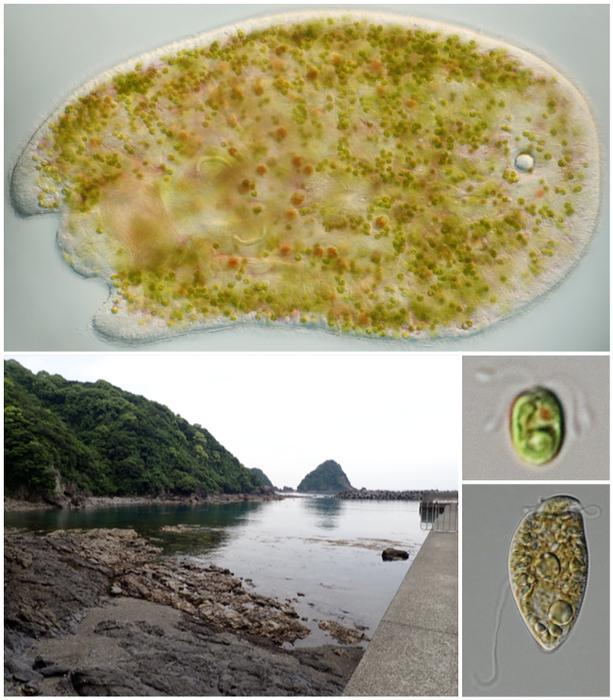
Acoel with symbionts and collection location

Credit: Kevin Wakeman and Siratee Riewluang

Acoels have been found to host a wide diversity of symbiotic, photosynthetic microalgae.

Animals and plants need energy. Some animals get energy by eating other animals, and many plants harvest the energy in sunlight through photosynthesis. However, in the ocean, there exists a remarkable group of small, worm-like animals called acoels that do both—some acoels form relationships (symbiosis) with single-celled, photosynthetic microalgae.

A study by Assistant Professor Kevin Wakeman and his undergraduate student, Siratee Riewluang, at Hokkaido University, Japan, has shed some light on the biodiversity underpinning symbiotic relationships between acoels and microalgae. Their findings were published in the journal PeerJ.

Acoels are superficially simple. However, this simplicity is misleading. Due to their regenerative ability and position as one of the first animal groups on the planet, acoels interest biologists in the fields of evolutionary biology, regenerative biology, and neurobiology. Some acoels also form symbiotic relationships with microalgae. This includes green algae and other types of microalgae that also associate with coral reefs called dinoflagellates.

“These acoels engulf microalgae seemingly as ‘food’, but they do not digest them. Instead, they store them below their outer surface. They create energy using sunlight—much like adding solar panels to your house,” explained Siratee.

“Photosynthetic acoels are mostly found in warmer waters. Therefore, we focused our sampling in Southern Japan. We also found acoels near Kochi, a region of Japan that receives warm water from the Kuroshio Current. Photosynthetic acoels can be difficult to spot—they are microscopic. But, under a microscope they are easily recognizable, by their brightly colored algae,” Siratee continued.

Throughout 2022, Wakeman and Siratee collected algae and sediment samples. The host acoel and their symbionts were identified by DNA sequencing. Symbiotic microalgae were removed from acoel hosts and put into culture. This study found that acoels contained various green algae (Tetraselmis); previously, only one species was known. Several dinoflagellate lineages were also found. Most belonged to the Symbiodiniaceae, a group famously associated with coral (and other invertebrates). Some of these Tetraselmis and dinoflagellates might be new to science.

Unexpectedly, Wakeman and Siratee came across what might turn out to be a whole new group of acoels harboring symbionts (only one group is currently known).

“We found that there was more diversity of acoels and their symbionts than we really expected,” said Wakeman. “Even in this present dataset, which focuses on Japan, it’s clear that there are fascinating interactions between acoels and microalgae. These results will lay the groundwork for future studies that can tease apart what are probably some interesting ecological mechanisms. I really am excited to see where this ends up.”

Wakeman and Siratee will continue work on photosynthetic acoels for Siratee’s Master’s. “It would be cool to figure out if they really are a new group of acoels with symbionts, but we need more genetic data and unambiguous morphological data to confidently assign a new name,” said Siratee. “Eventually, I would like to use advanced imaging and genetics to explore these acoels at a molecular level.”


Journal

PeerJ

DOI

10.7717/peerj.16078

Method of Research

Experimental study

Subject of Research

Not applicable

Article Title

Biodiversity of symbiotic microalgae associated with meiofaunal marine acoels in Southern Japan

Article Publication Date

5-Oct-2023
Share12Tweet8Share2ShareShareShare2

Related Posts

Here are a few rewritten headlines for a science magazine post, each with a slightly different tone: Intriguing & poetic: How do organs sculpt themselves? Sea stars hold the secret Direct & research-focused: Sea stars reveal the hidden rules of organ formation Metaphorical & inviting: Tiny architects beneath the waves: What sea stars teach us about building organs Short & punchy: Star-shaped clues to how our organs take shape Question-led: Could a sea star show us how organs form? Elegant & feature-style: The body’s blueprint, glimpsed in a sea star’s arm

July 6, 2026
Bacteria evolve faster with unconventional gene copies — Biology

Bacteria evolve faster with unconventional gene copies

July 6, 2026

Neighbours rewire soil feedback via root microbiome shifts

July 6, 2026

Evolution-Inspired Biosensors Revolutionize Lipid Tracking in Real Time

July 2, 2026

POPULAR NEWS

  • Detection of EDCs in Breast Milk and Infant Urine Up to Six Months Highlights Early Exposure Risks

    77 shares
    Share 31 Tweet 19
  • New Drug Candidate Developed at McMaster Shows Potential for Treating Brain Cancer

    58 shares
    Share 23 Tweet 15
  • Saying Goodbye to PGY-6: Pediatric Fellowship Realities

    103 shares
    Share 41 Tweet 26
  • KTU Researchers Explore Ultrasound’s Role in Enhancing Blood Flow Beyond Diagnostics

    53 shares
    Share 21 Tweet 13

About

We bring you the latest biotechnology news from best research centers and universities around the world. Check our website.

Follow us

Recent News

Massive antibody profiling now possible with scalable serolomics platform

Optoelectronic tweezers may revolutionize single-cell research

Men in the US more often diagnosed with late-stage cancers than women

Subscribe to Blog via Email

Enter your email address to subscribe to this blog and receive notifications of new posts by email.

Join 83 other subscribers
  • Contact Us

Bioengineer.org © Copyright 2023 All Rights Reserved.

Welcome Back!

Login to your account below

Forgotten Password?

Retrieve your password

Please enter your username or email address to reset your password.

Log In
No Result
View All Result
  • Homepages
    • Home Page 1
    • Home Page 2
  • News
  • National
  • Business
  • Health
  • Lifestyle
  • Science

Bioengineer.org © Copyright 2023 All Rights Reserved.