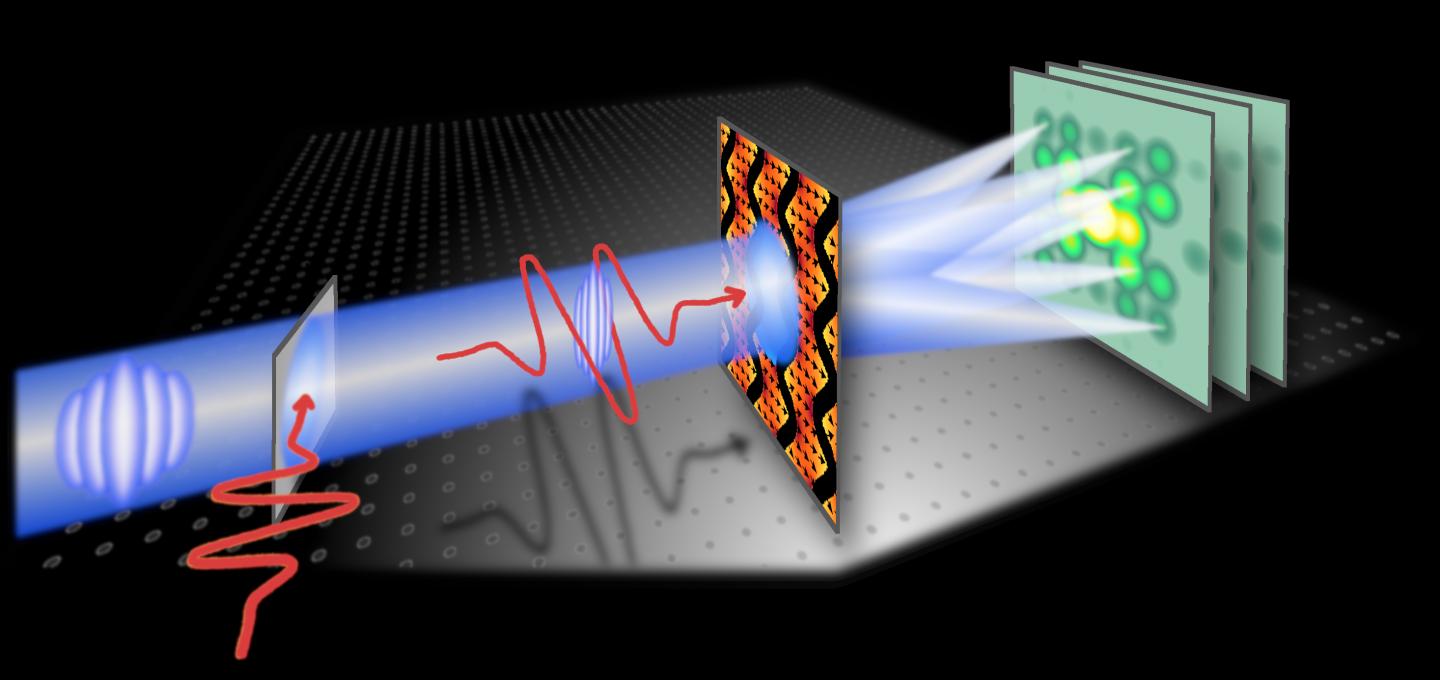
Credit: Kathrin Mohler, Ludwig-Maximilians-Universität München
Physicists from the University of Konstanz, Ludwig-Maximilians-Universität München (LMU Munich) and the University of Regensburg have successfully demonstrated that ultrashort electron pulses experience a quantum mechanical phase shift through their interaction with light waves in nanophotonic materials, which can uncover the nanomaterials’ functionality. The corresponding experiments and results are reported in the latest issue of Science Advances.
Nanophotonic materials and metamaterials
Many materials found in nature can influence electromagnetic waves such as light in all different kinds of ways. However, generating novel optical effects for the purpose of developing particularly efficient solar cells, cloaking devices or catalysts often requires artificial structures, so-called metamaterials. These materials achieve their extraordinary properties through sophisticated structuring at the nanoscale, i.e. through a grid-like arrangement of smallest building blocks on length scales well below the wavelength of the excitation.
The characterization and development of such metamaterials requires a deep understanding of how the incident light waves behave when they hit these tiny structures and how they interact with them. Consequently, the optically-excited nanostructures and their electromagnetic near fields must be measured at spatial resolutions in the range of nanometres (~10-9 m) and, at the same time, at temporal resolutions below the duration of the excitation cycle (~10-15 s). However, this cannot be achieved with conventional light microscopy alone.
Ultrafast electron diffraction of optically-excited nanostructures
In contrast to light, electrons have a rest mass and therefore offer 100,000 times better spatial resolution than photons. In addition, electrons can be used to probe electromagnetic fields and potentials due to their charges. A team led by Professor Peter Baum (University of Konstanz) has now succeeded in applying extremely short electron pulses to achieve such a measurement. To that end, the duration of the electron pulses was compressed in time by means of terahertz radiation to such an extent that the researchers were able to resolve the optical oscillations of the electromagnetic near fields at the nanostructures in detail.
High spatial and temporal resolutions
“The challenge involved with this experiment lies in making sure that the resolution is sufficiently high both in space and in time. To avoid space charge effects, we only use single electrons per pulse and accelerate these electrons to energies of 75 kiloelectron volts”, explains Professor Peter Baum, last author on the study and head of the working group for light and matter at the University of Konstanz’s Department of Physics. When being scattered by the nanostructures, these extremely short electron pulses interfere with themselves due to their quantum mechanical properties and generate a diffraction image of the sample.
Interaction with the electromagnetic fields and potentials
The investigation of the optical-excited nanostructures is based on the known principle of pump-probe experiments. After the optical excitation of the near fields, the ultrashort electron pulse arrives at a defined point in time and measures the time-frozen fields in space and time. “According to the predictions of Aharonov and Bohm, the electrons experience a quantum mechanical phase shift of their wave function when travelling through electromagnetic potentials”, explains Kathrin Mohler, a doctoral researcher at LMU Munich and first author on the study. These optically-induced phase shifts provide information about the ultrafast dynamics of light at the nanostructures, ultimately delivering a movie-like sequence of images that reveals the interaction of light with the nanostructures.
A new application regime for electron holography and diffraction
These experiments illustrate how electron holography and diffraction can be harnessed in the future to improve our understanding of fundamental light-matter interactions underlying nanophotonic materials and metamaterials. In the long term, this may even lead to the development and optimization of compact optics, novel solar cells or efficient catalysts.
###
Facts:
- Physicists from the University of Konstanz, Ludwig-Maximilians-Universität München and the University of Regensburg succeed in observing metamaterials in real time using ultrafast electron diffraction.
- Experiments led by Professor Peter Baum from the University of Konstanz demonstrate that ultrashort electron pulses experience a quantum mechanical phase shift through their interaction with light waves in nanophotonic materials.
- This can uncover the nanomaterials’ functionality.
- Improved understanding of nanophotonic materials and metamaterials through new application regimes for electron holography and diffraction.
- Original publication: K. J. Mohler, D. Ehberger, I. Gronwald, C. Lange, R. Huber, and P. Baum, Ultrafast electron diffraction from nanophotonic waveforms via dynamical Aharonov-Bohm phases, Science Advances, 20 November 2020. URL: https:/
/ advances. sciencemag. org/ content/ 6/ 47/ eabc8804
Note to editors:
You can download a photo here: https:/
Caption: Ultrafast electron diffraction of optically-excited metamaterials
Image credit: Kathrin Mohler, Ludwig-Maximilians-Universität München
Contact:
University of Konstanz
Communications and Marketing
Phone: +49 7531 88-3603
Email: [email protected]
uni.kn/en
Media Contact
Julia Wandt
[email protected]
Related Journal Article
http://dx.