• HOME
  • NEWS
  • EXPLORE
    • CAREER
      • Companies
      • Jobs
    • EVENTS
    • iGEM
      • News
      • Team
    • PHOTOS
    • VIDEO
    • WIKI
  • BLOG
  • COMMUNITY
    • FACEBOOK
    • INSTAGRAM
    • TWITTER
Wednesday, June 24, 2026
BIOENGINEER.ORG
No Result
View All Result
  • Login
  • HOME
  • NEWS
  • EXPLORE
    • CAREER
      • Companies
      • Jobs
        • Lecturer
        • PhD Studentship
        • Postdoc
        • Research Assistant
    • EVENTS
    • iGEM
      • News
      • Team
    • PHOTOS
    • VIDEO
    • WIKI
  • BLOG
  • COMMUNITY
    • FACEBOOK
    • INSTAGRAM
    • TWITTER
  • HOME
  • NEWS
  • EXPLORE
    • CAREER
      • Companies
      • Jobs
        • Lecturer
        • PhD Studentship
        • Postdoc
        • Research Assistant
    • EVENTS
    • iGEM
      • News
      • Team
    • PHOTOS
    • VIDEO
    • WIKI
  • BLOG
  • COMMUNITY
    • FACEBOOK
    • INSTAGRAM
    • TWITTER
No Result
View All Result
Bioengineer.org
No Result
View All Result
Home NEWS Science News

Shedding new light: A new type of immunosensor for immunoassay tests

Bioengineer by Bioengineer
May 27, 2021
in Science News
Reading Time: 2 mins read
0
IMAGE
Share on FacebookShare on TwitterShare on LinkedinShare on RedditShare on Telegram

IMAGE

Credit: Tokyo Tech

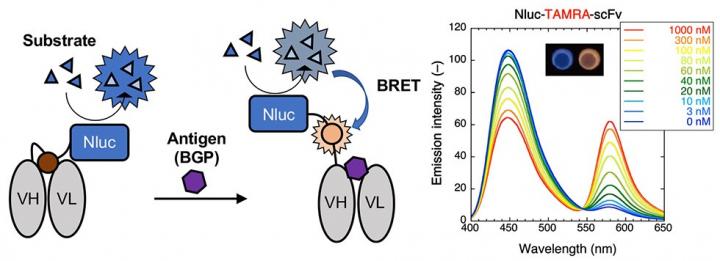
Immunosensors are widely used in immunoassays to detect antigens. One such immunosensor is a quenchbody (Q-body), which contains a modified antibody fragment with a quenched fluorescent dye. When an antigen binds to the Q-body, the dye leaves the antibody and the fluorescence intensifies. The change in fluorescence intensity is easy to measure, making Q-body-based antigen detection systems incredibly simple. However, this method requires an external light source to excite the electrons in the fluorescent dye to produce luminescence.

One way to solve this is to induce luminescence by an alternative method. To achieve this, researchers from Tokyo Tech, Japan, have developed a novel immunosensor. They used a modified luciferase enzyme called “NanoLuc” (Nluc) that is originally responsible for bioluminescence in shrimp and fused it to the Q-body. This immunosensor, termed “BRET Q-body”, works on the bioluminescence resonance energy transfer (BRET) principle. Here, a luminescent substrate is added to the fused Q-body. The substrate reacts with the enzyme and this reaction provides the energy required by the dye to induce fluorescence. This type of luminescence is advantageous, as Professor Hiroshi Ueda, who leads the team of researchers, explains, “The BRET Q-body system can be used to visualize the presence or the absence of an antigen as a change in the emission color without any instrument.” Their findings were recently published in the journal Analytical Chemistry.

To prepare the BRET Q-body, the researchers used a single-chain antibody fragment which binds to the antigen BGP, a protein found in the bone. The antibody fragment was then labeled with a fluorescent dye. They then tested the fluorescence intensity of the resulting BRET Q-bodies and observed that the addition of the antigen increased the intensity of the fluorescence.

After these initial results, the researchers tested the antigen dependency of the BRET Q-body. They compared the fluorescence obtained by the new BRET-based method against the conventional irradiation-based method. The fluorescence intensity of the BRET-Q body was initially measured with excitation light and later in the presence of the luminescent substrate. They found that the antigen-binding brought the Nluc enzyme and the dye closer together resulting in higher fluorescence intensity levels when the substrate was used. As luminescence from the BRET Q-body is obtained initially from the enzyme and then from the fluorescent dye upon antigen binding, a simple color change indicates the presence of an antigen.

This study paves the way forward for a new class of bioluminescent sensors that do not require an external excitation light source. The novel BRET Q-bodies are expected to make immunoassay tests much simpler and more accurate. As Prof. Ueda explains the advantages and potential applications of their findings, “The detection of the BRET signal does not need a light source, allows visual observation of the color change, and easier integration to a smartphone-based device. Therefore, we expect that BRET Q-bodies will be a promising tool for diagnosis, food safety, environmental preservation, and biological research.”

###

Media Contact
Kazuhide Hasegawa
[email protected]

Related Journal Article

http://dx.doi.org/10.1021/acs.analchem.0c05217

Tags: BiologyBiotechnology
Share12Tweet8Share2ShareShareShare2

Related Posts

Groundbreaking Global Seagrass Map Reveals Crucial Insights for Conservation Efforts — Technology and Engineering

Groundbreaking Global Seagrass Map Reveals Crucial Insights for Conservation Efforts

June 24, 2026

Comprehensive Microbiome Analysis Uncovers Reliable Colorectal Cancer Biomarkers

June 24, 2026

SwRI and St. Mary’s University Partner to Forecast Durability of Metal Hydride Hydrogen Storage

June 24, 2026

Hierarchical Endpoints, Win Stats in Geromedicine Trials

June 24, 2026
Please login to join discussion

POPULAR NEWS

  • Saying Goodbye to PGY-6: Pediatric Fellowship Realities

    103 shares
    Share 41 Tweet 26
  • Multi-Hospital Study Reveals Long Covid Burden Is Twice as High as Current Estimates

    92 shares
    Share 36 Tweet 23
  • Detection of EDCs in Breast Milk and Infant Urine Up to Six Months Highlights Early Exposure Risks

    77 shares
    Share 31 Tweet 19
  • New Drug Candidate Developed at McMaster Shows Potential for Treating Brain Cancer

    58 shares
    Share 23 Tweet 15

About

We bring you the latest biotechnology news from best research centers and universities around the world. Check our website.

Follow us

Recent News

Groundbreaking Global Seagrass Map Reveals Crucial Insights for Conservation Efforts

Comprehensive Microbiome Analysis Uncovers Reliable Colorectal Cancer Biomarkers

SwRI and St. Mary’s University Partner to Forecast Durability of Metal Hydride Hydrogen Storage

Subscribe to Blog via Email

Enter your email address to subscribe to this blog and receive notifications of new posts by email.

Join 82 other subscribers
  • Contact Us

Bioengineer.org © Copyright 2023 All Rights Reserved.

Welcome Back!

Login to your account below

Forgotten Password?

Retrieve your password

Please enter your username or email address to reset your password.

Log In
No Result
View All Result
  • Homepages
    • Home Page 1
    • Home Page 2
  • News
  • National
  • Business
  • Health
  • Lifestyle
  • Science

Bioengineer.org © Copyright 2023 All Rights Reserved.