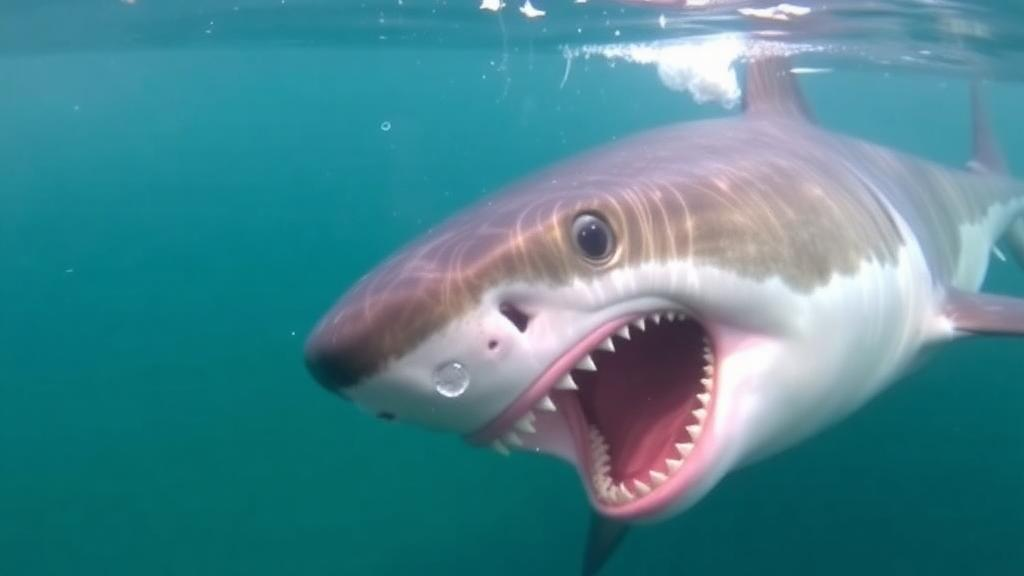
For decades, the intimate lives of blue sharks have remained one of the ocean’s most stubborn secrets. Despite being one of the most wide-ranging and recognizable sharks on Earth, the species has never been caught in the act of courtship — until now. In a remarkable stroke of luck off the Basque coast of northern Spain, researchers and ecotourism guides have documented the first visual evidence of putative mating behavior in blue sharks, capturing on camera a sequence of courtship behaviors that scientists had previously only inferred from scars, fisheries data, and analogies with other species. The discovery, published in the journal Web Ecology, suggests that the deep submarine canyons of the southern Bay of Biscay may serve as a seasonally important reproductive area for this iconic pelagic predator in the Northeast Atlantic.
The encounter unfolded on 31 July 2023, roughly eight kilometers offshore from the fishing town of Bermeo, above a submarine canyon where the seabed drops to depths of 400 to 600 meters. A shark ecotourism dive was underway when an adult male blue shark, estimated at 2.2 meters in fork length, appeared at the site. His claspers — the paired reproductive organs that identify male sharks — were large and rigid, indicating maturity. A minute later, a female of roughly 1.8 meters arrived. Based on published size-at-maturity estimates for North Atlantic blue sharks, she was almost certainly immature; only about eight percent of females at that length have reached reproductive maturity. What followed was a four-minute-and-fifteen-second drama that the research team recorded in extraordinary detail, using a Panasonic Lumix GH5 Mark 2 shooting in serial photo mode at up to twelve frames per second, alongside simultaneous video captured from a second angle.
The behavioral sequence matched, step by step, the courtship repertoire described for other shark species. The male first approached the female calmly, and the two swam in parallel toward the bait container used to attract sharks, the male trailing slightly behind. This so-called parallel or echelon swimming is a classic precursor to mating in elasmobranchs, allowing the male to assess the female’s receptivity. The pattern repeated itself two minutes later. Then the tone shifted abruptly: the male began chasing the female at high speed and, at 18:39:42 local time, succeeded in biting her left pectoral fin. He then maneuvered her into an inverted position, ventral side up, while maintaining his grip — a posture documented in hammerhead, nurse, and reef sharks during copulation, when both animals typically cease moving while upside down. In this case, however, copulation never occurred. The female accelerated erratically, tore free of the bite, and bolted. The male pursued her for another thirty seconds before she vanished from the site, leaving him to linger alone for nearly an hour.
The researchers are careful to describe the event as a putative mating attempt rather than a confirmed copulation, and with good reason. The female displayed no signs of acceptance; instead, her violent acceleration away from the male is textbook avoidance behavior. Yet every element of the interaction — the following, the parallel swimming, the close approach, the courtship bite, and the inversion — aligns with established descriptions of shark courtship. Direct observations of mating are extraordinarily rare in sharks generally, documented in only a handful of species such as nurse sharks, blacktip reef sharks, scalloped hammerheads in the Galapagos, and oceanic whitetip sharks in the Bahamas. For the blue shark, a placental viviparous species that gives birth to live young after nourishing embryos through a placenta-like connection, all previous knowledge of reproduction rested on indirect evidence: bite scars on females, dissections, and fisheries records.
That indirect evidence is precisely what makes the second half of the study so compelling. Combining roughly 200 ecotourism trips off Bermeo conducted between 2021 and 2024 with 24 dedicated research trips in 2023 and 2024, the team compiled seventeen records of female blue sharks bearing mating scars — the semi-circular jaw impressions and individual tooth cuts left when males bite females during courtship. The sharks ranged from 1.0 to 2.2 meters in fork length, with a mean of 1.6 meters, and the scars appeared consistently across all four years of the study, from late June to early October, with a pronounced peak in August that accounted for nearly two-thirds of the records. Most strikingly, the majority of the scarred females — nearly seventy-nine percent — were likely immature, and most carried multiple bite marks, concentrated primarily on the flanks of the body, with additional injuries on the pectoral fins and gill area.
The pattern of adult males courting immature females may sound alarming, but it fits a broader hypothesis in blue shark biology. Blue sharks normally segregate by sex and maturity status outside the mating season, and previous work off Nova Scotia, Canada, documented immature females between 1.6 and 2.0 meters carrying scars from adult males estimated at 1.8 to 2.6 meters. Researchers have long suggested that males may attempt mating with as many females as possible, regardless of maturity, to maximize reproductive success. There is also a fascinating physiological twist: female sharks in several species can store spermatozoa in their oviducal glands for extended periods, meaning that mating before reaching maturity could still result in pregnancy through delayed fertilization once the female’s eggs are ready. In other words, an unsuccessful-looking encounter with a young female may not be reproductively wasted from the male’s perspective.
The seasonal timing of the Basque observations adds another layer of significance. The scars recorded from June through October coincide with the known mating season of blue sharks in the Northwest Atlantic, off the eastern coast of North America from North Carolina to Newfoundland, where both sexes and scarred females gather each year. Similar seasonal scarring has been reported across vast areas of the Northwest Pacific during spring and summer. The convergence of direct behavioral evidence, multi-year scarring records, and matching seasonality now points toward the southern Bay of Biscay as a potential reproductive area for the species in the Northeast Atlantic — a role never previously assigned to European waters. The submarine canyons off Bermeo and Capbreton, where the continental shelf plunges into deep water, appear to concentrate sharks of both sexes during the summer months, creating conditions that may facilitate courtship.
What makes the discovery even more notable is how it was made. Nearly all of the records came from opportunistic data gathered during ecotourism operations, in which sharks were attracted to a drifting boat using albacore tuna, sardines, and mackerel, and photographed on professional mirrorless cameras. Shark lengths were estimated against objects of known size, sexes were determined by the presence or absence of claspers, and tagging trips added direct tape measurements. The authors argue that this demonstrates the underappreciated value of responsible shark ecotourism as a monitoring tool, capable of generating fishery-independent data in a region where such information has been almost entirely absent. Commercial fishing datasets have hinted at the presence of both sexes in the Bay of Biscay, but detailed knowledge of demographics, habitat use, and reproductive behavior has remained scarce.
Considerable caution is still warranted. The dataset is opportunistic, the single behavioral observation represents one interaction, and the ecological importance and spatial scale of the putative reproductive habitat cannot yet be quantified. The authors emphasize that long-term monitoring, satellite tagging, and reproductive physiology studies will be essential to confirm whether the Basque continental slope truly functions as a mating ground, and to understand how sharks in the region connect to the wider North Atlantic population. Fundamental questions remain open: how many sharks use these canyons, where they migrate afterward, whether females return to give birth, and how the area’s reproductive role compares with the well-documented mating grounds off eastern North America.
Even so, the implications for conservation are immediate. The blue shark is among the most heavily fished sharks in the world, and pelagic shark populations face mounting pressure from high-seas fisheries. Identifying and protecting reproductive habitats is a cornerstone of effective management for wide-ranging species, and the Bay of Biscay now deserves a place on that map. A single four-minute chase above a Spanish submarine canyon, filmed by divers with consumer-grade cameras, has rewritten what science knows about one of the ocean’s most familiar predators — and shown that sometimes the biggest discoveries begin with a boat, a bucket of sardines, and a patient eye on the water.
Subject of Research: First visual documentation of putative mating behavior in blue sharks in the Bay of Biscay
Article Title: First documentation of putative mating behavior in blue sharks (Prionace glauca) reveals a potential reproductive area in the Northeast Atlantic
Article References: Vossgaetter, L., Müller, L., Cruz, I., Schultz, M., Renner, A. T., & Erauskin-Extramiana, M. (2025). First documentation of putative mating behavior in blue sharks ( Prionace glauca ) reveals a potential reproductive area in the Northeast Atlantic. Web Ecology, 25(2), 213-219. https://doi.org/10.5194/we-25-213-2025
Image Credits: AI Generated
Keywords: blue shark, Prionace glauca, mating behavior, Bay of Biscay, Northeast Atlantic, mating scars, courtship bite, reproductive habitat, shark ecotourism, elasmobranch reproduction, submarine canyon, conservation
News Source: Margaret Porter. (October 9, 2026). Shark Camera Catches First-Ever Blue Shark Mating Attempt in European Waters. Scienmag.