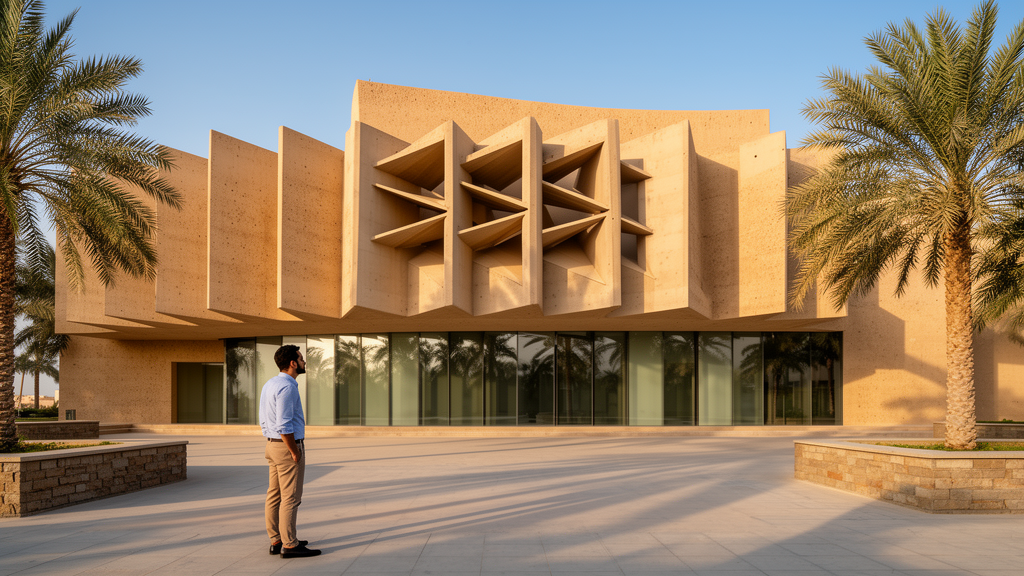
A new qualitative case study published in the journal Built Heritage examines the evolving discourse surrounding the preservation of modern architectural heritage in Sharjah, United Arab Emirates. The research, conducted by Irene Pasina, Marcella Camponogara, Ayman Kassem, and Taher Eldanaf, critically analyzes structures built during the rapid modernization of the 1970s and 1980s. The authors investigate the tension between two primary approaches to heritage conservation: museumification, which treats buildings as static, curated historical relics, and performative reuse, which advocates for the activation of sites through new, evolving functions and continuous social engagement. By taking a perspective informed by critical heritage studies, the paper introduces a conceptual framework known as adaptive authenticity, proposing that a site’s significance can be maintained through the continuity of cultural practice and narrative even as its physical space is modified or repurposed.
The study focuses on three emblematic sites in Sharjah that represent different trajectories of modern heritage management. These cases include Al Qasimiyah School, a 1970s educational complex transformed in 2023 into the headquarters for the Sharjah Architecture Triennial; the Flying Saucer, a distinctive 1978 structure repurposed in 2020 as a cultural and community venue; and Bank Street, a collection of 1970s buildings currently caught between adaptive reuse and redevelopment plans. These sites were selected to illustrate a spectrum of outcomes, ranging from successful reuse to potential loss, and to explore how diverse strategies can coexist and reshape the understanding of heritage in the Gulf region.
The United Arab Emirates experienced a period of intense modernization following its establishment in 1971, fueled by oil discovery and rapid economic growth. Throughout the 1970s and 1980s, widespread construction of modernist buildings occurred, embodying the country’s ambitions and newfound prosperity. Over time, these structures have transitioned from symbols of progress to elements of cultural and historical importance. However, recent studies on Gulf urbanism reveal a persistent tension in how heritage is conceptualized. Historically, state-led initiatives have centered on the pre-oil period, privileging sites associated with traditional, Islamic, or Arab identities as markers of authenticity, while modernist buildings have often been marginalized or demolished without adequate documentation.
The methodology employed in this study is a qualitative case study approach that analyzes the physical transformations and the social and cultural dimensions of each site. Data were collected from archival records, media reports, institutional documents, and onsite observations. The analysis is guided by critical heritage study questions, such as whose heritage is being preserved, who benefits from its reuse, and how these approaches impact cultural continuity and urban life. Each case study is evaluated based on its restoration design, the new program introduced, and the level of community engagement, allowing for a comparison of how each project navigates the spectrum between preserving the past and enabling new uses.
Al Qasimiyah School, built in the mid-1970s by architect Nabil Kanafani, serves as a prominent example of modernist educational architecture. The building features repetitive flat-vaulted bays, perforated screens, and shaded walkways, reflecting a modernist ethos adapted to the local climate. By the 2000s, the school had been decommissioned and was essentially abandoned. In a move exemplifying performative reuse, the Sharjah Architecture Triennial chose the former school as its headquarters. The renovation, completed in time for the inaugural Triennial in 2019, retained the core architectural character of the school, preserving signature elements such as barrel-vaulted canopies and concrete screens. The project transformed the deserted school into a vibrant cultural institution, shifting from a closed educational enclave to an open cultural campus with design workshops, art installations, and public amenities.
The Flying Saucer, built in 1978 by architect Aly Noor El Din Nassar, features a star-shaped canopy around a large concrete dome, giving it the appearance of a landed UFO. Originally a commercial venture, the building went through several incarnations, including a supermarket and a pharmacy, before its striking form was marred by ad hoc modifications. In 2012, the Sharjah Art Foundation acquired the building, recognizing its iconic status. The restoration project, completed in September 2020, removed later additions to recover the authentic design of the building as it existed in 1978. A bold adaptive addition, an underground extension dubbed “The Launch Pad,” was introduced to provide space for a café, library, and workshop, demonstrating adaptive authenticity by complementing the historic structure without visually competing with it.
Bank Street, officially known as Al Bank Street, represents a more contentious case where the impulses of museumification threatened to override the potential for adaptive reuse. The boulevard, laid out in the 1970s, features 17 mid-rise buildings designed by the Spanish firm Técnica y Proyectos. These buildings served as archetypes of 1970s Gulf modernism, providing commercial and residential space. However, the fortunes of Bank Street shifted as newer commercial areas emerged elsewhere in the city. The Sharjah Investment and Development Authority initiated the Heart of Sharjah program to revitalize the city’s historic core, prioritizing the reconstruction of a pre-oil vernacular townscape. This approach led to selective demolitions along the Granada line and the reconstruction of Al Hisn Fort, marginalizing the city’s modern layers. More recently, growing recognition of the cultural significance of modern architecture has tempered the project’s original ambitions, creating space for the potential integration of some of Bank Street’s 1970s buildings within an expanded heritage framework.
The concept of adaptive authenticity redefines authenticity as a dynamic and relational process, shifting the emphasis from static form to social function and cultural relevance. This approach aligns with critical heritage perspectives that view heritage as an ongoing practice with an orientation towards present and future needs. By foregrounding lived experience, memory, and personal connections, adaptive authenticity enables a more inclusive understanding of heritage. Applied to Gulf modernism, it reveals adaptation not as a rupture from tradition but rather as a culturally embedded mechanism through which continuity and meaning are continually produced. This framework challenges conventional understandings of authenticity that privilege material integrity and stylistic distinction, which often marginalize modern architecture in rapidly evolving, postcolonial contexts.
Global charters such as the Venice Charter, the Nara Document, and the Burra Charter have shaped conservation principles worldwide, but modernism in the Gulf has exposed their limits. The Venice Charter exemplified a Eurocentric, monument-focused view of authenticity, emphasizing material integrity and original design. The Nara Document sought to broaden this view by insisting that authenticity must be understood as relative to each culture’s values, treating intangible attributes as integral to authenticity. The Burra Charter further shifted its focus from fabric to cultural significance, recognizing that significance is embodied in a place’s uses, associations, and meanings. These evolving frameworks mark a progression from rigid to more pluralistic definitions of authenticity, yet established frameworks have proven insufficient for understanding Gulf modernism due to the quotidian character of many modern buildings and the overlapping temporal registers of the post-oil urban environment.
Sharjah’s adaptive reuse case studies present a distinctive model for engaging modern heritage through the integration of pre-oil and post-oil buildings within a continuous urban narrative. The lessons learned from these case studies serve as a powerful argument that Gulf modernism cannot be fully accounted for by existing charters alone. Adaptations in Sharjah were successful because they were grounded in local values; preserving a 1970s school or a space-age pavilion was deemed authentic because these structures embody the narrative of the UAE’s post-independence generation. Community engagement is key to this approach, as projects led by local institutions and used by local audiences exemplify engagement-driven conservation. This model offers a concrete operationalization of theoretical shifts in heritage discourse, demonstrating how heritage can be sustained through activation rather than solely through conservation.
The 2024 UAE National Modern Architectural Heritage Programme, launched in December 2024, formalized a shift that had already been visible in Sharjah’s practice. It recognizes modern architecture as integral to national identity and promotes adaptive reuse as a primary conservation strategy. Sharjah’s approach resonates with global discussions on living heritage, adaptive reuse, and the social production of authenticity. However, Sharjah diverges from many Western precedents in that it operates within a context of compressed modernization, where buildings that are only a few decades old already embody foundational national narratives. This temporal condition challenges conventional heritage hierarchies and accelerates the need for new evaluative criteria that account for social meaning, memory, and usage patterns.
The findings of the study show that performative reuse enables a more sustainable, inclusive, and culturally meaningful approach than static conservation does, particularly in rapidly changing urban contexts. Sharjah contributes a distinct perspective by demonstrating how modern heritage operates within the compressed timelines of urban development. Buildings from the late 20th century are not distant artifacts but rather active components of collective memory and identity. Their significance lies less in age or stylistic value than it does in the roles they play in shaping everyday life and social continuity. The case studies reveal that heritage value can be sustained through adaptation, whereas continuity is achieved by reactivating rather than preserving spaces.
There are several implications for global practice derived from this research. First, modern architecture requires greater recognition as heritage, particularly in regions shaped by rapid development. Second, evaluation criteria must expand to include social meaning, memory, and usage patterns. Third, governance models driven by public cultural institutions rather than market forces demonstrate alternative pathways for the management of heritage. Finally, social equity must be considered in adaptive reuse strategies to ensure that revitalization processes remain accessible and inclusive. Adaptive authenticity offers a culturally grounded and transferable model for rethinking heritage conservation, challenging conventional frameworks by emphasizing that authenticity is not fixed but rather negotiated through time, use, and community engagement.
In conclusion, the study validates the modern, the hybrid, and the evolving as legitimate forms of heritage. Sharjah’s experience extends international heritage discourse by supporting a more inclusive understanding of cultural continuity. This ensures that Gulf modernism is preserved not only as a form but also as a living, ongoing practice. The research highlights the importance of moving beyond the dichotomy of preservation versus transformation, demonstrating that continuity can be achieved through change and that modern heritage can play a central role in shaping more inclusive and dynamic urban futures. By foregrounding experience, memory, and use, the paradigm of adaptive authenticity offers a transferable lens for rethinking modern heritage in other rapidly transforming regions.
Subject of Research: Qualitative case study on adaptive reuse and adaptive authenticity in Sharjah's modernist architectural heritage
Article Title: Performative reuse and adaptive authenticity: reviving Sharjah’s modernist heritage
Article References: Pasina, I., Camponogara, M., Kassem, A., & Eldanaf, T. (2026). Performative reuse and adaptive authenticity: reviving Sharjah’s modernist heritage. Built Heritage, 10(1), Article 32. https://doi.org/10.1186/s43238-026-00278-4
Image Credits: AI Generated
DOI: 10.1186/s43238-026-00278-4
Keywords: adaptive reuse, modernist architecture, heritage conservation, Sharjah, UAE, critical heritage studies, urban development, cultural continuity, museumification, performative reuse, Performative, reuse
News Source: Denise Maddox. (November 10, 2026). Sharjah Study Proposes Adaptive Authenticity for Modernist Heritage. Scienmag.