


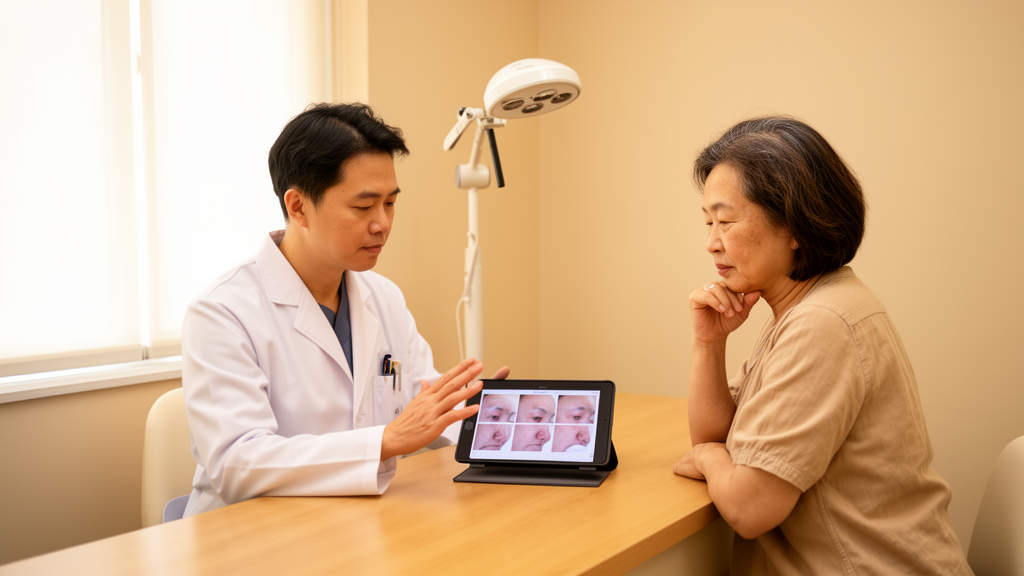
Adults with moderate-to-severe plaque psoriasis who took part in a shared decision-making consultation in Taiwan reported high levels of preparedness to make treatment choices and high satisfaction with their clinicians’ communication, according to a retrospective single-group self-report survey published in BMC Medical Informatics and Decision Making. The study also found that the proportion of patients reporting they had made a treatment decision rose sharply after the consultation, while self-reported decision-related anxiety declined.
The research team, led by Yu-Huei Huang, set out to develop a tailored shared decision-making program for psoriasis patients in Taiwan and to evaluate its feasibility, acceptability, and preliminary associations with perceived decision-making preparedness, satisfaction with clinician communication, self-reported decision-related anxiety, and treatment decision completion. Psoriasis is a chronic inflammatory skin disease that significantly impairs patients’ quality of life, and although shared decision-making enhances patient involvement in care, it remains underutilized in psoriasis management.
A multidisciplinary team created the shared decision-making program along with a paper-based patient decision aid designed for adult patients with moderate-to-severe plaque psoriasis who were considering biologic treatments. The program was culturally adapted for use in Taiwan, aiming to help patients weigh biologic treatment options together with their clinicians rather than having decisions made for them.
The study design was a retrospective single-group self-report survey. A total of 72 patients completed a post-consultation questionnaire that measured perceived preparedness using the Preparation for Decision Making scale, known as PrepDM, and satisfaction with clinician communication using the CollaboRATE scale. Patients also retrospectively reported their pre-consultation decision status and their self-reported decision-related anxiety in the same questionnaire, and then reported their post-consultation status after the decision aid-guided consultation.
The results pointed to high perceived preparedness. After the shared decision-making consultation, the mean PrepDM score was 78.4, with a standard deviation of 21.0, out of a possible 100, which the authors describe as suggesting a high level of perceived decision-making preparedness. The mean CollaboRATE score was 90.4, with a standard deviation of 12.3, out of 100, reflecting high satisfaction with clinician communication.
Decision completion changed markedly over the course of the consultation. The proportion of patients reporting that they had made a treatment decision by the end of the consultation increased from 4.2 percent before the shared decision-making session to 86.1 percent after it, a difference the authors report as statistically significant with a p value below 0.001. Because patients reported their pre-consultation status retrospectively in the same questionnaire, this before-and-after contrast should be read as a self-reported shift within a single group rather than a comparison against a control group.
Self-reported anxiety also moved in a favorable direction. The proportion of patients reporting elevated decision-related anxiety decreased from 52.8 percent before the consultation to 33.3 percent after it, with a reported p value of 0.029. Like the decision completion figures, this measure relied on patients’ own retrospective and immediate post-consultation reports rather than a validated anxiety instrument administered at both time points.
The authors are explicit that these findings should be interpreted cautiously as preliminary and hypothesis-generating. Because the survey was retrospective, single-group, and based on self-report, it cannot establish that the shared decision-making program caused the improvements in preparedness, satisfaction, decision completion, or anxiety. The authors state that further prospective controlled studies using validated decisional quality and anxiety measures are needed before causal conclusions or broader implementation recommendations can be made.
Within those limits, the study suggests that a culturally adapted shared decision-making program for biologic treatment selection in psoriasis was feasible to implement in this Taiwanese setting and was associated with high perceived decision-making preparedness, high satisfaction with clinician communication, increased decision completion, and lower self-reported decision-related anxiety immediately after the consultation. For a chronic condition in which treatment choices can be complex and quality-of-life implications substantial, the results offer an early signal that structured decision aids and collaborative consultations may support patients facing biologic therapy decisions, pending confirmation in controlled prospective research.
Subject of Research: A retrospective self-report survey evaluating a shared decision-making program and patient decision aid for adults with moderate-to-severe plaque psoriasis considering biologic treatments in Taiwan.
Article Title: Shared decision-making in psoriasis care: a retrospective self-report survey of decision-making preparedness, satisfaction, and anxiety in Taiwan
Article References: Huang, Y.-H. (2026). Shared decision-making in psoriasis care: a retrospective self-report survey of decision-making preparedness, satisfaction, and anxiety in Taiwan. BMC Medical Informatics and Decision Making. https://doi.org/10.1186/s12911-026-03876-5
Image Credits: AI Generated
DOI: 10.1186/s12911-026-03876-5
Keywords: psoriasis, shared decision-making, patient decision aid, biologic treatments, decision-making preparedness, CollaboRATE, PrepDM, Taiwan, patient satisfaction, decision-related anxiety, survey study, Shared
News Source: Denise Maddox. (October 29, 2026). Shared Decision-Making Program Shows Promise for Psoriasis Patients in Taiwan Survey. Scienmag.



