• HOME
  • NEWS
  • EXPLORE
    • CAREER
      • Companies
      • Jobs
    • EVENTS
    • iGEM
      • News
      • Team
    • PHOTOS
    • VIDEO
    • WIKI
  • BLOG
  • COMMUNITY
    • FACEBOOK
    • INSTAGRAM
    • TWITTER
Thursday, May 14, 2026
BIOENGINEER.ORG
No Result
View All Result
  • Login
  • HOME
  • NEWS
  • EXPLORE
    • CAREER
      • Companies
      • Jobs
        • Lecturer
        • PhD Studentship
        • Postdoc
        • Research Assistant
    • EVENTS
    • iGEM
      • News
      • Team
    • PHOTOS
    • VIDEO
    • WIKI
  • BLOG
  • COMMUNITY
    • FACEBOOK
    • INSTAGRAM
    • TWITTER
  • HOME
  • NEWS
  • EXPLORE
    • CAREER
      • Companies
      • Jobs
        • Lecturer
        • PhD Studentship
        • Postdoc
        • Research Assistant
    • EVENTS
    • iGEM
      • News
      • Team
    • PHOTOS
    • VIDEO
    • WIKI
  • BLOG
  • COMMUNITY
    • FACEBOOK
    • INSTAGRAM
    • TWITTER
No Result
View All Result
Bioengineer.org
No Result
View All Result
Home NEWS Science News Chemistry

Shape shifting protocells hint at the mechanics of early life

Bioengineer by Bioengineer
July 25, 2019
in Chemistry
Reading Time: 2 mins read
0
IMAGE
Share on FacebookShare on TwitterShare on LinkedinShare on RedditShare on Telegram

IMAGE

Credit: University of Bristol

Inspired by the processes of cellular differentiation observed in developmental biology, an interdisciplinary team of researchers at the University of Bristol have demonstrated a new spontaneous approach to building communities of cell-like entities (protocells) using chemical gradients.

In a new study published today in the journal Nature Communications, Professor Stephen Mann from Bristol’s School of Chemistry, together with colleagues Dr Liangfei Tian, Dr Mei Li, and Dr Avinash Patil in the Bristol Centre for Protolife Research, and Professor Bruce Drinkwater from the Faculty of Engineering used a chemical gradient to transform a uniform population of small droplets into a diverse community of artificial cells.

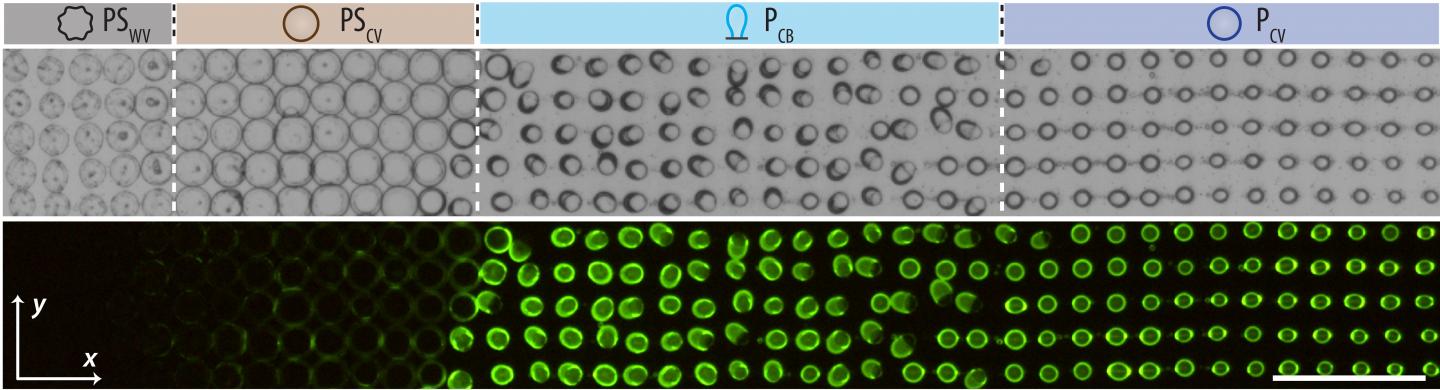
The team first used ultrasonic waves to create regular rows of thousands of droplets containing the energy storage molecule ATP.
They then allowed shape-shifting molecules (artificial morphogens) to diffuse in one direction through the population.

As the morphogens came into contact with the droplets, the droplets transformed row by row into membrane-bounded protocells with different shapes, chemical compositions and enzyme activities. How the droplets changed was dependent on the local morphogen concentration in the advancing chemical gradient.

Waves of differentiation were seen to travel across the population, leaving a pattern of differentiated protocells such that a complex and ordered community emerged spontaneously from the homogeneous population.

Professor Mann said: “This work opens up a new horizon in protocell research because it highlights the opportunities for spontaneously constructing protocell communities with graded structure and functionality.

“Although the research is just beginning, the results provide a step towards developing artificial cell platforms for chemical sensing and monitoring under non-equilibrium (flow-based) conditions.”

Dr Tian added: “As droplet-based protocells have been proposed as plausible progenitors to membrane-bounded protocells on the early Earth, our work could have implications for contemporary theories of the origin of life.

“In particular, as chemical gradients produce protocell diversity from uniform populations, maybe a similar mechanism was responsible for the emergence of functional complexity in ancient proto-living systems.”

###

Media Contact
Stephen Mann
[email protected]

Tags: Chemistry/Physics/Materials Sciences
Share12Tweet8Share2ShareShareShare2

Related Posts

Researchers Develop High-Efficiency Hydrogen Separation Membranes Using Innovative ‘Mortar-and-Brick’ Design — Chemistry

Researchers Develop High-Efficiency Hydrogen Separation Membranes Using Innovative ‘Mortar-and-Brick’ Design

May 13, 2026
Green Electrosynthesis Paves the Way for Direct Amines Production from Atmospheric Nitrogen — Chemistry

Green Electrosynthesis Paves the Way for Direct Amines Production from Atmospheric Nitrogen

May 13, 2026

Decoding Life’s Chemistry: A Revolutionary Search Engine from Molecules to Meaning

May 13, 2026

How Olympic Weightlifting Harnesses the Barbell’s ‘Whip’ for Peak Performance #ASA190

May 13, 2026
Please login to join discussion

POPULAR NEWS

  • Research Indicates Potential Connection Between Prenatal Medication Exposure and Elevated Autism Risk

    842 shares
    Share 337 Tweet 211
  • New Study Reveals Plants Can Detect the Sound of Rain

    729 shares
    Share 291 Tweet 182
  • Salmonella Haem Blocks Macrophages, Boosts Infection

    62 shares
    Share 25 Tweet 16
  • Breastmilk Balances E. coli and Beneficial Bacteria in Infant Gut Microbiomes

    57 shares
    Share 23 Tweet 14

About

We bring you the latest biotechnology news from best research centers and universities around the world. Check our website.

Follow us

Recent News

Lineage and Organ Signals Forge Intrinsic Nerves

Functional Ability and Heat Vulnerability in Older Adults

Impact of Invitation Types on Breast Screening Attendance

Subscribe to Blog via Email

Enter your email address to subscribe to this blog and receive notifications of new posts by email.

Join 82 other subscribers
  • Contact Us

Bioengineer.org © Copyright 2023 All Rights Reserved.

Welcome Back!

Login to your account below

Forgotten Password?

Retrieve your password

Please enter your username or email address to reset your password.

Log In
No Result
View All Result
  • Homepages
    • Home Page 1
    • Home Page 2
  • News
  • National
  • Business
  • Health
  • Lifestyle
  • Science

Bioengineer.org © Copyright 2023 All Rights Reserved.