


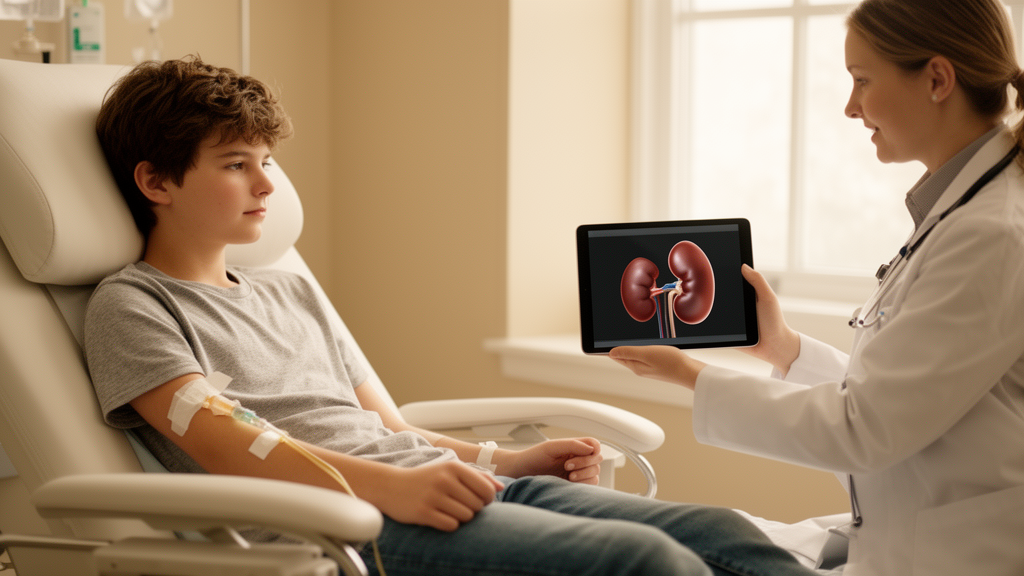
A 17-year-old boy with testicular cancer that had spread to his lungs, spine, mediastinal lymph nodes, liver, and right kidney received extensive cisplatin-based chemotherapy, and his kidneys began to show the strain. Three months into treatment, nephrologists at the University of Texas Health Science Center at Houston and MD Anderson Cancer Center found him with elevated blood pressure, a declining estimated glomerular filtration rate of 62 mL/min/1.73 m2 on the CKiD U25 equation, and persistent hypomagnesemia that oral supplements alone could not correct. At that point his cumulative cisplatin dose had reached 300 mg/m2, and his blood pressure measured 142/78.
The clinical team added dapagliflozin, a sodium glucose cotransporter 2 inhibitor, at 5 mg daily, alongside irbesartan 150 mg daily for blood pressure control. Two weeks later, because his magnesium levels remained low, the dapagliflozin dose was raised to 10 mg daily, and irbesartan was increased to 300 mg daily as his blood pressure climbed to 155/76. He received no additional cisplatin during that two-week interval. Bleomycin-induced pulmonary toxicity then forced a switch from the standard BEP regimen of bleomycin, etoposide, and cisplatin to TIP, combining paclitaxel, ifosfamide, and cisplatin, which brought his cumulative cisplatin exposure to 555 mg/m2.
The course grew more complicated when rising tumor markers four months into treatment led to hematopoietic stem cell transplantation with carboplatin conditioning at a cumulative dose of 750 mg/m2. His post-transplant recovery was derailed by septic shock and acute kidney injury that did not require dialysis. Dapagliflozin was temporarily held during the kidney injury episode and restarted once renal function recovered. When the malignancy proved refractory after transplantation, treatment moved to an epirubicin and cisplatin regimen, and two further cycles raised his total cumulative cisplatin exposure to 735 mg/m2.
What followed is the core of the case report published in Frontiers in Pediatrics. While taking dapagliflozin, he no longer needed intravenous magnesium and maintained adequate serum levels on oral supplementation alone. His antihypertensive therapy was fully discontinued three months after the SGLT2 inhibitor was started, and glucosuria appeared on urinalysis, the expected signature of the drug’s mechanism.
The drug is eliminated through the kidneys and taken up by renal tubular cells via transporters including copper transporter 1, accumulating especially in proximal tubular cells where it damages DNA, generates oxidative stress, and injures mitochondria. Vasoconstriction of renal blood vessels adds ischemic injury. The reported rate of cisplatin-induced nephrotoxicity is 28 to 30 percent, and the risk is higher in patients receiving more than 50 mg/m2 of body surface area. The toxicity is dose-dependent and can appear as acute kidney injury, chronic kidney disease, or both, often forcing dose reductions or discontinuation of a otherwise essential drug.
Magnesium wasting follows a similar dose-dependent pattern and arises early, frequently before serum creatinine rises or filtration rate falls, because cisplatin’s primary toxicity targets the proximal convoluted tubule while relatively sparing the glomeruli. Among patients affected by cisplatin-induced nephrotoxicity, up to 90 percent also experience hypomagnesemia, often requiring aggressive supplementation to keep serum levels normal. The authors note that magnesium supplementation itself has been shown to protect against the nephrotoxicity even when serum magnesium stays within the normal range, hinting at a protective effect independent of systemic magnesium concentration.
SGLT2 inhibitors work by blocking glucose reabsorption in the proximal tubule, producing glucosuria, and by blocking sodium reabsorption, which drives natriuresis, reduces total body volume, and lowers blood pressure. The class has established benefit in slowing diabetic and other chronic kidney disease by preserving filtration function. Animal studies add mechanistic support: cisplatin-treated animals given SGLT2 inhibitors showed significantly lower plasma urea and creatinine, reduced urinary NGAL and albumin-to-creatinine ratios, decreased inflammatory markers such as TNF-alpha and interleukin-6, and elevated antioxidant levels. These drugs also regulate expression of NKCC2, claudin-16, and TRPM6, which the authors link to reduced magnesium wasting.
A recent large retrospective cohort study found that SGLT2 inhibitor use mitigated cisplatin-induced nephrotoxicity and cisplatin-induced hypomagnesemia in diabetic patients, and individual case reports have described the drugs being used for cisplatin-related magnesium loss. The authors describe a characteristic initial fluctuation in serum creatinine after dapagliflozin initiation and titration, reflecting the acute hemodynamic changes and reduced intraglomerular pressure typical of the class, followed by a stable maintenance phase.
Adult clinical trials have shown an elevated risk of genital infections with SGLT2 inhibitors and an increased risk of urinary tract infections specifically with dapagliflozin 10 mg daily, the dose this patient ultimately took. SGLT2 inhibitor-induced glucosuria creates a urinary environment that favors bacterial growth, though in adults these infections are predominantly lower urinary tract genital mycotic infections rather than severe infections or urosepsis. Whether the same risk profile applies to children is uncharacterized, and pediatric patients with congenital anomalies of the kidney and urinary tract already carry heightened baseline infection risk from urinary obstruction, vesicoureteral reflux, or clean intermittent catheterization.
The authors are careful about what this single case can and cannot show. Concurrent irbesartan, which was given for hypertension throughout much of the course, represents a study limitation because it could have influenced renal recovery, and no urinary magnesium wasting indices were collected to directly measure the drug’s effect on magnesium handling. They frame their conclusion as a hypothesis: that SGLT2 inhibitor therapy stabilized renal function and mitigated magnesium loss despite extensive cisplatin exposure in this adolescent. The case, they write, highlights the need for further studies to establish whether SGLT2 inhibitors provide true nephroprotection against cisplatin toxicity in children.
Subject of Research: Use of an SGLT2 inhibitor to manage cisplatin-induced nephrotoxicity and hypomagnesemia in a pediatric cancer patient
Article Title: Case Report: Sodium glucose cotransporter 2 inhibitor use in a pediatric patient with cancer receiving cisplatin
Article References: Elsamny, E., Elgehiny, A., & Swinford, R. (2026). Case Report: Sodium glucose cotransporter 2 inhibitor use in a pediatric patient with cancer receiving cisplatin. Frontiers in Pediatrics, 14, 1906970. https://doi.org/10.3389/fped.2026.1906970
Image Credits: AI Generated
DOI: 10.3389/fped.2026.1906970
Keywords: cisplatin, nephrotoxicity, SGLT2 inhibitor, dapagliflozin, hypomagnesemia, pediatric oncology, germ cell tumor, kidney function, proteinuria, case report, Case, Report
News Source: Jerry Hayes. (October 30, 2026). SGLT2 inhibitor stabilized kidney function in teen on cisplatin. Scienmag.



