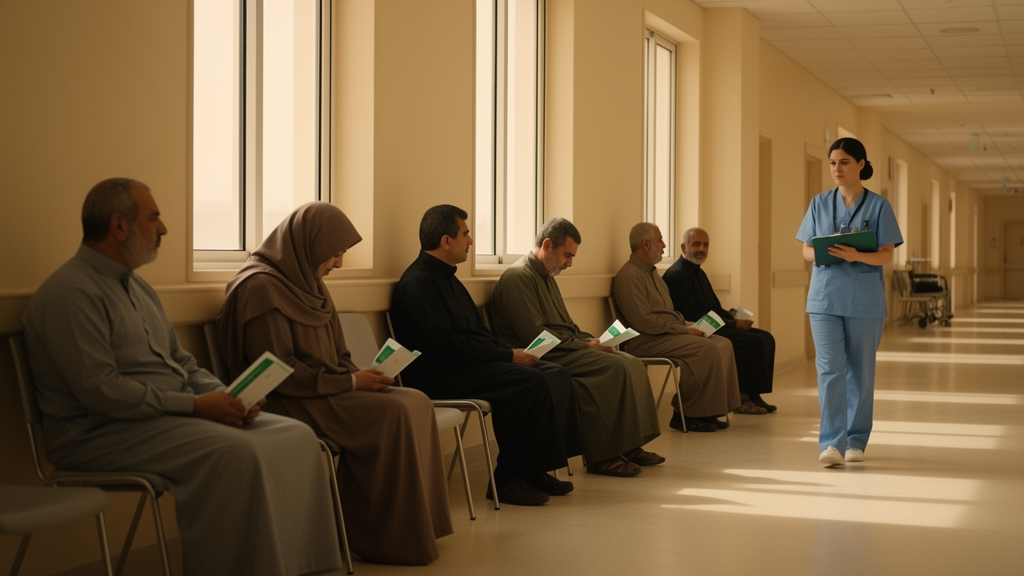
For a decade, a single hospital in Riyadh carried the entire lung transplant burden of Saudi Arabia. Between January 2014 and December 2023, King Faisal Specialist Hospital and Research Centre (KFSHRC) stood as the only center in the country performing lung-only transplantation, and donor lungs were allocated by clinical judgment rather than a formal scoring system. That unusual arrangement has now yielded something rare in transplant medicine: a complete national baseline of waitlist outcomes from a region outside North America and Europe, captured just before the country overhauled its allocation policy.
A team of researchers led by Rayid Abdulqawi and colleagues at KFSHRC’s Organ Transplant Centre of Excellence combed through the records of every adult patient listed for a first-time lung transplant at the center during that ten-year window, following them until June 30, 2025. Their analysis, published as a letter in Transplant International, tracked 368 candidates with a median age of 45 years, 52 percent of them male. The most common indication was restrictive lung disease, accounting for 60.9 percent of listings, and nearly half of all candidates—48.1 percent—carried blood type O. The researchers applied competing risk regression, a statistical framework that distinguishes the probability of receiving a transplant from the probability of dying or deteriorating on the waitlist, since these outcomes are mutually exclusive and each competes to be the first event a patient experiences.
The headline numbers tell a story of both achievement and inequity. Seventy percent of listed patients—257 individuals—ultimately received new lungs, while 13.6 percent died waiting, 7.9 percent were removed for other reasons, and 8.7 percent remained on the list when follow-up ended. The unadjusted one-year cumulative incidence of transplantation was 63.5 percent, with waitlist mortality at 9.2 percent and removal at 5.0 percent. The median wait from listing to surgery was 118 days, and that duration was statistically indistinguishable between women and men. But the crude similarity of waiting times masked a deeper imbalance that only emerged when the researchers adjusted for clinical and demographic confounders.
In the multivariable Fine-Gray competing risk analysis, male candidates had a 70 percent greater likelihood of undergoing transplantation than female candidates, with a subdistribution hazard ratio of 1.70 and a 95 percent confidence interval of 1.23 to 2.36. The disparity persisted even after accounting for two well-documented biological disadvantages faced by women: significantly higher rates of HLA sensitization and shorter stature. Nearly 28 percent of female candidates had a calculated panel reactive antibody of 50 percent or above, compared with 9.5 percent of males, and 19.1 percent of women exceeded the 80 percent threshold against just 2.6 percent of men. Sensitization narrows the pool of compatible donors because highly sensitized recipients are more likely to reject organs carrying HLA antigens they have already been exposed to, typically through pregnancy, transfusion, or prior transplantation. Shorter stature, meanwhile, constrains which donor lungs fit the recipient’s chest cavity.
Blood group O carried its own penalty. Candidates with type O blood had a 43 percent lower likelihood of transplantation, with a hazard ratio of 0.43, and faced a 2.2-fold greater risk of dying on the waitlist. The mechanism is straightforward: type O recipients can only accept organs from type O donors, while type O donors are universal donors whose lungs can go to candidates of any blood group. When allocation rests on clinical judgment rather than a formal scoring system, the arithmetic of ABO compatibility quietly works against the largest compatible group of candidates. The authors note that blood group O was the most common among their cohort, meaning the penalty touched nearly half of everyone waiting.
The sex disparity echoes findings from the United States, where an Organ Procurement and Transplantation Network-based analysis by Riley and Lascano documented gender and racial gaps in lung transplant access, and from France, where researchers reported increased delays to transplantation for women candidates. What makes the Saudi result striking is that the disparity survived adjustment for sensitization and anthropometric differences, leading the authors to suggest that systemic barriers beyond clinical or height-related factors may have contributed—though they caution that the retrospective design leaves open the influence of unmeasured variables.
Post-transplant outcomes added another layer to the picture. Female recipients spent significantly longer on mechanical ventilation and in the hospital and intensive care unit, and required postoperative ECMO more frequently than their male counterparts, although 90-day mortality was comparable between the sexes. The authors point to donor-recipient size mismatch as a plausible driver: with 78.6 percent of donors being male and a median donor age of 41, the predominantly male donor pool disproportionately disadvantages women, whose shorter stature increases the odds of receiving oversized lungs. Higher HLA sensitization burdens may compound the early postoperative difficulty. Graft survival probabilities stood at 86 percent at one year, 72 percent at three years, and 55 percent at five years.
The disease distribution in the Saudi cohort also diverged from Western registries, with restrictive lung disease dominating and a relatively young candidate population—findings the authors argue underscore the importance of understanding regional variation in transplant candidacy rather than importing allocation assumptions from other continents. Until early 2024, when a second lung transplant center opened and the Composite Allocation Score was adopted nationally, priority decisions rested entirely on the transplant team’s clinical judgment. The new data now provide a pre-CAS benchmark against which future studies can measure whether a formal allocation system improves equity and timely access.
Donor scarcity remains the fundamental constraint. Saudi Arabia’s deceased donation rate of 4.0 per million population sits far below Spain’s 49.4 and the United States’ 48.0, and reported local barriers include confusion between brain death and coma, inconsistent ICU communication, and religious and cultural hesitancy despite formal religious approval of organ donation. National efforts such as the Saudi Center for Organ Transplantation’s Proactive Detection Program and digital donor registration initiatives aim to expand the pool, while the authors propose broader use of extended-criteria donors, donation after circulatory death, ex vivo lung perfusion, novel preservation technologies, and a Gulf Cooperation Council-wide organ-sharing network modeled on Eurotransplant. Living-donor lobar lung transplantation may offer another route, particularly given Saudi Arabia’s comparatively strong living-donation culture.
The study carries the usual limitations of retrospective design, including vulnerability to unmeasured confounding, and its generalizability to the current national context is constrained by the recent establishment of a second transplant program and the adoption of the CAS system. Still, the authors conclude that their findings reveal disparities in transplant access by sex and blood group, and that the data furnish a national pre-CAS benchmark for determining whether formal allocation improves equity in lung transplantation across Saudi Arabia.
Subject of Research: Disparities in outcomes among patients on lung transplantation waitlist in Saudi Arabia
Article Title: Disparities in outcomes among patients on lung transplantation waitlist in Saudi Arabia
Article References: Albatli, A., Fadhel, R., Yousef, Y. R., Ahmed Saleh, R., Aldakhil, H., Altwaijri, Y., Albaiz, F., Alkattan, K., Saleh, W., Alawwami, M., Alzahrani, A., Thalib, H., Almudaiheem, B., Marquez, K., & Abdulqawi, R. (2026). Disparities in outcomes among patients on lung transplantation waitlist in Saudi Arabia. Transplant International, 39, Article 17165. https://doi.org/10.3389/ti.2026.17165
Image Credits: AI Generated
Keywords: Disparities, outcomes, patients, lung, transplantation, waitlist, Saudi, Arabia, scientific research
News Source: Drew Townsend. (October 17, 2026). Sex and Blood Group Disparities Mark Saudi Arabia’s Lung Transplant Waitlist. Scienmag.