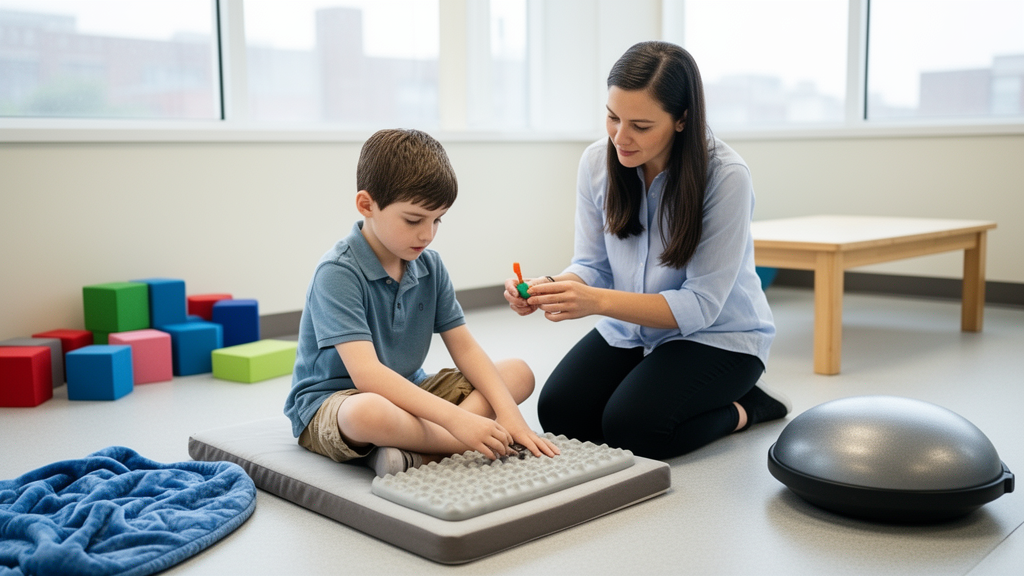
A 12-week sensory integration therapy program was associated with modest reductions in autism symptom severity and improvements in several sensory-processing domains among 30 children with autism spectrum disorder in a non-randomized pre-post intervention study. Researchers recruited participants from the sensory integration therapy clinic at the Child and Adolescent Psychiatry Department of Okasha Institute of Psychiatry, Ain Shams University, in Cairo, between May 2023 and January 2025.
Children aged 3 to 10 received one 30-minute sensory integration therapy session each week for 12 weeks. The researchers assessed them before and after the intervention using the Childhood Autism Rating Scale and a caregiver-completed Sensory Profile questionnaire. Mean CARS scores decreased from 33.9, with a standard deviation of 3.42, before treatment to 31.95, with a standard deviation of 3.40, afterward. The proportion of participants classified as having mild autism increased to 76.67%, while the proportion classified as having moderate autism decreased to 10%; severe cases remained unchanged. Because the study did not include a randomized comparison group, the results show changes over time during the intervention rather than establishing that therapy caused the improvements.
The sensory questionnaire identified the largest changes in vestibular processing, emotional and social responses, emotionally reactive behavior, and inattention or distractibility, each with a reported p-value below 0.001. Auditory processing and modulation of body position and movement in relation to activity level also changed, with p-values of 0.001. The smallest changes were observed in sensory processing related to endurance or tone, including low endurance or tone. Before the intervention, the most affected domains were vestibular processing, emotional and social responses, behavioral outcomes associated with sensory processing, and fine-motor and perceptual functioning.
The cohort was small and had a limited demographic profile. Boys represented 80% of the participants, and 46.66% were between three and five years old. IQ scores for 73.33% of the children fell within the narrow range of 60 to 64. In addition to CARS and the Sensory Profile, the study used a sociodemographic and clinical questionnaire, an Arabic version of the Schedule for Affective Disorders and Schizophrenia for School-Age Children, Present and Lifetime Version, and the Stanford–Binet Intelligence Scales, Fifth Edition. The trial was registered retrospectively on ClinicalTrials.gov in March 2025 under the identifier NCT06882642.
The findings offer a measured picture of change after a short course of sensory integration therapy: the average autism symptom score fell, and children showed improvement in several sensory and behavioral domains, with the clearest responses occurring in vestibular, emotional and social, and attention-related measures. The study design and small, demographically narrow sample constrain the strength of interpretation, particularly because every participant received the intervention and no randomized comparison group was available. The authors concluded that sensory integration therapy effectively reduced autism severity and improved key sensory and behavioral domains of sensory processing, particularly in mild-to-moderate cases. The article was reported in BMC Pediatrics and published on 22 October 2026.
Subject of Research: Pre-post outcomes of 12-week sensory integration therapy in children with autism spectrum disorder
Article Title: Outcomes of sensory integration therapy in children with autism spectrum disorder: a non-randomized pre-post intervention study
Article References: Rahman, R. M. A., Sayed, M. M., Samei, A. M. A., El Sheikh, M. M., & Mohamed, M. Y. (2026). Outcomes of sensory integration therapy in children with autism spectrum disorder: a non-randomized pre-post intervention study. BMC Pediatrics. https://doi.org/10.1186/s12887-026-07568-x
Image Credits: AI Generated
DOI: 10.1186/s12887-026-07568-x
Keywords: autism spectrum disorder, sensory integration therapy, children, CARS, sensory processing, vestibular processing, autism severity, behavioral outcomes, pre-post study, non-randomized study, Outcomes, sensory
News Source: Ophelia Keating. (October 24, 2026). Sensory integration therapy linked to modest improvements in 30 autistic children. Scienmag.