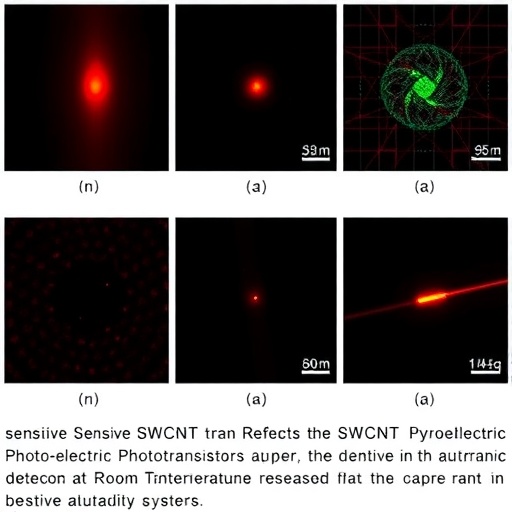
In a groundbreaking advancement poised to revolutionize infrared (IR) detection technology, researchers at the Skolkovo Institute of Science and Technology (Skoltech) in Russia have unveiled a novel phototransistor design that operates effectively at room temperature, bypassing the need for bulky and costly cryogenic cooling. Led by Dr. Svetlana I. Serebrennikova and Professor Albert G. Nasibulin, the team combined the extraordinary electrical properties of single-walled carbon nanotubes (SWCNTs) with the pyroelectric characteristics of lithium niobate (LiNbO₃) to engineer a detector that achieves remarkable sensitivity across a broad spectral range.
Infrared detection plays a vital role in fields ranging from firefighting thermal imaging and automotive night vision to environmental gas sensing and secure optical communications. However, the sensitivity of conventional IR sensors typically hinges on cryogenic cooling, limiting their portability and affordability. The newly developed device skillfully circumvents this limitation by exploiting the pyroelectric effect inherent in LiNbO₃ crystals. When exposed to infrared light, LiNbO₃ experiences a subtle temperature rise that induces a transient shift in its internal electric polarization—generating an electric field that acts as a dynamic gate voltage for the attached SWCNT network.
This strategic integration is significant because SWCNTs are semiconducting nanomaterials with an electronic bandgap, allowing their conductivity to respond dramatically—to as much as a 10⁵ fold change—under slight variations in gate voltage. This sets them apart from graphene, which, despite its versatile electronic properties, lacks a bandgap and thus exhibits limited conductivity modulation in response to gating fields. Essentially, the device transduces minute thermal fluctuations caused by IR radiation into amplified electrical signals through pyroelectric gating, forming a highly sensitive phototransistor.
Fabrication of these detectors involved cultivating high-quality, sparse networks of SWCNTs using refined aerosol chemical vapor deposition. These nanotube films were then transferred onto z-cut LiNbO₃ substrates via an innovative dry capillary transfer method, mitigating contamination and preserving electronic integrity. Metal electrodes were lithographically patterned to complete the device architecture. The resulting phototransistors demonstrate sensitivity to light spanning the visible spectrum to wavelengths as long as 9.3 micrometers, achieving specific detectivities on the order of 10¹⁰ cm·Hz¹/²/W. These figures not only surpass previous graphene-based pyroelectric devices by orders of magnitude but also approach the theoretical limits for uncooled thermal detectors.
Beyond their impressive sensitivity, these SWCNT-LiNbO₃ phototransistors offer practical advantages vital for real-world applications. Their ability to function reliably without cooling enables lightweight, low-power sensors ideal for portable uses, such as handheld thermal cameras, drone-mounted environmental monitors, and gas leak detectors. This democratization of IR sensing could profoundly impact public safety, industrial monitoring, automotive technology, and healthcare diagnostics.
While the current devices have a response time limited to around two seconds—primarily due to thermal diffusion through the 500-micrometer-thick LiNbO₃ substrate—the research team is actively exploring design improvements. Strategies include employing thinner substrates or membrane structures to expedite thermal response and adding protective coatings to enhance stability and reduce hysteresis. Optimizing thermal coupling to heat sinks is also expected to sharpen speed and spatial resolution for advanced beam profiling.
This development represents a pivotal step toward compact, broadband, room-temperature IR detectors that rival cooled sensors in sensitivity while offering unparalleled portability and cost-effectiveness. By marrying cutting-edge nanomaterial synthesis with pyroelectric phenomena, the researchers at Skoltech have charted a promising course for the next generation of infrared sensing technologies set to reshape multiple industries.
Article Title: Highly sensitive SWCNT-based pyroelectric phototransistors for broadband room temperature infrared detection
News Publication Date: 14-May-2026
References: DOI: 10.29026/oea.2026.260019
Image Credits: Professor Albert G. Nasibulin, Skolkovo Institute of Science and Technology, Russia
Keywords
Infrared detection, single-walled carbon nanotubes, pyroelectric effect, lithium niobate, room temperature sensor, phototransistor, nanomaterials, aerosol chemical vapor deposition, uncooled thermal detectors, optoelectronics
Tags: advanced IR detection at room temperaturebroadband IR detection technologiescryogen-free infrared sensorsenvironmental gas sensing IR sensorslithium niobate pyroelectric effectnanomaterial-based phototransistorsnanotechnology in infrared sensingportable thermal imaging devicesroom temperature infrared photodetectorssecure optical communication detectorssingle-walled carbon nanotubes pyroelectric sensorsSWCNTs and lithium niobate hybrid devices