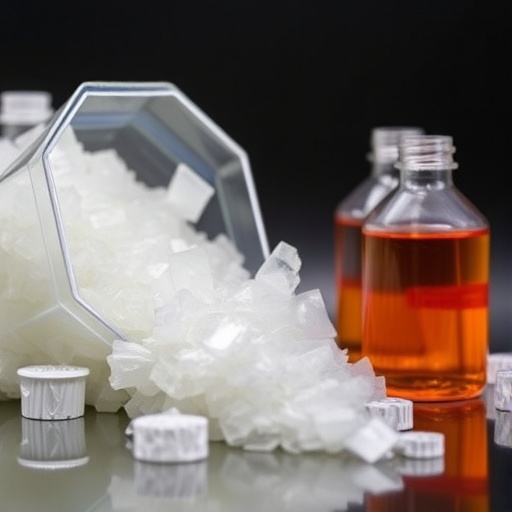
A groundbreaking advancement in polymer recycling promises to revolutionize the fate of one of the most persistent plastic pollutants: polystyrene (PS). Constituting about one-third of landfill waste globally, polystyrene’s backbone of robust carbon–carbon bonds has long stymied efforts to break it down into valuable chemicals. However, researchers have now pioneered a selective depolymerization and hydrogenolysis process that converts polystyrene waste almost exclusively into toluene, a highly sought-after industrial chemical.
Traditional pyrolysis methods grapple with a fundamental thermodynamic contradiction. Depolymerization—the breakdown of long polymer chains—requires high temperatures to cleave the inert C–C bonds, yet these conditions degrade the activity of catalysts essential for hydrogenolysis, the subsequent step that refines depolymerized fragments into simpler molecules. As a result, conventional processes yield complex mixtures of monocyclic and polycyclic aromatics rather than a singular, valuable product.
To circumvent this limitation, the new approach employs a tandem system that physically and thermally separates the depolymerization and hydrogenolysis stages. In the first phase, polystyrene is depolymerized at a high temperature of 475 °C, producing aromatic intermediates. These intermediates are then subjected to vapor-phase hydrogenolysis at a significantly lower temperature of 275 °C and mild pressure over a novel ruthenium single-atom catalyst supported on Co₃O₄ (RuSA/Co₃O₄).
This ruthenium single-atom catalyst plays a pivotal role, lowering the energy barrier for cleaving Csp²–Csp₃ and Csp₃–Csp₃ bonds within the intermediates—key steps in steering the reaction toward the exclusive formation of toluene. Additionally, it facilitates toluene’s rapid desorption from catalytic sites, preventing side reactions that would generate undesired byproducts.
The system achieves an unprecedented 99% selectivity for toluene with an impressive yield of 83.5 wt%. Moreover, it demonstrates remarkable versatility, efficiently processing assorted polystyrene waste streams while maintaining high yields and selectivity. This process also offers promising economic feasibility and a reduced carbon footprint, underscoring its potential for sustainable industrial adoption.
Toluene’s importance as a chemical feedstock cannot be overstated; global demand is projected to soar from 37 million tons today to 77 million tons by 2035. Given that the phenyl group constitutes around 74% of polystyrene’s mass, selectively converting polystyrene into toluene not only valorizes waste but also advances circular carbon strategies and reduces dependence on fossil-derived petrochemicals.
Despite this breakthrough, industrial adoption faces challenges such as ensuring continuous plastic feeding, accommodating diverse plastic types like polyethylene and polypropylene, managing mixed plastic streams, and achieving sustainable energy integration at scale. Future efforts will need to refine catalyst stability, activity, selectivity, and delve deeper into reaction mechanisms to broaden applicability.
This pioneering work exemplifies how rational catalyst design married with innovative process engineering can break long-standing trade-offs between yield and product selectivity. By transforming polystyrene waste into a single high-value product, the strategy charts a transformative course for plastic recycling, elevating it from indiscriminate degradation to targeted chemical synthesis.
Subject of Research:
Not applicable
Article Title:
Polystyrene waste valorization via selective C−C bond cleavage: the second life of polymers
News Publication Date:
10-May-2026
Web References:
http://dx.doi.org/10.1007/s11705-026-2664-4
Keywords
Polystyrene recycling, selective C–C bond cleavage, hydrogenolysis, ruthenium single-atom catalyst, toluene production, tandem depolymerization, plastic waste valorization, catalyst design, sustainable chemistry
Tags: advanced catalytic recycling methodsenvironmentally friendly plastic breakdownhydrogenolysis of polystyrenelandfill waste reductionplastic waste depolymerizationpolymer waste conversionpolystyrene recyclingruthenium single-atom catalystselective chemical recyclingsustainable plastic waste managementtandem catalytic processtoluene production from plastics