• HOME
  • NEWS
  • EXPLORE
    • CAREER
      • Companies
      • Jobs
    • EVENTS
    • iGEM
      • News
      • Team
    • PHOTOS
    • VIDEO
    • WIKI
  • BLOG
  • COMMUNITY
    • FACEBOOK
    • INSTAGRAM
    • TWITTER
Sunday, May 10, 2026
BIOENGINEER.ORG
No Result
View All Result
  • Login
  • HOME
  • NEWS
  • EXPLORE
    • CAREER
      • Companies
      • Jobs
        • Lecturer
        • PhD Studentship
        • Postdoc
        • Research Assistant
    • EVENTS
    • iGEM
      • News
      • Team
    • PHOTOS
    • VIDEO
    • WIKI
  • BLOG
  • COMMUNITY
    • FACEBOOK
    • INSTAGRAM
    • TWITTER
  • HOME
  • NEWS
  • EXPLORE
    • CAREER
      • Companies
      • Jobs
        • Lecturer
        • PhD Studentship
        • Postdoc
        • Research Assistant
    • EVENTS
    • iGEM
      • News
      • Team
    • PHOTOS
    • VIDEO
    • WIKI
  • BLOG
  • COMMUNITY
    • FACEBOOK
    • INSTAGRAM
    • TWITTER
No Result
View All Result
Bioengineer.org
No Result
View All Result
Home NEWS Science News Chemistry

Semimetals are high conductors

Bioengineer by Bioengineer
March 18, 2019
in Chemistry
Reading Time: 2 mins read
0
IMAGE
Share on FacebookShare on TwitterShare on LinkedinShare on RedditShare on Telegram

IMAGE

Credit: Sergey Savrasov, UC Davis

Researchers in China and at UC Davis have measured high conductivity in very thin layers of niobium arsenide, a type of material called a Weyl semimetal. The material has about three times the conductivity of copper at room temperature, said Sergey Savrasov, professor of physics at UC Davis. Savrasov is a coauthor on the paper published March 18 in Nature Materials.

New materials that conduct electricity are of great interest to physicists and materials scientists, both for basic research and because they could lead to new types of electronic devices.

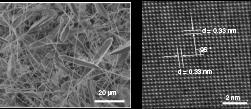
Savrasov works on theoretical condensed matter physics. With others, he proposed the existence of Weyl semimetals in 2011. The Chinese team were able to fabricate and test small pieces, called nanobelts, of niobium arsenide, confirming the predictions of theory. The nanobelts are so thin they are essentially two-dimensional.

“A Weyl semimetal is not a conductor or an insulator, but something in between,” Savrasov said. Niobium arsenide, for example, is a poor conductor in bulk but has a metallic surface that conducts electricity. The surface is topologically protected, meaning that it cannot be changed without destroying the bulk material.

With most materials, surfaces can be chemically altered as they pick up impurities from the environment. These impurities can interfere with conductivity. But topologically protected surfaces reject these impurities.

“In theory we expect Weyl surfaces to be good conductors as they don’t tolerate impurities,” Savrasov said.

If you think of electrons flowing through material, imagine them bouncing off or scattering from impurities. At the quantum level, a conductive material has a Fermi surface which describes all the quantum energy states that electrons can occupy. This Fermi surface affects conductivity of the material.

The nanobelts tested in these experiments had a limited Fermi surface or Fermi arc, meaning that electrons could only be scattered to a limited range of quantum states.

“The Fermi arc limits the states electrons can bounce back to, therefore they are not scattered,” Savrasov said.

Materials that are highly conductive at very small scales could be useful as engineers strive to build smaller and smaller circuits. Less electrical resistance means that less heat is generated as current passes through.

###

Coauthors on the paper are Cheng Zhang, Zhuoliang Ni, Jinglei Zhang, Xiang Yuan, Yanwen Liu, Yichao Zou, Zhiming Liao, Yongping Du, Awadhesh Narayan, Hongming Zhang, Tiancheng Gu, Xuesong Zhu, Li Pi, Stefano Sanvito, Xiaodong Han, Jin Zou, and Faxian Xiu. The research institutions represented include Fudan University, Shanghai; Chinese Academy of Sciences, Hefei; Nanjing University of Science and Technology and Nanjing University, Nanjing; Beijing University of Technology; the University of Queensland, Australia; ETH Zurich, Switzerland; and Trinity College Dublin, Ireland. Funding support came from the National Natural Science Foundation of China and other Chinese government agencies; U.S. National Science Foundation; the Australian Research Council; and Science Foundation Ireland.

Media Contact
Andy Fell
[email protected]

Original Source

https://egghead.ucdavis.edu/2019/03/18/semimetals-are-high-conductors/

Tags: Chemistry/Physics/Materials SciencesMaterialsSuperconductors/Semiconductors
Share12Tweet8Share2ShareShareShare2

Related Posts

Miniature Sensor Uses Light to Detect Touch — Chemistry

Miniature Sensor Uses Light to Detect Touch

May 8, 2026
Iron Minerals Determine Whether Dissolved Organic Matter Fuels Microbes or Becomes Long-Term Carbon Storage — Chemistry

Iron Minerals Determine Whether Dissolved Organic Matter Fuels Microbes or Becomes Long-Term Carbon Storage

May 8, 2026

Kate Evans Appointed Associate Lab Director for Biological and Environmental Systems Science at ORNL

May 8, 2026

Advancing Multiscale Modeling and Overcoming Operational Challenges in Autothermal COâ‚‚-to-Methanol Reactors

May 8, 2026
Please login to join discussion

POPULAR NEWS

  • Research Indicates Potential Connection Between Prenatal Medication Exposure and Elevated Autism Risk

    840 shares
    Share 336 Tweet 210
  • New Study Reveals Plants Can Detect the Sound of Rain

    727 shares
    Share 290 Tweet 181
  • Scientists Investigate Possible Connection Between COVID-19 and Increased Lung Cancer Risk

    68 shares
    Share 27 Tweet 17
  • Salmonella Haem Blocks Macrophages, Boosts Infection

    61 shares
    Share 24 Tweet 15

About

We bring you the latest biotechnology news from best research centers and universities around the world. Check our website.

Follow us

Recent News

Evaluating Digoxin Use in Patients with Symptomatic Rheumatic Heart Disease

Evaluating the Effectiveness and Safety of Digitalis Glycosides in Treating Heart Failure

Urdu Fall Risk Questionnaire Adapted for Elderly

Subscribe to Blog via Email

Enter your email address to subscribe to this blog and receive notifications of new posts by email.

Join 82 other subscribers
  • Contact Us

Bioengineer.org © Copyright 2023 All Rights Reserved.

Welcome Back!

Login to your account below

Forgotten Password?

Retrieve your password

Please enter your username or email address to reset your password.

Log In
No Result
View All Result
  • Homepages
    • Home Page 1
    • Home Page 2
  • News
  • National
  • Business
  • Health
  • Lifestyle
  • Science

Bioengineer.org © Copyright 2023 All Rights Reserved.