• HOME
  • NEWS
  • EXPLORE
    • CAREER
      • Companies
      • Jobs
    • EVENTS
    • iGEM
      • News
      • Team
    • PHOTOS
    • VIDEO
    • WIKI
  • BLOG
  • COMMUNITY
    • FACEBOOK
    • INSTAGRAM
    • TWITTER
Friday, May 22, 2026
BIOENGINEER.ORG
No Result
View All Result
  • Login
  • HOME
  • NEWS
  • EXPLORE
    • CAREER
      • Companies
      • Jobs
        • Lecturer
        • PhD Studentship
        • Postdoc
        • Research Assistant
    • EVENTS
    • iGEM
      • News
      • Team
    • PHOTOS
    • VIDEO
    • WIKI
  • BLOG
  • COMMUNITY
    • FACEBOOK
    • INSTAGRAM
    • TWITTER
  • HOME
  • NEWS
  • EXPLORE
    • CAREER
      • Companies
      • Jobs
        • Lecturer
        • PhD Studentship
        • Postdoc
        • Research Assistant
    • EVENTS
    • iGEM
      • News
      • Team
    • PHOTOS
    • VIDEO
    • WIKI
  • BLOG
  • COMMUNITY
    • FACEBOOK
    • INSTAGRAM
    • TWITTER
No Result
View All Result
Bioengineer.org
No Result
View All Result
Home NEWS Science News Chemistry

Semiconductor technology mitigates fire risk in electric vehicle batteries

Bioengineer by Bioengineer
September 6, 2025
in Chemistry
Reading Time: 2 mins read
0
IMAGE
Share on FacebookShare on TwitterShare on LinkedinShare on RedditShare on Telegram

Convergence of semiconductor physics and electrochemistry leads to effective inhibition of dendrite formation using semiconducting passivation layers

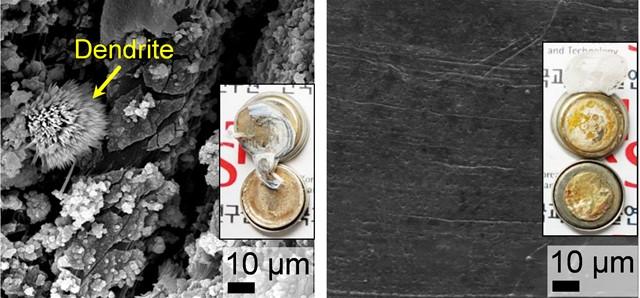
Despite rapid development of electric vehicles (EVs), the safety of the lithium-ion (Li-ion) batteries remains a concern as they are as a fire and explosion risk. Among the various approaches to tackle this issue, Korean researchers have used semiconductor technology to improve the safety of Li-ion batteries. A research team from the Korea Institute of Science and Technology (KIST) led by Dr. Joong Kee Lee of the Center for Energy Storage Research has succeeded in inhibiting the growth of dendrites, crystals with multiple branches that cause EV battery fires by forming protective semiconducting passivation layers on the surface of Li electrodes.

When Li-ion batteries are charged, Li ions are transported to the anode (the negative electrode) and are deposited on the surface as Li metal; at this point, tree-like dendrites are formed. These Li dendrites are responsible for the uncontrollable volumetric fluctuations and leads to reactions between the solid electrode and the liquid electrolyte, which causes a fire. Unsurprisingly, this severely degrades battery performance.

To prevent dendrite formation, the research team exposed fullerene (C60), a highly electronic conductive semiconductor material, to plasma, resulting in the formation of semiconducting passivation carbonaceous layers between the Li electrode and the electrolyte. The semiconducting passivation carbonaceous layers allow Li-ions to pass through while blocking electrons due to generation of Schottky barrier, and by preventing electrons and ions from interacting on the electrode surface and inside, they stops the formation of Li crystals and the consequent growth of dendrites.

*fullerene : a particular physical form of carbon in which 60 carbon atoms are connected by single and double bonds in a pentagonal shape to form a soccer ball-like shape

The stability of the electrodes with the semiconducting passivation carbonaceous layers was tested using Li/Li symmetric cells in extreme electrochemical environments where typical Li electrodes remain stable for up to 20 charge/discharge cycles. The newly developed electrodes showed significantly enhanced stability, with Li dendrite growth suppressed for up to 1,200 cycles. Moreover, using a lithium cobalt oxide (LiCoO2) cathode in addition to the developed electrode, approximately 81% of the initial battery capacity was maintained after 500 cycles, representing an improvement of approximately 60% over conventional Li electrodes.

###

This research was carried out as part of a KIST’s institutional R&D project and a mid-career researcher project. It also received funding as an outstanding new overseas research project from the National Research Foundation of Korea with the support of the Ministry of Science and ICT (MSIT). The results of this study are published in the latest issue of ‘ACS Energy Letters‘ (IF: 19.003, Top 1.852% in JCR), a highly respected international journal in the field of materials science.

Media Contact
Do-Hyun Kim
[email protected]

Related Journal Article

http://dx.doi.org/10.1021/acsenergylett.1c00150

Tags: Chemistry/Physics/Materials SciencesTechnology/Engineering/Computer Science
Share13Tweet8Share2ShareShareShare2

Related Posts

Study Reveals How Valproate Affects Early Brain Development: Insights into the Antiepileptic Drug’s Impact — Chemistry

Study Reveals How Valproate Affects Early Brain Development: Insights into the Antiepileptic Drug’s Impact

May 22, 2026
Sustainable Chemistry: Iron Replaces Noble Metals in Catalytic Reactions — Chemistry

Sustainable Chemistry: Iron Replaces Noble Metals in Catalytic Reactions

May 22, 2026

Advancing Thin-Film Device Manufacturing with Imaging Ellipsometry for Enhanced Process Control

May 22, 2026

Simple Adjustment in 3D Printing Enhances Fit of Dental Crowns

May 22, 2026
Please login to join discussion

POPULAR NEWS

  • blank

    New Study Reveals Plants Can Detect the Sound of Rain

    734 shares
    Share 293 Tweet 183
  • ESMO 2025: mRNA COVID Vaccines Enhance Efficacy of Cancer Immunotherapy

    309 shares
    Share 124 Tweet 77
  • Research Indicates Potential Connection Between Prenatal Medication Exposure and Elevated Autism Risk

    847 shares
    Share 339 Tweet 212
  • Breastmilk Balances E. coli and Beneficial Bacteria in Infant Gut Microbiomes

    58 shares
    Share 23 Tweet 15

About

We bring you the latest biotechnology news from best research centers and universities around the world. Check our website.

Follow us

Recent News

Breakthrough in Augmented Reality: Active Retinal Projection Display Achieves Pixel-to-Pixel Collimation

Scientists Discover Novel Biomarker Predicting Therapy Response in Pediatric Cancers

Innovative Microneedle Patch Speeds Up Oral Ulcer Healing Through Immune Modulation

Subscribe to Blog via Email

Enter your email address to subscribe to this blog and receive notifications of new posts by email.

Join 82 other subscribers
  • Contact Us

Bioengineer.org © Copyright 2023 All Rights Reserved.

Welcome Back!

Login to your account below

Forgotten Password?

Retrieve your password

Please enter your username or email address to reset your password.

Log In
No Result
View All Result
  • Homepages
    • Home Page 1
    • Home Page 2
  • News
  • National
  • Business
  • Health
  • Lifestyle
  • Science

Bioengineer.org © Copyright 2023 All Rights Reserved.