Credit: ©Science China Press
Quantum computing, along with 5G and AI, has been the focus for the next-generation technology in the last decades. Up to now, numerous physical systems have been investigated to build a test device for quantum computing, including superconducting Josephson junctions, trapped ions and semiconductors. Among them, the semiconductors is a new star for its high control fidelity and promise for integration with classical CMOS technology. Professor Guo-Ping Guo with his co-workers, Xin Zhang and Hai-Ou Li from the Key Laboratory of Quantum Information, Chinese Academy of Sciences, University of Science and Technology of China, reviewed recent developments of qubits based on semiconductors and discussed the challenges and opportunities for scalable quantum computing. This work, entitled “Semiconductor quantum computation” was published in National Science Review (Natl Sci Rev 2019; 6: 32-54).
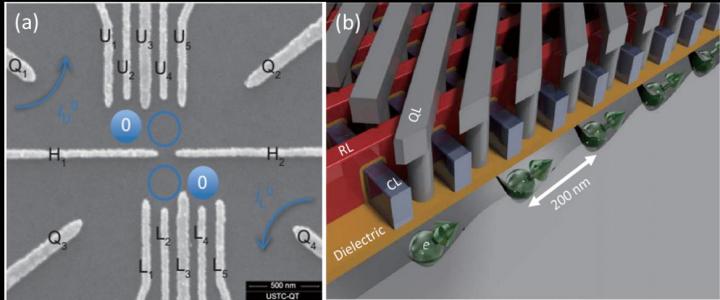
Qubit, or quantum bit, like the bit in a classical computer, is the basic unit of a quantum processor. According to the life cycle of a qubit technology, the typical qubit progression can be roughly divided into six stages. It starts from the demonstration of single- and two-qubit control and measurement of coherence time (Stage I), then moves to the benchmarking of control and readout fidelity of three to ten qubits (Stage II). With these developments, the demonstration of certain error correction of some physical qubits can be made (Stage III) and after that, a logical qubit made from error correction of physical qubits (Stage IV) and corresponding complex control should be completed (Stage V). Finally, a scalable quantum computer composed of such logical qubits is built for fault tolerant computing (Stage VI). In the fields of semiconductor quantum computing, there are various types of qubits spanning from spin qubits, charge qubits, singlet-triplet qubits, exchange-only qubits, hybrid qubits and etc. Among them, control of both single- and two-qubit gates were demonstrated for spin qubits, charge qubits and singlet-triplet qubits, which suggests they have finished stage I and the on-going researches shows the state II is also going to be completed. Up to now, benchmarking of single- and two-qubit control fidelity near the fault tolerant threshold were demonstrated and scaling up to three or more qubits are necessary in the following years. One example of such devices is shown in figure (a), which was fabricated by Guo guoping’s group at the University of Science and Technology of China for coherently controlling the interaction between two charge qubit states.
For further developments, there are still some challenges to resolve. In this review, the authors put forward three major problems as more effective and reliable readout methods, uniform and stable materials, and scalable designs. Approaches to overcome these obstacles have been investigated by a number of groups, such as employing microwave photons to detect charge or spin states and using purified silicon to replace gallium arsenide for spin control. The scalable designs with the strategy for wiring readout lines and control lines were also proposed, and in these plans the geometry and operation time constraints, engineering configuration for the quantum-classical interface, suitability for different fault tolerant codes to implement logical qubits were also discussed. One example of such design is illustrated in figure (B), which was proposed by Li et al. at Delft University of Technology in 2018. In such a device, the crossbar architecture of electrodes can form an array of electrons in silicon and their spin states can be controlled by microwave bursts.
In the light of arguments for noisy intermediate-scale quantum technology (NISQ), which means that a quantum computer with 50-100 qubits and low circuit depth that can surpass the capabilities of today’s classical computers will be available in the near future, the authors anticipated that as a new candidate to compete in the field of scalable quantum computing with superconducting circuits and trapped ions, semiconductor quantum devices can also reach this technical level in the following years.
###
This work was supported by the National Key Research and Development Program of China, the National Natural Science Foundation of China, the Strategic Priority Research Program of the Chinese Academy of Sciences and the Anhui initiative in Quantum information Technologies.
See the article:
Xin Zhang, Hai-Ou Li, Gang Cao, Ming Xiao, Guang-Can Guo and Guo-Ping Guo
Semiconductor quantum computation
Natl Sci Rev 2019; 6: 32-54
https:/
The National Science Review is the first comprehensive scholarly journal released in English in China that is aimed at linking the country’s rapidly advancing community of scientists with the global frontiers of science and technology. The journal also aims to shine a worldwide spotlight on scientific research advances across China.
Media Contact
Bei Yan
[email protected]
Related Journal Article
http://dx.