Mitochondria, the so-called “powerhouse of the cell,” depend on a newly discovered recycling mechanism identified by scientists at The Hospital for Sick Children (SickKids).
Mitochondria, the so-called “powerhouse of the cell,” depend on a newly discovered recycling mechanism identified by scientists at The Hospital for Sick Children (SickKids).
Mitochondria are tiny structures inside of cells that carry out a wide range of critical functions, including generating energy to help keep cells healthy. Every mitochondrion has two layers of membranes: the outer membrane and the inner membrane. On the inner membrane, folds called cristae contain proteins and molecules needed for energy production. When cristae are damaged, there can be a negative impact on an entire cell.
“Our research shows, for the first time, that mitochondria are able to recycle a localized injury, removing damaged cristae, and then function normally afterward,” says Dr. Nicola Jones, Staff Physician and Senior Scientist in the Cell Biology program at SickKids and lead of the study published in Nature.
In addition to being essential to keeping mitochondria healthy, the research team believe this mechanism could present a future target for the diagnosis and treatment of conditions characterized by mitochondrial dysfunction, including infection, fatty liver disease, aging, neurodegenerative conditions and cancer.
The mechanisms of mitochondrial recycling
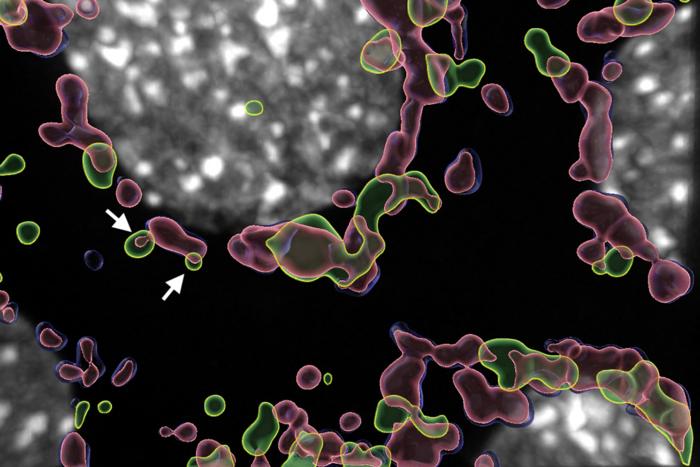
In cells, structures called lysosomes act as recycling centers that can digest different kinds of molecular material. With state-of-the art microscopes at the SickKids Imaging Facility, Dr. Akriti Prashar, a postdoctoral fellow in Jones’ lab and first author on the paper, identified that a mitochondria’s damaged crista can squeeze through its outer membrane to have a lysosome directly engulf it and break it down successfully.
The researchers named the novel process VDIM formation, which stands for vesicles derived from the inner mitochondrial membrane. By removing damaged cristae through VDIMs, cells can prevent harm from spreading to the rest of the mitochondria and the whole cell.
“We believe that VDIMs could be a way of protecting cells from health conditions that affect mitochondria, such as cancer and neurodegeneration,” Prashar says.
A new process: VDIM formation
The research team, including scientists at the Francis Crick Institute and Johns Hopkins University, found that forming a VDIM involved several steps and molecules. First, a damaged crista releases a signal that activates a channel on the nearby lysosome to allow calcium to flow out of the lysosome. Calcium then activates another channel on the outer membrane of the mitochondria to form a pore and allow damaged cristae to squeeze out of the mitochondria into the lysosome, which digests the damaged material – something that has never been seen before. By recycling just the damaged crista, mitochondria can continue its regular function.
“Understanding this process gives us insight into how mitochondria stay healthy, which is important to everyone’s overall health and longevity,” says Prashar.
Future research will explore how altering VDIM formation could improve symptoms or even prevent health conditions caused by underperforming or damaged mitochondria.
This research was funded by Canadian Institutes of Health Research (CIHR) and a SickKids Restracomp fellowship.
Journal
Nature
DOI
10.1038/s41586-024-07835-w
Article Title
Lysosomes drive the piecemeal removal of mitochondrial inner membrane
Article Publication Date
21-Aug-2024