• HOME
  • NEWS
  • EXPLORE
    • CAREER
      • Companies
      • Jobs
    • EVENTS
    • iGEM
      • News
      • Team
    • PHOTOS
    • VIDEO
    • WIKI
  • BLOG
  • COMMUNITY
    • FACEBOOK
    • INSTAGRAM
    • TWITTER
Wednesday, July 1, 2026
BIOENGINEER.ORG
No Result
View All Result
  • Login
  • HOME
  • NEWS
  • EXPLORE
    • CAREER
      • Companies
      • Jobs
        • Lecturer
        • PhD Studentship
        • Postdoc
        • Research Assistant
    • EVENTS
    • iGEM
      • News
      • Team
    • PHOTOS
    • VIDEO
    • WIKI
  • BLOG
  • COMMUNITY
    • FACEBOOK
    • INSTAGRAM
    • TWITTER
  • HOME
  • NEWS
  • EXPLORE
    • CAREER
      • Companies
      • Jobs
        • Lecturer
        • PhD Studentship
        • Postdoc
        • Research Assistant
    • EVENTS
    • iGEM
      • News
      • Team
    • PHOTOS
    • VIDEO
    • WIKI
  • BLOG
  • COMMUNITY
    • FACEBOOK
    • INSTAGRAM
    • TWITTER
No Result
View All Result
Bioengineer.org
No Result
View All Result
Home NEWS Science News Chemistry

Selective conversion of reactive lithium compounds made possible

Bioengineer by Bioengineer
August 12, 2020
in Chemistry
Reading Time: 2 mins read
0
IMAGE
Share on FacebookShare on TwitterShare on LinkedinShare on RedditShare on Telegram

Catalysis without unwanted by-products
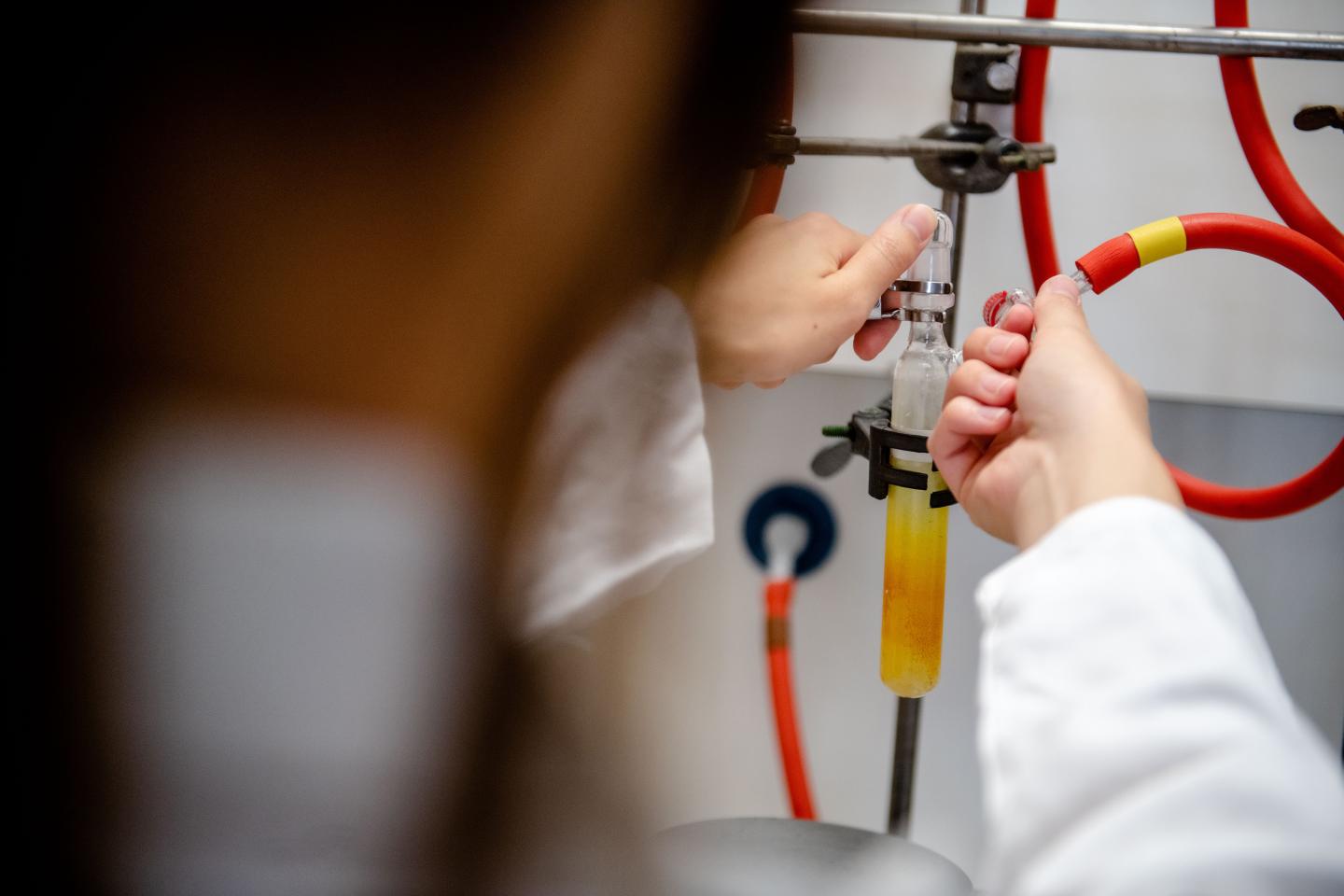
IMAGE

Credit: RUB, Marquard

Researchers at Ruhr-Universität Bochum have developed a new catalyst that can catalyse reactions to produce pharmaceuticals or chemicals used in agriculture. It creates carbon-carbon bonds between what are known as organolithium compounds without creating any unwanted by-products. The team led by Professor Viktoria Däschlein-Gessner, Inorganic Chemistry II Research Group, describes the results in the journal Angewandte Chemie, published online on 29 July 2020.

Indispensable for many applications

Organolithium compounds are reagents with a lithium-carbon bond, which are among the most reactive compounds in synthetic chemistry. “Due to their special properties, they are indispensable in many applications, even on an industrial scale,” says Viktoria Däschlein-Gessner, member of the Cluster of Excellence Ruhr Explores Solvation, Resolv for short. “However, high reactivity often also leads to unwanted side reactions. As a result, organolithium compounds have so far only been considered to a limited extent, or even not at all, for some applications.”

The research group led by Viktoria Däschlein-Gessner was able to overcome such limitations with the help of a highly efficient catalyst. The new phosphine-palladium catalyst selectively couples two carbon atoms – both with different organolithium compounds and many so-called aryl halides. The decisive factor was that it is sufficiently active, even at room temperature.

Market launch planned

No additional additives are needed for the new synthesis process and it can be used widely. This means that intermediate steps during synthesis can be avoided, thus producing less metal salt waste. The catalyst guarantees a high degree of selectivity, even if product quantities of several grams are produced. To allow for use on an industrial scale, the next step must be to test it at even larger volumes.

In cooperation with industry, the researchers in Bochum intend to launch the developed catalysts on the market soon. “Their particular activity is not only advantageous in the described reactions, but also offers improvements for numerous other transformations in almost all areas of fine chemical synthesis,” says Däschlein-Gessner. In addition to the production of pharmaceuticals and chemicals for agriculture, these include fragrances and materials for organic light-emitting diodes.

###

Media Contact
Viktoria Däschlein-Gessner
[email protected]

Original Source

https://news.rub.de/english/press-releases/2020-08-12-catalysis-selective-conversion-reactive-lithium-compounds-made-possible

Related Journal Article

http://dx.doi.org/10.1002/anie.202008866

Tags: Chemistry/Physics/Materials SciencesIndustrial Engineering/Chemistry
Share12Tweet8Share2ShareShareShare2

Related Posts

Applying Physical Pressure Can Double EV Battery Lifespan and Slash Environmental Impact — Chemistry

Applying Physical Pressure Can Double EV Battery Lifespan and Slash Environmental Impact

July 1, 2026
Scientists Capture Ultrafast Chemical Reactions Unfolding in Real Time — Chemistry

Scientists Capture Ultrafast Chemical Reactions Unfolding in Real Time

July 1, 2026

Biochar-Based Materials Offer Promising Solution for Sustainable Uranium Recovery in Nuclear Energy

June 30, 2026

From Cells to Boundaries: Unveiling the Origins of Biological Order

June 30, 2026
Please login to join discussion

POPULAR NEWS

  • Detection of EDCs in Breast Milk and Infant Urine Up to Six Months Highlights Early Exposure Risks

    77 shares
    Share 31 Tweet 19
  • Saying Goodbye to PGY-6: Pediatric Fellowship Realities

    103 shares
    Share 41 Tweet 26
  • New Drug Candidate Developed at McMaster Shows Potential for Treating Brain Cancer

    58 shares
    Share 23 Tweet 15
  • KTU Researchers Explore Ultrasound’s Role in Enhancing Blood Flow Beyond Diagnostics

    53 shares
    Share 21 Tweet 13

About

We bring you the latest biotechnology news from best research centers and universities around the world. Check our website.

Follow us

Recent News

University of Manchester Study Backs WHO’s Groundbreaking Global Air Pollution Update

Applying Physical Pressure Can Double EV Battery Lifespan and Slash Environmental Impact

Baby-Led Weaning: An Evidence-Based Strategy for Infant Nutrition

Subscribe to Blog via Email

Enter your email address to subscribe to this blog and receive notifications of new posts by email.

Join 82 other subscribers
  • Contact Us

Bioengineer.org © Copyright 2023 All Rights Reserved.

Welcome Back!

Login to your account below

Forgotten Password?

Retrieve your password

Please enter your username or email address to reset your password.

Log In
No Result
View All Result
  • Homepages
    • Home Page 1
    • Home Page 2
  • News
  • National
  • Business
  • Health
  • Lifestyle
  • Science

Bioengineer.org © Copyright 2023 All Rights Reserved.