• HOME
  • NEWS
  • EXPLORE
    • CAREER
      • Companies
      • Jobs
    • EVENTS
    • iGEM
      • News
      • Team
    • PHOTOS
    • VIDEO
    • WIKI
  • BLOG
  • COMMUNITY
    • FACEBOOK
    • INSTAGRAM
    • TWITTER
Saturday, May 23, 2026
BIOENGINEER.ORG
No Result
View All Result
  • Login
  • HOME
  • NEWS
  • EXPLORE
    • CAREER
      • Companies
      • Jobs
        • Lecturer
        • PhD Studentship
        • Postdoc
        • Research Assistant
    • EVENTS
    • iGEM
      • News
      • Team
    • PHOTOS
    • VIDEO
    • WIKI
  • BLOG
  • COMMUNITY
    • FACEBOOK
    • INSTAGRAM
    • TWITTER
  • HOME
  • NEWS
  • EXPLORE
    • CAREER
      • Companies
      • Jobs
        • Lecturer
        • PhD Studentship
        • Postdoc
        • Research Assistant
    • EVENTS
    • iGEM
      • News
      • Team
    • PHOTOS
    • VIDEO
    • WIKI
  • BLOG
  • COMMUNITY
    • FACEBOOK
    • INSTAGRAM
    • TWITTER
No Result
View All Result
Bioengineer.org
No Result
View All Result
Home NEWS Science News Chemistry

Seeking sounds of superfluids

Bioengineer by Bioengineer
April 14, 2020
in Chemistry
Reading Time: 3 mins read
0
IMAGE
Share on FacebookShare on TwitterShare on LinkedinShare on RedditShare on Telegram

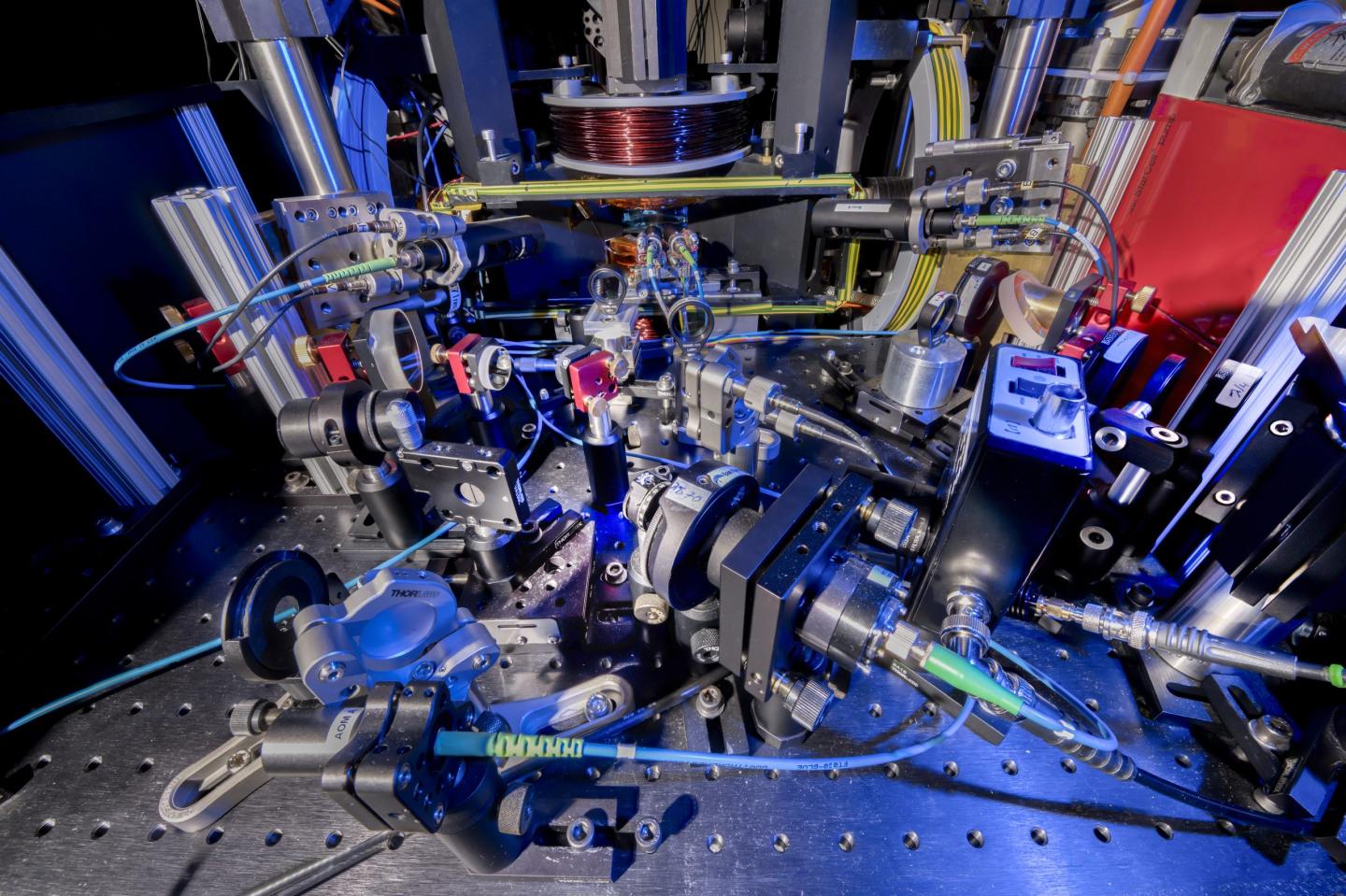
Probing quantum gases with sound waves
IMAGE

Credit: FLEET

Sound waves reveal the unique properties of an ultracold quantum gas, a model system for describing certain superconductors and forms of nuclear matter. A new Australian study examines the propagation of energy as sound waves in a quantum gas, revealing for the first time strong variations in the nature of the sound wave as a function of temperature.

At low energies, this energy travels via the collective movement of many particles moving in sync – essentially, as sound waves -quantified using quasiparticles known as phonons.

Below the superfluid transition temperature Tc these sound waves in a unitary Fermi gas can propagate without collisions and are driven by ripples in the phase of the superfluid order parameter (wave-function)–this mode is known as the Bogoliubov-Anderson (BA) phonon.

Above Tc, the sound waves become more strongly-damped, and collisions play a dominant role.

Strong similarities were identified in the temperature dependence of sound in the unitary Fermi gas and the behaviour of phonons in liquid helium, which was one of the first superfluids identified historically.

This study provides quantitative benchmarks for dynamical theories of strongly-correlated fermions.

MORE ABOUT THE STUDY

The ultracold atomic gases formed and studied in Prof Chris Vale’s lab at Swinburne allow very precise tuning of interactions between atoms.

“We cooled and confined a highly dilute gas of Li6 atoms, realising a unitary Fermi gas, which exhibits the strongest interactions allowed by quantum mechanics with a contact potential,” explains Prof Vale.

In a unitary gas, elastic collisions become resonant and the thermodynamic properties of the gas become universal functions of the temperature and density. Unitary Fermi gases allow precise testing of theories of interacting fermions.

The team then studied excitations in the gas above and below the superfluid phase transition Tc using two-photon Bragg spectroscopy.

“We measured excitation spectra at a momentum of approximately half the Fermi momentum, both above and below the superfluid critical temperature Tc,” explains study author Dr Carlos Kuhn.

Two, focused laser pulses (approx 1.2 milliseconds in duration) intersecting within the gas create a periodic perturbation for the lithium atoms.

Immediately after the twin laser pulse, the confining optical trap is swiTched off and the momentum of atoms is measured after 4 milliseconds of expansion, and can be mapped as a function of laser frequency.

The finite duration and size of the Bragg beams lead to a Fourier-limited spectral resolution of approximately 1:25 kHz FWHM which is well below the typical Fermi energies, EF 11 kHz, used in the experiments.

###

THE STUDY

High Frequency Sound in a Unitary Fermi Gas was published in Physical Review Letters (PRL) in March 2020. (DOI 10.1103/physrevlett.124.150401)

As well as support from the Australian Research Council the authors thank M. Zwierlein, Y. Castin and H. Hu for stimulating discussions and J. Denier for assistance on initial experiments, and acknowledge financial support from the Independent Research Fund of Denmark.

Media Contact
Errol Hunt
[email protected]

Original Source

http://www.fleet.org.au/blog/seeking-the-sounds-of-superfluids-at-swinburne/

Related Journal Article

http://dx.doi.org/10.1103/physrevlett.124.150401

Tags: Atomic PhysicsChemistry/Physics/Materials SciencesMaterialsOpticsSuperconductors/Semiconductors
Share12Tweet8Share2ShareShareShare2

Related Posts

Study Reveals How Valproate Affects Early Brain Development: Insights into the Antiepileptic Drug’s Impact — Chemistry

Study Reveals How Valproate Affects Early Brain Development: Insights into the Antiepileptic Drug’s Impact

May 22, 2026
Sustainable Chemistry: Iron Replaces Noble Metals in Catalytic Reactions — Chemistry

Sustainable Chemistry: Iron Replaces Noble Metals in Catalytic Reactions

May 22, 2026

Advancing Thin-Film Device Manufacturing with Imaging Ellipsometry for Enhanced Process Control

May 22, 2026

Simple Adjustment in 3D Printing Enhances Fit of Dental Crowns

May 22, 2026
Please login to join discussion

POPULAR NEWS

  • blank

    New Study Reveals Plants Can Detect the Sound of Rain

    734 shares
    Share 293 Tweet 183
  • ESMO 2025: mRNA COVID Vaccines Enhance Efficacy of Cancer Immunotherapy

    312 shares
    Share 125 Tweet 78
  • Research Indicates Potential Connection Between Prenatal Medication Exposure and Elevated Autism Risk

    847 shares
    Share 339 Tweet 212
  • Common Food Preservatives Associated with Elevated Blood Pressure and Increased Heart Disease Risk

    55 shares
    Share 22 Tweet 14

About

We bring you the latest biotechnology news from best research centers and universities around the world. Check our website.

Follow us

Recent News

Fish Consumption and Mercury Exposure in Chicago Asians

Music and Motion Shape Emotion in Chinese Performance

N-acetylcysteine Trials for Preterm Birth Prevention

Subscribe to Blog via Email

Enter your email address to subscribe to this blog and receive notifications of new posts by email.

Join 83 other subscribers
  • Contact Us

Bioengineer.org © Copyright 2023 All Rights Reserved.

Welcome Back!

Login to your account below

Forgotten Password?

Retrieve your password

Please enter your username or email address to reset your password.

Log In
No Result
View All Result
  • Homepages
    • Home Page 1
    • Home Page 2
  • News
  • National
  • Business
  • Health
  • Lifestyle
  • Science

Bioengineer.org © Copyright 2023 All Rights Reserved.