• HOME
  • NEWS
  • EXPLORE
    • CAREER
      • Companies
      • Jobs
    • EVENTS
    • iGEM
      • News
      • Team
    • PHOTOS
    • VIDEO
    • WIKI
  • BLOG
  • COMMUNITY
    • FACEBOOK
    • INSTAGRAM
    • TWITTER
Sunday, May 10, 2026
BIOENGINEER.ORG
No Result
View All Result
  • Login
  • HOME
  • NEWS
  • EXPLORE
    • CAREER
      • Companies
      • Jobs
        • Lecturer
        • PhD Studentship
        • Postdoc
        • Research Assistant
    • EVENTS
    • iGEM
      • News
      • Team
    • PHOTOS
    • VIDEO
    • WIKI
  • BLOG
  • COMMUNITY
    • FACEBOOK
    • INSTAGRAM
    • TWITTER
  • HOME
  • NEWS
  • EXPLORE
    • CAREER
      • Companies
      • Jobs
        • Lecturer
        • PhD Studentship
        • Postdoc
        • Research Assistant
    • EVENTS
    • iGEM
      • News
      • Team
    • PHOTOS
    • VIDEO
    • WIKI
  • BLOG
  • COMMUNITY
    • FACEBOOK
    • INSTAGRAM
    • TWITTER
No Result
View All Result
Bioengineer.org
No Result
View All Result
Home NEWS Science News

Seeing is believing: Eye-tracking technology could help make driving safer

Bioengineer by Bioengineer
September 24, 2019
in Science News
Reading Time: 2 mins read
0
IMAGE
Share on FacebookShare on TwitterShare on LinkedinShare on RedditShare on Telegram

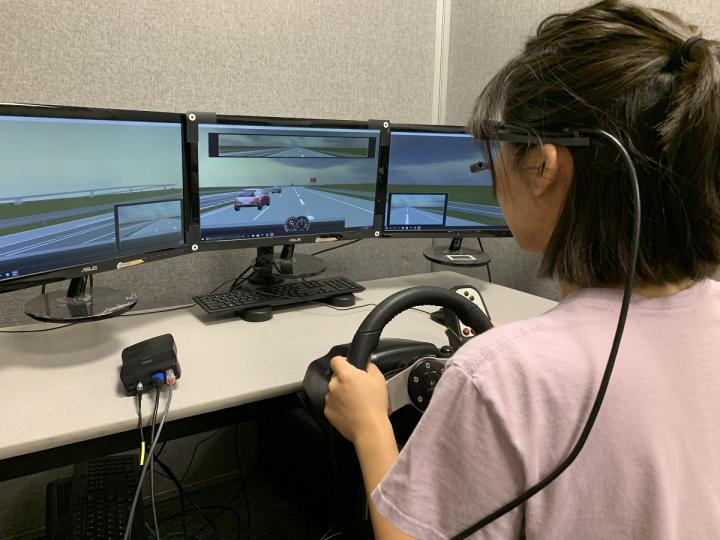
MU scientists take a new look at the importance of keeping your eyes on the road
IMAGE

Credit: University of Missouri

“Keep your eyes on the road.”

With the recent advances in vehicle-assisted safety technology and in-car displays, this old adage has a new meaning, thanks to two new applications of eye-tracking technology developed by researchers at the University of Missouri.

Designing a better collision avoidance warning

Observing how someone’s eyes change — specifically the pupil — while they respond to an alert given by a vehicle collision avoidance warning could one day help scientists design safer systems.

“Prior to a crash, drivers can be easily distracted by an alert from a collision avoidance warning — a popular feature in new vehicles — and we feel this could be a growing problem in distraction-related vehicle crashes,” said Jung Hyup Kim, an assistant professor of industrial and manufacturing systems engineering in the MU College of Engineering. “Therefore, a two-way communication channel needs to exist between a driver and a vehicle. For instance, if a driver is aware of a possible crash, then the vehicle does not have to warn the driver as much. However, if a vehicle provides an alert that, by itself, creates a distraction, it could also cause a crash.”

Kim and Xiaonan Yang, a graduate student at MU, watched how people’s pupils changed in response to their physical reactions to a collision avoidance warning by a vehicle-assisted safety system. Researchers believe they have enough data to begin the next step of developing a two-way communication model.

Evaluating rear-end accidents from a driver’s perspective

A person’s pupil could also help scientists find a way to decrease distracted driving crashes through a first-hand perspective into a driver’s behavior, according to Kim and Rui Tang, a graduate student at MU. Using a driving simulator at the MU College of Engineering, the researchers evaluated a driver’s physical behavior in real-time by focusing on the driver’s eyes as the crash happened.

“We saw the size of a person’s pupil changed depending on the behavioral response to the severity of the accident,” Kim said. “Now, we want to take that data, find common patterns and build a model to test how we could help decrease distracted-driving crashes.”

###

The conference papers, “Evaluating rear-end vehicle accident using pupillary analysis in a driving similar environment,” and “Pupillary response and EMG predict upcoming responses to collision avoidance warning,” were presented at the 2019 International Conference on Applied Human Factors and Ergonomics in Washington, D.C.

Media Contact
Eric Stann
[email protected]

Original Source

https://munews.missouri.edu/news-releases/2019/0924-seeing-is-believing-eye-tracking-technology-could-help-make-driving-safer/

Tags: BiotechnologyComputer ScienceDecision-making/Problem SolvingElectrical Engineering/ElectronicsMechanical EngineeringPerception/AwarenessResearch/DevelopmentSoftware EngineeringTechnology/Engineering/Computer ScienceVehicles
Share12Tweet8Share2ShareShareShare2

Related Posts

Evaluating Digoxin Use in Patients with Symptomatic Rheumatic Heart Disease

May 10, 2026

Evaluating the Effectiveness and Safety of Digitalis Glycosides in Treating Heart Failure

May 10, 2026

Urdu Fall Risk Questionnaire Adapted for Elderly

May 10, 2026

Key Pharmacological Markers for HIV Prevention in MSM

May 10, 2026
Please login to join discussion

POPULAR NEWS

  • Research Indicates Potential Connection Between Prenatal Medication Exposure and Elevated Autism Risk

    840 shares
    Share 336 Tweet 210
  • New Study Reveals Plants Can Detect the Sound of Rain

    727 shares
    Share 290 Tweet 181
  • Scientists Investigate Possible Connection Between COVID-19 and Increased Lung Cancer Risk

    68 shares
    Share 27 Tweet 17
  • Salmonella Haem Blocks Macrophages, Boosts Infection

    61 shares
    Share 24 Tweet 15

About

We bring you the latest biotechnology news from best research centers and universities around the world. Check our website.

Follow us

Recent News

Evaluating Digoxin Use in Patients with Symptomatic Rheumatic Heart Disease

Evaluating the Effectiveness and Safety of Digitalis Glycosides in Treating Heart Failure

Urdu Fall Risk Questionnaire Adapted for Elderly

Subscribe to Blog via Email

Success! An email was just sent to confirm your subscription. Please find the email now and click 'Confirm' to start subscribing.

Join 82 other subscribers
  • Contact Us

Bioengineer.org © Copyright 2023 All Rights Reserved.

Welcome Back!

Login to your account below

Forgotten Password?

Retrieve your password

Please enter your username or email address to reset your password.

Log In
No Result
View All Result
  • Homepages
    • Home Page 1
    • Home Page 2
  • News
  • National
  • Business
  • Health
  • Lifestyle
  • Science

Bioengineer.org © Copyright 2023 All Rights Reserved.