Social cognition research is undergoing a fundamental methodological transition from investigating isolated individuals responding to static stimuli toward examining dynamically coupled brains, bodies, and environments during real-time interpersonal exchanges. As synthesized in a Frontiers in Neuroscience Research Topic, real social life unfolds through bidirectional exchanges where the actions of one individual continuously shape and respond to another. Investigating these interactive configurations requires recording modalities that capture live interpersonal dynamics, moving the field beyond traditional individual-centered experimental paradigms.
Individual psychological states significantly alter how social information is processed in the brain during interpersonal encounters. Research by Arioli and colleagues demonstrated that socially negative words represent a distinct category of stimuli for individuals experiencing loneliness, defined as an affective state stemming from a discrepancy between desired and actual connectedness. Utilizing electroencephalography, the investigators observed that higher loneliness levels were associated with greater neural differentiation in the N450 component when distinguishing negative social cues from neutral stimuli, an electrophysiological pattern that may reflect heightened hypervigilance toward potential social rejection or exclusion.
Interpersonal exchanges also directly influence cognitive processes and subsequent behavioral responses. Examining these dynamics, Graham-Engeland and colleagues reported significant associations between perceived discrimination, encompassing stigmatization and threat, and distinct anger expression styles, specifically anger suppression (anger-in) and outward anger expression (anger-out). Their findings further demonstrated that the association between perceived discrimination and anger expression is partially mediated by social-cognitive mechanisms, including rumination and social vigilance.
At the collective level, interpersonal emotional dynamics can yield maladaptive outcomes through what Haag describes as Groupfeel syndrome. Introduced as a dysfunctional emotional condition emerging within aggregated groups, the syndrome is characterized by intense shared emotions, rigid pressure to preserve emotional positivity, and an absence of emotionally intelligent regulation. While adverse interpersonal exchanges such as discrimination disrupt socio-cognitive functioning in targeted individuals, collective affective dynamics in Groupfeel syndrome impair critical thinking and bias group decision-making, highlighting how group-level affective trajectories carry relevance for clinical evaluation and intervention.
To capture interactive functioning in clinical contexts, researchers are developing specialized computational and assessment instruments. Akinwumi and colleagues utilized the Multimodal Dataset for Autism Intervention Analysis to examine exchanges between children with autism spectrum disorder and clinicians during therapy sessions, implementing an unsupervised multimodal deep-learning framework to characterize therapeutic interaction dynamics. Complementing observational tools, Herzl and colleagues developed and validated a questionnaire evaluating disgust as a primary emotion, identifying robust associations between trait disgust, neuroticism, and anxiety that indicate disgust sensitivity may serve as a relevant affective marker in clinical populations.
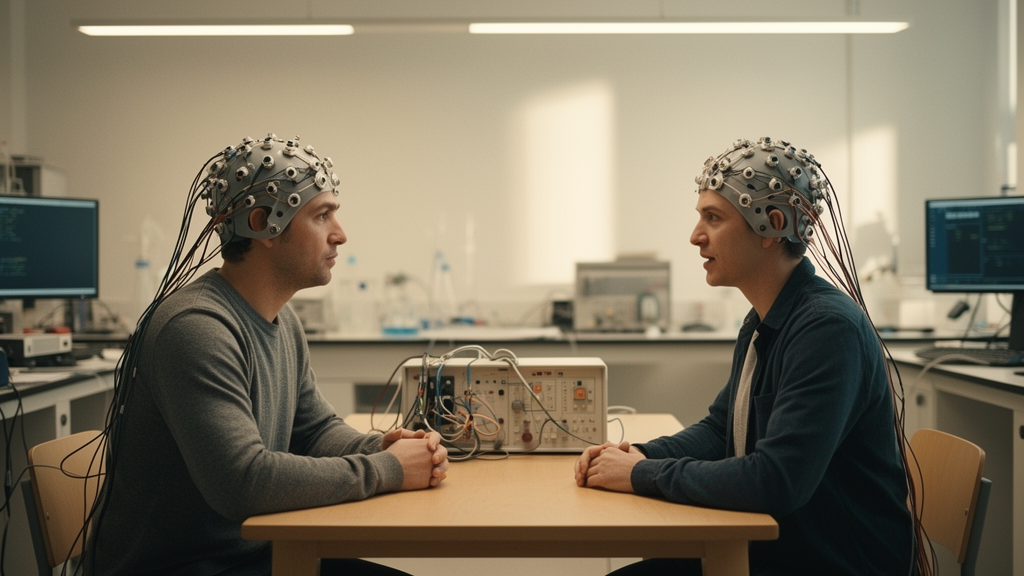
Methodologically, hyperscanning addresses the interactive dimension of social cognition by simultaneously recording neural signals from multiple participants engaged in real-time communication. Employing an electroencephalography hyperscanning protocol, Balconi and colleagues tracked neural variations across distinct negotiation phases. Participants initially assumed asymmetric roles as persuaders or receivers before transitioning to symmetric negotiation. During the concluding phase, persuaders exhibited enhanced alpha activity in left frontal regions while speaking, consistent with a more passive stance, whereas both persuaders and receivers displayed increased beta power in right temporo-central and parieto-occipital areas during receiver speech, reflecting elevated cognitive control and social engagement.
Advancing the quantitative analysis of multi-brain interactions beyond conventional synchrony, Goldstein and colleagues implemented cross-recurrence quantification analysis (CRQA) to treat functional near-infrared spectroscopy signals as a coupled dynamical system. In dyads negotiating public health budget allocations, traditional synchrony metrics such as inter-subject correlation and wavelet coherence showed no relationship with interaction outcomes. In contrast, CRQA identified systematic associations between dynamic coupling in the temporo-parietal junction and medial prefrontal cortex and successful negotiation, demonstrating the utility of analytical frameworks capable of capturing non-linear and time-lagged interpersonal dynamics.
Hyperscanning has also been applied to investigate communication across digital and face-to-face environments. Azhari and colleagues utilized functional near-infrared spectroscopy during a naturalistic Zoom seminar, finding that prefrontal inter-brain synchrony emerged primarily during active discussion and presentations, with higher synchrony predicting greater participant satisfaction and performance. However, face-to-face communication provides embodied sensorimotor scaffolding that alters neural coupling: Tao and colleagues observed greater inter-brain synchrony in the right superior frontal gyrus when friends shared emotional stories face-to-face compared to strangers, while Wang and colleagues found that face-to-face social exclusion accelerated defection decisions by altering subjective experience and prefrontal coordination patterns, supporting Magni and colleagues’ argument that digital platforms often attenuate embodied cues.
Expanding the scope of interaction paradigms, Lettieri proposed incorporating peripheral physiological and interoceptive measurements into multimodal hyperscanning during naturalistic tasks to capture multi-level alignment from dyads to larger groups. In conceptual processing, Falcinelli and colleagues identified hyperscanning as a valuable approach for evaluating how linguistic and social interactions contribute to constructing meaning for abstract concepts that lack physical referents and exhibit contextual variability.
Interactive paradigms are similarly illuminating developmental learning, shared media processing, and cross-species interactions. Rodrigues and colleagues documented that mother-child prefrontal synchrony during emotional scenarios varied with context and reflected maternal emotion-regulation difficulties alongside child cognitive reappraisal. In shared media viewing, Schäfer and colleagues found that social presence alone did not alter synchrony, yet frontal and fronto-parietal synchrony correlated with prosociality and liking. Extending beyond human dyads, Carbone and colleagues demonstrated that human-dog interactions elicited distinct cortical oscillatory dynamics, characterized by occipital alpha and theta suppression alongside frontal and central beta modulation, demonstrating that non-human social exchanges engage robust attentional and sensorimotor neural processes.
The transition toward interactive neuroscience introduces profound analytical challenges that necessitate moving beyond simple measurements of simultaneous neural activation. As demonstrated by Goldstein and colleagues, conventional synchrony metrics such as inter-subject correlation and wavelet coherence proved incapable of predicting the outcomes of dyads negotiating public health budget allocations. By implementing cross-recurrence quantification analysis, the researchers treated functional near-infrared spectroscopy signals as a coupled dynamical system, successfully uncovering systematic relationships between collaborative success and dynamic coupling patterns within the temporo-parietal junction and medial prefrontal cortex. This analytical advance highlights an emerging priority within social interaction research: shifting away from merely assessing whether two nervous systems synchronize at identical moments toward mapping how non-linear, time-lagged neural coupling trajectories evolve alongside unfolding interpersonal communication. Because social exchanges constitute qualitatively distinct neural stimuli, tracking these temporal trajectories allows investigators to evaluate the continuous feedback loops that define authentic interpersonal communication rather than relying on static snapshots of isolated cognitive processing.
Understanding these interaction dynamics becomes particularly critical when evaluating how modern communication environments alter interpersonal coupling. Azhari and colleagues established that virtual interactions during naturalistic academic seminars depend heavily on reciprocal participation, with prefrontal inter-brain synchrony surfacing specifically during active discussions and presentations rather than passive lecture viewing. Yet, as experimental comparisons illustrate, virtual environments lack the rich sensorimotor cues that naturally scaffold face-to-face interaction. In physical settings, Tao and colleagues observed heightened emotion perception and elevated inter-brain synchrony in the right superior frontal gyrus when friends shared emotional narratives, whereas Wang and colleagues demonstrated that face-to-face social exclusion actively accelerates defection choices by disrupting subjective experiences and altering prefrontal coordination. Magni and colleagues point out that technology-mediated environments tend to destabilize embodied metaphors, rendering communication substantially more cognitively demanding and less intuitive. To mitigate these constraints, researchers suggest redesigning digital interaction platforms to incorporate bodily, rhythmic, multisensory, and metaphorically grounded dimensions that can better recreate the embodied dynamics inherent to physical, face-to-face social encounters.
To capture the full physiological architecture of interpersonal communication, hyperscanning methodologies are increasingly expanding beyond central cortical activity. Lettieri argues that incorporating peripheral physiological and interoceptive measurements alongside neural recordings provides critical insight into how multiple regulatory systems interact during naturalistic tasks. In clinical and developmental settings, this multimodal synchrony offers both an objective mechanistic readout of interpersonal alignment and an actionable target for therapeutic interventions designed to stabilize internal physiological states and promote social connectedness. Developmental findings by Rodrigues and colleagues underscore this interplay, showing that mother-child inter-brain synchrony during emotionally evocative contexts directly reflects maternal emotion-regulation difficulties as well as child cognitive reappraisal. Similarly, Schäfer and colleagues clarified that neural alignment is not an automatic consequence of mere physical co-presence during video viewing; instead, frontal and fronto-parietal synchrony reflected individual differences in prosociality and liking, proving that inter-brain measures capture nuanced social-affective functioning rather than passive environmental exposure.
The scope of dynamic interaction paradigms further extends to linguistic conceptualization, collective group pathologies, and inter-species communication. Falcinelli and colleagues proposed hyperscanning as an effective framework for investigating how abstract concepts, which lack concrete physical referents and exhibit contextual variability, are shaped through interpersonal dialogue and social exchange. At the group level, examining interactive affective trajectories provides vital diagnostic models for collective dysfunctions. Haag’s conceptualization of Groupfeel syndrome demonstrates how excessive pressure to preserve shared emotional positivity without intelligent regulation locks groups into rigid affective trajectories, impairing critical thinking and collective decision-making. Finally, research by Carbone and colleagues confirms that interactive neural dynamics are not restricted to human partnerships; interacting with a dog elicited marked occipital alpha and theta suppression alongside fronto-central beta modulation, indicating heightened attention, arousal, and sensorimotor anticipation. Across these diverse domains, the Research Topic demonstrates that understanding social cognition requires an integrated body-brain framework that treats social encounters as continuous, reciprocal, and embodied exchanges across individuals, groups, and species.
Subject of Research: Neural and behavioral dynamics of real-time social interaction and hyperscanning
Article Title: Editorial: The brain and social interactions: from paradigms of social emotion recognition to hyperscanning
Article References: Arioli, M., Ciricugno, A., Giuliani, M., & Candini, M. (2026). Editorial: The brain and social interactions: from paradigms of social emotion recognition to hyperscanning. Frontiers in Neuroscience, 20, 2018824. https://doi.org/10.3389/fnins.2026.2018824
Image Credits: AI Generated
DOI: 10.3389/fnins.2026.2018824
Keywords: hyperscanning, social cognition, electroencephalography, functional near-infrared spectroscopy, inter-brain synchrony, cross-recurrence quantification analysis, loneliness, perceived discrimination, Groupfeel syndrome, autism spectrum disorder, disgust sensitivity, negotiation dynamics, virtual interaction, social exclusion, mother-child interaction, human-dog interaction, multimodal hyperscanning, prefrontal cortex
News Source: Cassandra Pierce. (November 11, 2026). Hyperscanning Research Captures Neural Alignment and Dynamic Coupling Across Social Exchanges. Scienmag.